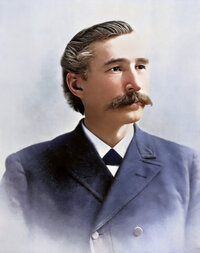
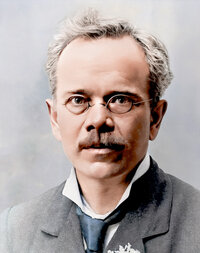
1855–1944
Summary
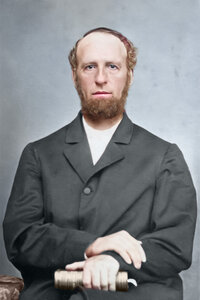
William Warren Prescott was a Seventh-day Adventist scholar, educator, editor, and administrator who served the church for fifty-two years and was a member of the General Conference Executive Committee for forty-two of them. Born September 2, 1855, in Alton, New Hampshire, to former-Millerite parents who later embraced the seventh-day Sabbath, he became the church’s first university-trained college president (Battle Creek College, 1885–1894), founded Walla Walla and Union Colleges, was a featured speaker alongside A. T. Jones at the 1893 General Conference, served as the General Conference Education Secretary (1887–1897), president of the foreign mission board, and editor of the Review and Herald (1909–1912 and 1915–1918). He died in 1944 at the age of eighty-eight.
Early Life and Education (1855–1885)
Per the Encyclopedia of Seventh-day Adventists (Gilbert M. Valentine), Prescott was born September 2, 1855, in Alton, New Hampshire, to James L. Prescott (1828–1915), a shoemaker, and Harriet Tripp Prescott (1831–1920). His father had been a Millerite lay preacher in 1842 — converted under Joshua V. Himes’s preaching — who passed through the Great Disappointment and eventually accepted the seventh-day Sabbath in 1858.
When William was nine, the family moved to North Berwick, Maine. In December 1869 — when William was fourteen — three of his younger brothers died in a single two-week stretch from diphtheria. The experience deepened his spiritual sensitivity. He went on to Dartmouth College, graduating in 1877, and was the first university-trained Adventist to enter denominational educational service.
Battle Creek College and Education Secretary (1885–1897)
Per ESDA, Prescott was elected president of Battle Creek College in 1885 at the age of twenty-nine, and from 1887 onward also served as the General Conference Education Secretary. Under his leadership the church established Union College in Lincoln, Nebraska (1891), and Walla Walla College in Washington (1892). He was a featured speaker at the 1893 General Conference where he was widely recognized for his preaching during the post-1888 awakening. The General Conference Bulletin of 1893 records his exclamation at one of those meetings: “The times of refreshing are here, brethren. The Spirit of God is here. Open the heart, open the heart. Open the heart in praise and thanksgiving” (General Conference Bulletin, 1893, page 417.7; refcode GCB/GCDB 1893, page 417.7).
Ellen White’s Endorsement of Jones, Waggoner, and Prescott
In her 1893 testimony preserved in The Ellen G. White 1888 Materials, Ellen White grouped Prescott with Jones and Waggoner as those whom the Lord was using: “We have every evidence that the Lord is using Elder Jones, Elder Waggoner, and Professor Prescott; and with this evidence before us, it pains my heart that any of my brothers in the faith should feel impatient and bitter toward them, and refuse to draw in cords of love and unity with them. Strife must cease. We must have unity.” (The Ellen G. White 1888 Materials, p. 1156, par. 2; refcode 1888 1156.2).
Religious Liberty Advocate (1898)
In 1898 Prescott testified before the United States Senate Committee on Education and Labor in defense of religious liberty. The published Reasons for and Against Sunday Legislation records his testimony: “I would say that the same law which protects public worship should protect it every day of the week that it does not require any special legislation for any day or time. Such legislation as protects public worship should protect it every day of the week. That would be my reply” (Reasons Against Sunday Legislation, p. 10, par. 3; refcode RJSB 10.3).
Spiritual Influence in Australia and New Zealand (1895–1898)
Per ESDA, Prescott served as a worker in Australia from 1895 to 1898 — a period during which his preaching profoundly influenced Ellen White herself. Her diary entry preserved in Through Crisis to Victory records one of the moments: “Professor Prescott arose and attempted to speak, but his heart was full and he did not utter a word for five minutes, but stood weeping before the people.” (The Retirement Years, p. 92, par. 1; refcode TR 92.1).
Editor of the Review and Final Years (1909–1944)
Per ESDA, Prescott served two terms as editor of the Review and Herald — 1909–1912 and 1915–1918 — and continued his theological writing into his eighties. He was also instrumental in producing the 1908 Adventist Bible Conference and the 1911 revision of The Great Controversy. He died on June 27, 1944, at the age of eighty-eight.