1782–1849
Summary
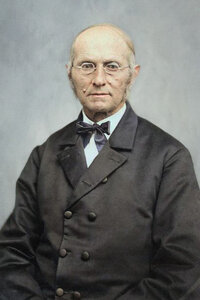
William Miller was a New England farmer, militia captain, and Baptist layman whom Ellen White identified as “the man specially chosen of God to lead out in the proclamation of Christ’s second coming” (The Great Controversy, p. 317, par. 1; refcode GC 317.1). After fifteen years of methodical Bible study following his conversion in 1816, he became convinced that Daniel’s 2300-day prophecy pointed to the second advent in his own generation. From 1831 until his death he proclaimed that hope across the United States and Canada, and the movement that gathered around his preaching in 1844 became the seedbed of the Seventh-day Adventist Church.
Early Life
Miller was born February 15, 1782, at Pittsfield, Massachusetts, “the eldest of sixteen children, five of whom were sons and eleven were daughters” (Sylvester Bliss, Memoirs of William Miller, p. 2, par. 3; refcode MWM 2.3). When William was four his father moved the family to a section of frontier between Vermont and New York that “was an almost uninhabited wilderness” and would later be called Low Hampton, New York (Bliss, Memoirs of William Miller, p. 7, par. 3; refcode MWM 7.3). Although his formal schooling was scant, he read widely, kept careful diaries, and married Lucy Smith in 1803.
When the United States declared war on Britain on June 18, 1812, Miller was already a captain of state volunteers in Vermont; “his captain’s commission is dated” the day after the act of the state government authorized the raising of the body (Bliss, Memoirs of William Miller, p. 31, par. 7; refcode MWM 31.7). He served through the Plattsburgh campaign and returned home in 1815.
Conversion (1816)
Before the war Miller had drifted away from his mother’s evangelical faith. Ellen White summarized that period plainly: “By association with these men, Miller was led to adopt their sentiments” (The Great Controversy, p. 318, par. 1; refcode GC 318.1). She added in the same paragraph that “He continued to hold these views, however, for about twelve years. But at the age of thirty-four the Holy Spirit impressed his heart with a sense of his condition as a sinner” (The Great Controversy, p. 318, par. 1; refcode GC 318.1). Miller himself described that anguish: “Annihilation was a cold and chilling thought, and accountability was sure destruction to all. The heavens were as brass over my head, and the earth as iron under my feet” (The Great Controversy, p. 318, par. 2; refcode GC 318.2). The same paragraph closes, “I mourned, but without hope” (The Great Controversy, p. 318, par. 2; refcode GC 318.2).
His conversion came in 1816 with a vision of Christ that opened the Scriptures to him. He recorded:
I saw that the Bible did bring to view just such a Saviour as I needed; and I was perplexed to find how an uninspired book should develop principles so perfectly adapted to the wants of a fallen world. I was constrained to admit that the Scriptures must be a revelation from God. They became my delight; and in Jesus I found a friend. The Saviour became to me the chiefest among ten thousand; and the Scriptures, which before were dark and contradictory, now became the lamp to my feet and light to my path. My mind became settled and satisfied. I found the Lord God to be a Rock in the midst of the ocean of life. The Bible now became my chief study, and I can truly say, I searched it with great delight. I found the half was never told me.
(The Great Controversy, p. 319, par. 2; refcode GC 319.2)
Bible Study and Prophetic Discovery (1816–1831)
For two years Miller laid aside every commentary and “compared scripture with scripture by the aid of the marginal references and the concordance” (The Great Controversy, p. 320, par. 1; refcode GC 320.1). He continued for the next thirteen years. Ellen White affirmed the supernatural help he received: “Link after link of the chain of truth rewarded his efforts, as step by step he traced down the great lines of prophecy. Angels of heaven were guiding his mind and opening the Scriptures to his understanding” (The Great Controversy, p. 320, par. 2; refcode GC 320.2). She also wrote that “God directed the mind of William Miller to the prophecies and gave him great light upon the book of Revelation” (Early Writings, p. 231, par. 1; refcode EW 231.1). Applying the day-for-a-year principle to Daniel 8:14, he concluded that the 2300 prophetic days would close near 1843 or 1844.
Public Ministry (1831–1844)
Miller resisted the conviction that he ought to preach the message publicly. He first published his views in 1831 in the Vermont Telegraph, a Baptist paper at Brandon, and “first spoke in public on the subject in the year 1832” (John N. Loughborough, The Great Second Advent Movement, p. 120, par. 4; refcode GSAM 120.4). Ellen White’s account opens with the same image of a reluctant farmer summoned from his fields:
God sent His angel to move upon the heart of a farmer who had not believed the Bible, to lead him to search the prophecies. Angels of God repeatedly visited that chosen one, to guide his mind and open to his understanding prophecies which had ever been dark to God’s people.
(Early Writings, p. 229, par. 1; refcode EW 229.1)
She described his entry into ministry in language that places him beside the great forerunner of Christ: “With trembling, William Miller began to unfold to the people the mysteries of the kingdom of God, carrying his hearers down through the prophecies to the second advent of Christ. With every effort he gained strength. As John the Baptist heralded the first advent of Jesus and prepared the way for His coming, so William Miller and those who joined with him proclaimed the second advent of the Son of God” (Early Writings, p. 229, par. 2; refcode EW 229.2).
The character of his preaching is captured in her recollection of the meetings she heard as a teenager in Maine: “In March, 1840, William Miller visited Portland, Maine, and gave his first course of lectures on the second coming of Christ. These lectures produced a great sensation, and the Christian church on Casco Street, occupied by Mr. Miller, was crowded day and night” (Testimonies for the Church, vol. 1, p. 14, par. 1; refcode 1T 14.1). And of his bearing under opposition she wrote: “Angels of God accompanied William Miller in his mission. He was firm and undaunted, fearlessly proclaiming the message committed to his trust” (Early Writings, p. 232, par. 1; refcode EW 232.1).
Miller kept his own ledger. After a tour of Massachusetts that closed in Lynn in June 1839 he wrote in his memorandum-book, “Thus ends my tour into Massachusetts, making eight hundred lectures from October 1, 1834, to June 9, 1839 – four years, six months, nine days” (Bliss, Memoirs of William Miller, p. 137, par. 1; refcode MWM 137.1). By the close of his ministry he could record with quiet astonishment, “Now I have given, since 1832, three thousand two hundred lectures” (Bliss, Memoirs of William Miller, p. 254, par. 2; refcode MWM 254.2).
Joining Forces with Joshua V. Himes (1839–1840)
The connection that turned Miller’s regional revivals into a national movement came at the end of 1839. Bliss records: “On the 11th of November Mr. M. commenced a course of lectures in Exeter, N. H., which continued till the 19th. On the 12th a conference of the Christian Connection was in session there, and they called on Mr. Miller in a body” (Bliss, Memoirs of William Miller, p. 139, par. 2; refcode MWM 139.2). At that conference Miller met his future publisher: “It was on this occasion that he became acquainted with Elder Joshua V. Himes, then pastor of the Chardon-street church, Boston. Elder H. had written to Mr. M., on the 19th of October, inviting him to give a course of lectures in his chapel. He now renewed his invitation, and got the promise of a course of lectures in December” (Bliss, Memoirs of William Miller, p. 139, par. 3; refcode MWM 139.3).
The Boston course opened a few weeks later: “He arrived in Boston on the 7th of December, and from the 8th to the 16th lectured in the Chardon-street chapel, – his first course of lectures in that city” (Bliss, Memoirs of William Miller, p. 139, par. 4; refcode MWM 139.4). Miller’s third Boston course, in February 1840, was the moment Adventist publishing was born. Bliss writes: “FROM the 8th to the 29th of February, Mr. M. gave his third course of lectures in Boston, in the Marlboro’ Chapel and other places, as the doors opened. It was during this series of meetings that the publication of a journal, devoted to the doctrine of the Advent, was effected” (Bliss, Memoirs of William Miller, p. 144, par. 1; refcode MWM 144.1). Miller himself recalled the negotiation: “On my visit to Boston in the winter of 1840, I mentioned to Brother Himes my wishes respecting a paper, and the difficulties I had experienced in the establishment of one. He promptly offered to commence a paper which should be devoted to this question, if I thought the cause of truth would be thereby advanced. The next week, without a subscriber or any promise of assistance, he issued the first No. of the Signs of the Times, on the 20th of March, [28th of February,] 1840” (Bliss, Memoirs of William Miller, p. 144, par. 3; refcode MWM 144.3).
The first General Conference of believers in the advent was set for that October. Miller was determined to attend but was struck down on his way: “In anticipation of attending the first General Conference of believers in the second coming of Christ, which was to assemble on the 14th of October, 1840, in Boston, Mr. Miller left home on the 8th, and proceeded as far as Fairhaven, Vt., about two miles from home, where he was taken with a severe attack of typhoid fever. In the afternoon of the same day he was carried back to Low Hampton. He was thus deprived of the long-desired privilege of meeting fellow-laborers in the work in which he was engaged” (Bliss, Memoirs of William Miller, p. 152, par. 4; refcode MWM 152.4).
By the spring of 1841 Miller could measure the scale of his preaching. After lectures in Lowell, he calculated that since October 1, 1839 he had “travelled four thousand five hundred and sixty miles, and preached six hundred and twenty-seven lectures, averaging one and a half hours each, resulting in about five thousand hopeful conversions” (Bliss, Memoirs of William Miller, p. 157, par. 1; refcode MWM 157.1).
The Disappointments (1843–1844)
Miller initially expected the advent within the Jewish year that ran from March 21, 1843 to March 21, 1844. When that date passed he acknowledged the misjudgment without abandoning his confidence in the prophecy. Of the seventh-month movement that fixed October 22, 1844 as the day, he wrote, “I, therefore, had no fellowship with that movement until about two or three weeks previous to the 22nd of October, when, seeing it had obtained such prevalence, and considering it was at a probable point of time, I was persuaded that it was a work of God, and felt that, if it should pass by, I should be more disappointed than I was in my first published time” (Bliss, Memoirs of William Miller, p. 330, par. 1; refcode MWM 330.1). The October 22 date corresponded, by the older Karaite reckoning, to the tenth day of the seventh Jewish month—the Day of Atonement (Loughborough, The Great Second Advent Movement, p. 109, par. 1; refcode GSAM 109.1).
Final Years and Death
Miller continued to hope for the soon return of Christ but did not accept the third angel’s message of Revelation 14, which his fellow believers later identified with the Sabbath and the heavenly sanctuary. Ellen White was given a vision of his last struggle: “My attention was then called to William Miller. He looked perplexed and was bowed with anxiety and distress for his people” (Early Writings, p. 257, par. 1; refcode EW 257.1). She continued in the same paragraph, “A human influence was exerted to keep him in darkness and to retain his influence among those who opposed the truth” (Early Writings, p. 257, par. 1; refcode EW 257.1). She added on the next page, “If William Miller could have seen the light of the third message, many things which looked dark and mysterious to him would have been explained” (Early Writings, p. 258, par. 1; refcode EW 258.1).
After months of confinement to his bed, Miller died at his Low Hampton home: “At three o’clock in the afternoon of December 20, 1849, he peacefully fell asleep” (Everett N. Dick, Founders of the Message, p. 65, par. 3; refcode FOME 65.3). The closing words of the prophet Daniel were carved on his grave-marker: “But go thou thy way till the end be, for thou shalt rest, and stand in thy lot at the end of the days” (Bliss, Memoirs of William Miller, p. 383, par. 3; refcode MWM 383.3).
Ellen White’s reflection on his life and death is the closing word that Adventist readers most often remember:
Moses erred as he was about to enter the Promised Land. So also, I saw that William Miller erred as he was soon to enter the heavenly Canaan, in suffering his influence to go against the truth. Others led him to this; others must account for it. But angels watch the precious dust of this servant of God, and he will come forth at the sound of the last trump.
(Early Writings, p. 258, par. 2; refcode EW 258.2)