1807–1888
Summary
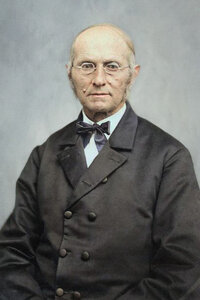
William Farnsworth was a New Hampshire farmer and lay leader of the Christian Society of Washington who, in late 1844 or early 1845, became the first Adventist layman to publicly accept the seventh-day Sabbath. With his brother Cyrus he formed the small Sabbath-keeping company at Washington, New Hampshire, that became one of the seedbeds of Sabbatarian Adventism. He raised twenty-two children — most of them lifelong Seventh-day Adventists — and remained near “Happy Hollow” his entire life.
Family Roots and Birth (1807)
The Adventist Pioneer Library compilation Lest We Forget records the Farnsworth family’s pioneer arrival in New Hampshire and William’s birth: “William Farnsworth was a true pioneer, though not in the same sense as his great-great-great grandfather, Jonathan, who, in 1663, settled with his father, Matthias, near the new colony of Plymouth, Massachusetts; nor as his grandfather and grandmother, Simeon and Esther, who in, 1767, decided to move with fifteen other pioneer families to a more favorable farming area, a nearly virgin territory in” (Lest We Forget, ch. 69 (“A TRUE PIONEER —1807-1888”), p. 122, ¶ 1). LWF continues: “In 1776, the little town that grew up in that place was named Washington after George Washington, then a general of the Army” (Lest We Forget, ch. 69, p. 122, ¶ 2). And of William’s birth: “William, their first son, was born in 1807, and weighed little more than two and a half pounds. The story is told that his father bundled him up in their ample coffee pot to keep him warm! He was so small, everyone thought he might die” (Lest We Forget, ch. 69, p. 122, ¶ 3).
Marriage to Sally Mead and “Happy Hollow” (1830)
LWF records the family connection between the Farnsworths and the Meads: “Among their close neighbors was the Mead family. Their children attended school together, played together, and later, married each other. William was a strong young man, twenty-three years old when he married Sally Mead. They selected two hundred sixteen acres beside the Ashuelot River and built their own home which they called, “Happy Hollow.” They lived there the rest of their lives” (Lest We Forget, ch. 69, p. 122, ¶ 4).
The Star Shower (November 14, 1833)
LWF preserves the night that became, in early-Adventist memory, one of the heralds of the second advent: “One exciting night, November 14, 1833, William and Sally had the thrilling experience of witnessing the solemn rain of stars which was one of the signs that the second coming of Jesus was approaching” (Lest We Forget, ch. 69, p. 122, ¶ 5).
Christian Society of Washington and the Adventist Awakening (1841–1844)
LWF records William’s role as a founding member of the Washington congregation: “In 1841, William joined a group of thirty-two neighbors, to form the Christian Society of Washington, New Hampshire. At that time they constructed a large church close to their homes” (Lest We Forget, ch. 69, p. 122, ¶ 6). LWF continues with the moment that turned that congregation toward Adventism: “William was president of the Christian Society in 1842 when he invited a visiting minister, Joshua Goodwin, to preach in their church the next Sunday. Great attention was paid to his sermon when he announced, “Jesus is coming to this earth in 1843! Are you ready?”” (Lest We Forget, ch. 69, p. 123, ¶ 7).
The seventh-month message that fixed October 22 reached Washington in August 1844: “By mid-August, 1844, advent preachers were sounding the midnight cry everywhere, spreading the astounding message that prophetic end-time, and Christ’s second coming would be October 22, 1844, according to a more accurate prophetic chronology proposed by Samuel S. Snow” (Lest We Forget, ch. 69, p. 123, ¶ 8).
The First Adventist Layman to Keep the Sabbath (1844–1845)
The decisive shift in Washington came through the Seventh Day Baptist Rachel Oakes. LWF records the chain: “Before the disappointment, in 1843, Rachel Oakes moved to Washington to live with her daughter, Delight, who was the school teacher. Rachel was a Seventh-day Baptist, but worshipped with the Adventist group there in the little Christian Church” (Lest We Forget, ch. 69, p. 123, ¶ 10). LWF continues with Rachel Oakes’s confrontation of the Methodist preacher Frederick Wheeler: “Rachel Oakes reproached him about this and challenged him to live what he preached by keeping the right Sabbath. As a result of this, and after prayer and Bible study, he began keeping the s” (Lest We Forget, ch. 69, p. 123, ¶ 11).
LWF records William Farnsworth’s own decisive step: “Upon reading Revelation 11:18, 19, William Farnsworth had been impressed that the Sabbath of the ten commandments was still to be kept by Christians. Sometime between the disappointment and the first Sabbath in January of 1845, he declared publicly his decision to keep the seventh day holy. He was the first advent layman to keep the seventh-day Sabbath. Others in the church were influenced by Will” (Lest We Forget, ch. 69, p. 124, ¶ 12). The break with the Sunday-keeping congregation was immediate: “They could no longer worship in the church at Washington, for their decision to keep the Sabbath meant separation from their Sunday-keeping brethren. The next Sabbath, instead of going to the fields to work, William and Cyrus and their families joined together at their father’s home to keep their first Sabbath. On Sunday, William and his eldest son, John, went to work in the fields” (Lest We Forget, ch. 69, p. 124, ¶ 13).
Joseph Bates’s 1845 Visit
LWF records the visit by Joseph Bates that linked the Washington Sabbath-keepers to the wider movement: “In early 1845, Joseph Bates visited Washington, New Hampshire, to study the Sabbath message with them there. He found that Farnsworth and the others had begun keeping the Sabbath a few weeks before he himself had. In the autumn of 1846 James and Ellen White also began keeping the seventh-day Sabbath. On April 7, 1847, Ellen White had a vision regarding the fourth commandment Sabbath, which affirme” (Lest We Forget, ch. 69, p. 125, ¶ 14).
Family and Final Years (1855–1888)
LWF records the loss of Sally and the second marriage: “On June 30, 1855, 43-year-old Sally Farnsworth died after a ten-hour illness. It all happened so suddenly! William knew he needed help with the children, and was not slow in filling the great void Sally had left, with a young bride, Cynthia Stowell, 25 years old at the time. They were married several months later, on September 19, 1855” (Lest We Forget, ch. 69, p. 125, ¶ 15). And of the children: “William and Cynthia also had eleven children, making a total of twenty-two for William. From the Farnsworth home, three sons, Eugene, Orvil, and Elmer became ministers; and one daughter, Loretta, became the first woman S.D.A. Bible instructor. Of the sixteen children born after 1843, all but one lived faithful, consistent lives as Seventh-day Adventists” (Lest We Forget, ch. 69, p. 125, ¶ 16).
LWF closes the chapter with the assessment that gave it its title: “All this happened because, though an ordinary man and a common farmer, William Farnsworth, as a true pioneer, did not hesitate to step forward, even in the face of ridicule, to follow Christ’s leading as the Holy Spirit opened new light to his understanding” (Lest We Forget, ch. 69, p. 125, ¶ 17).