Summary
William Farnsworth was a farmer from Washington, New Hampshire, who was an early Sabbatarian Adventist. As the leader of the Christian Society of Washington, he was among the first Adventist believers to publicly accept and observe the seventh-day Sabbath, an act of courage that helped establish the first Sabbatarian Adventist congregation. His large family produced ministers, missionaries, and Bible workers who spread the Seventh-day Adventist message across multiple continents. Though he never traveled far from his birthplace and lived the life of a plain farmer, his faithfulness to conviction shaped the course of an entire denomination.
Early Life
William was born on February 8, 1807, the oldest child of Daniel (1782–1864) and Martha “Patty” Proctor Farnsworth (1785–1875). As a baby it was reported that he weighed only two and a half pounds and his father bundled him up in a coffee pot to help keep him warm. Everyone thought he would die, but eventually the diminutive child grew up to a towering six feet and 240 pounds as an adult. He was remembered for having “converted to God quite early in life.”
William Farnsworth had a total of twenty-two children, eleven children with each of his two wives. He married his first wife, Sarah (“Sally”) Mead (1812–1855), on December 2, 1830. Together they selected 216 acres beside the Ashuelot River and built their home, which they called “Happy Hollow.” They lived there the rest of their lives. After Sarah’s death on June 30, 1855, he married Cynthia Stowell (1829–1917) on September 19, 1855. Such large families were more common in the nineteenth century. Six of William’s children would not reach the age of 25.
The Farnsworths were modestly prosperous farmers. In 1850 he was listed as a farmer with a farm worth $1,000. By 1870 their property had appreciated to $2,000 in value with an additional $600 of personal property. William never had a bank account, but by selling off a few head of cattle, sheep, turkeys, geese, potatoes, and other things grown on the tillable soil, he was seldom without a little money in his pocket. He died free from debt and left something for the support of his family.
On one occasion, according to a descendant, William woke up his son Eugene (1847–1935) to have him go to Marlowe to get the doctor because “Mother is having a baby.” Eugene told his father he didn’t want to go because “There are already too many children in this family.” William responded with Genesis 1:28, “increase and multiply and replenish the earth.” Eugene retorted: “Yes, but he did not tell you to do it all by yourself.”
Of the fifteen children born after 1843, all but one remained faithful Seventh-day Adventists. His son Eugene, reflected later on in life that he pitied the boy who did not have any siblings. “I tell you,” he added, “you let a boy be brought up in a family with twenty-one brothers and sisters, and he will get a lot of selfish corners knocked off him before he gets to be twenty-one years old.”
Conversion and the Millerite Movement
William was the leader of the Christian Society of Washington when thirty-two families covenanted together to construct a church. In 1842 he heard Joshua Goodwin preach that Christ would return about 1843–1844. William and Sarah, along with most of the members of the Christian Society, became Adventists, joyfully awaiting the coming of Christ.
On November 14, 1833, William and Sally had the thrilling experience of witnessing the great rain of stars — the Leonid meteor shower — one of the signs that the second coming of Jesus was approaching.
When Jesus failed to appear on October 22, 1844, the little group experienced the Great Disappointment. Though some fell away in discouragement, the Farnsworth family continued believing the word of prophecy.
Acceptance of the Seventh-day Sabbath
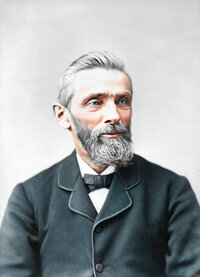
Rachel Oakes Preston (1809–1868), a Seventh Day Baptist, stayed at the home of William’s brother Cyrus so that she could be close to her daughter, Rachel Delight (1825–1858), who was teaching at the rural school. Rachel Oakes shared her convictions with Frederick Wheeler (1811–1910), the Millerite Methodist minister who preached at the church. At a quarterly meeting in the spring of 1844, Wheeler administered the communion and remarked that all those partaking in “the communion should be ready to follow Christ, and keep all of God’s commandments.” A couple of days later, he met Rachel Oaks at the home of the family of William Farnsworth. She reminded Wheeler of his remarks and then told him, “I came near getting up in that meeting at that point… and saying something.” She said, “I wanted to tell you that you would better set that communion table back and put the cloth over it until you begin to keep the commandments of God.” Those words “cut him deeper than anything that he had ever had spoken to him,” Wheeler later told another minister. Returning home, Wheeler pondered the question and, soon convinced, began to observe the seventh-day Sabbath. He thus became the first Sabbatarian Adventist minister.
William and Sarah, along with his brother Cyrus, as well as his oldest son, John (1834–1918), accepted the seventh-day Sabbath. While some debates exist on the precise dating, it is plausible that this first Sabbath that William Farnsworth joined Wheeler may have been March 16, 1844, and his younger brother, Cyrus, joined him a week later. The following Sunday, William worked on what had previously been a day of rest for him.
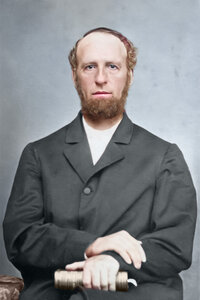
According to several accounts, Joseph Bates during the height of the Millerite movement had shared with the Washington believers about Christ’s soon return. He returned to Washington, New Hampshire, to share his newfound conviction about the seventh-day Sabbath. When he arrived at the home of William Farnsworth:
“[H]e remarked, ‘Brother William, I’ve come to bring you some new light.’ Brother Farnsworth said, ‘Is it the Sabbath?’ ‘Why, yes,’ said Elder Bates, ‘have you heard about the Sabbath?’ ‘The temple of God was opened in heaven, and there was seen in his temple the ark of his testament,’ replied Brother Farnsworth, ‘and don’t you know that in that ark is the ten commandments, the fourth precept of which we have not been obeying?’ The two men then compared notes, and both had begun the observance of the Sabbath on the same day, both having had their attention called to its observance by the Holy Spirit’s impressing their minds with the identical words of Scripture.”
More believers joined them after the Great Disappointment. Partially as a result of their acceptance of the seventh-day Sabbath, William parted ways with the Washington, New Hampshire, Church that he had founded. They began to take turns worshipping in one another’s homes. Some neighbors on their way to church threatened him, but he refused to back down.
Church Organization and Final Years
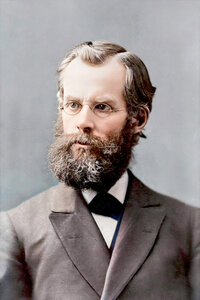
In 1845, William subscribed to The Day-Star, a periodical in which Millerites encouraged one another to remain faithful to their belief in Christ’s soon return. He wrote to the editor, Enoch Jacobs (1809–1894):
“This [Second Advent] hope brings joy inexpressible, truly. Yet, the hope of soon seeing Jesus, visibly and personally too, is what cheers me. The truth that the ‘Day Star’ contains, is what I love. So I send the enclosed mite to pay my subscription, and also for a new subscriber.”
“The cause in this place has suffered much from those that have turned aside from the truth — in believing that the second coming of Jesus has taken place. I think this to be an extreme error. The only lovely band in Washington, has been divided by this influence. Warn your brethren faithfully, against this last device of the enemy, to destroy souls. I believe the conflict will soon be over, Praise the Lord!”
On January 12, 1862, William was one of the eleven initial members of the Washington Seventh-day Adventist Church, which by this point had taken over the original Christian Connexion church building. Cynthia, his wife, joined on June 6, 1862. William often led out in the singing during early worship services and sometimes read a chapter or sermon when there was not a visiting minister.
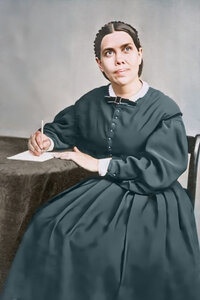
At one point, Ellen White admonished him that he was in spiritual darkness. She warned him he had increased the size of his family without recognizing “the responsibility” he had brought upon his companions. “Your first wife ought not to have died, but you brought upon her cares and burdens which ended in the sacrifice of her life.” She added that by “increasing your family so rapidly, you have been kept in a state of poverty.”
Final Days and Legacy
William died of “old age and paralysis” on December 17, 1888, at the age of eighty-one. His children became farmers, ministers, and missionaries. Many of them traveled the world and spread the church that he helped found. William himself never moved or traveled far from where he was born. He is buried in the church cemetery near the Washington Meetinghouse.
From the Farnsworth home, three sons — Eugene William, Orvil Orlando, and Elmer Ellsworth — became ministers. Eugene served as an ordained minister and church administrator who spent six years as a missionary in Australia. Orvil served as a missionary to Ireland, England, and Trinidad. Loretta Viola became a pioneer Bible worker and religion teacher who went with her husband Asa to Africa and Australia as missionaries.
As Dores Robinson wrote in 1944: “The name of William Farnsworth, of Washington, New Hampshire, finds a place among the pioneers of Seventh-day Adventists, but not because of a brilliant career, for he lived as a plain, humble farmer; not because of widespread popularity, for he was little known outside of a radius of a few miles of his birthplace where he spent his entire life; not because of scholastic achievements, for his education was limited to the small rural school near by…. He is, however, worthy of honor because of his courage in standing as the first in his church to announce his conviction that the seventh day is the Sabbath, and his decision to keep it.”
His son Eugene reflected on his heritage: “My father… was the first Adventist man to begin the observance of the Sabbath. So my lineage runs back to the very beginning of Sabbath keeping among the Seventh-day Adventist people. I am glad of that, and yet I do not know as that helps me very much, after all. You know the Jews in the days of Christ made a great boast of having Abraham to their father; but John the Baptist took the glory all out of it at once. So it doesn’t help me very much that my father was the first Sabbath keeper among the Adventist people. Every man must have an experience of his own in order for him to be right before God.”
The little church at Washington, New Hampshire, where William first took his stand, became known as the birthplace of the Sabbatarian Adventist movement and stands to this day as a monument to the courage of these early believers.
Key Quotes
The encounter with Bates: “Brother William, I’ve come to bring you some new light.” — “Is it the Sabbath?” — “The temple of God was opened in heaven, and there was seen in his temple the ark of his testament, and don’t you know that in that ark is the ten commandments, the fourth precept of which we have not been obeying?”
On the Advent hope (letter to the Day-Star, 1845): “This [Second Advent] hope brings joy inexpressible, truly. Yet, the hope of soon seeing Jesus, visibly and personally too, is what cheers me.”
Eugene Farnsworth on his heritage: “Every man must have an experience of his own in order for him to be right before God.” — Review and Herald, June 4, 1926.