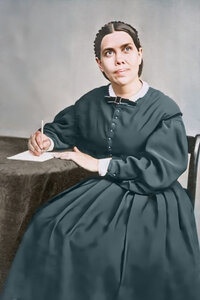
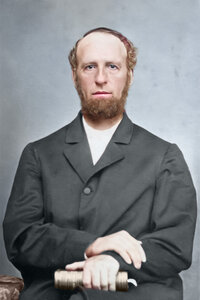
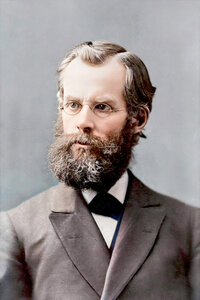
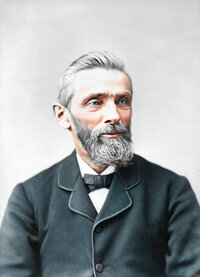
1818–1893
Summary
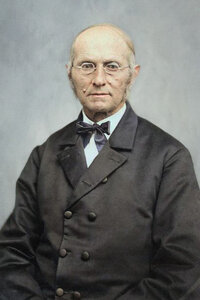
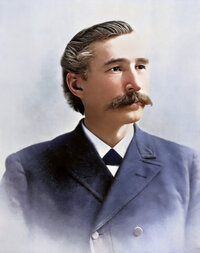
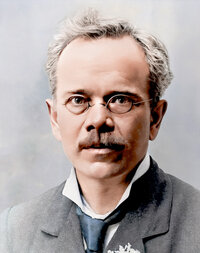
William Ellis Foy was a black Free Will Baptist minister whom Seventh-day Adventists hold to be the first of three persons to receive prophetic visions in the Millerite period, followed by Hazen Foss and Ellen G. Harmon. Foy received two visions in Boston in early 1842 — the first on January 18 at the Twelfth Baptist Church, the second on February 4 at the African Methodist Episcopal Church on May Street — and a third vision in 1844 near the close of the prophetic period of the 2,300 days. He travelled and lectured widely on his visions during 1842–1845, drawing crowds in Massachusetts and Maine. Ellen Harmon, then a teenager, heard him lecture at Beethoven Hall in Portland, Maine, and later met him in Cape Elizabeth after his ministry had begun to wind down. Foy continued to pastor and preach as a Free Will Baptist (and later as an independent minister) until his death in 1893 at Plantation No. 7, near Sullivan, Maine.
Early Life and Conversion (1818–1841)
Per the Encyclopedia of Seventh-day Adventists (Benjamin Baker), William Ellis Foy was born around 1818 in Kennebec County, Maine, to a free black farming couple, Joseph and Elizabeth (Betsey) Foy. The family later moved to nearby Palermo, Maine, and around 1837 William married Ann (maiden name unknown). In 1840 Foy and his wife relocated to Boston, settling on the north slope of Beacon Hill — at the time one of the centers of black church life in the United States — so that William could pursue ministerial training. By his own testimony Foy had been baptized into the Free Will Baptist faith three months after his 1835 conversion, under the preaching of Elder Silas Curtis at the Augusta Free Will Baptist Church in Maine.
Foy’s own 1845 pamphlet, The Christian Experience of William E. Foy, reproduces a certificate of standing signed by his church clerk: “This certifies that Bro. Wm. E. Foy, is a regular member, of the first Freewill Baptist Church, in Augusta, in good standing. And as such, we commend him to the fellowship of the people of God, of every name, wherever he may chance to meet them” (The Christian Experience of William E. Foy, p. 23, par. 10; refcode CEWF 23.10).
The First Vision (January 18, 1842)
Foy’s first vision came on the evening of January 18, 1842, at the Twelfth Baptist Church on Beacon Hill. Ten witnesses signed a certificate, reproduced in Christian Experience: “We the undersigned, inhabitants of Boston were witnesses of the apparently inanimate conditions into which our brother, Wm. Ellis Foy, was thrown from some unknown cause, on the 18th of January 1842 when he laid two hours and a half; and again February 4th when he laid twelve hours and a half, during which, each time he testifies that he experienced extraordinary visions of the other world.” (The Christian Experience of William E. Foy, p. 23, par. 6; refcode CEWF 23.6). A physician’s affidavit followed. The source text reads: “Dr. Henry Cummings testifies” (The Christian Experience of William E. Foy, p. 23, par. 7; refcode CEWF 23.7), and Cummings’s own words, recorded in the same paragraph, are: “I was present with our brother at the time of his visions. I examined him, but could not find any appearance of life, except around his heart.” (The Christian Experience of William E. Foy, p. 23, par. 7; refcode CEWF 23.7).
Ann Foy’s testimony of her husband’s coming-to is recorded in the same pamphlet (the wrapper of which reads, “Ann Foy testifies”): “The first appearance of life I saw in him, was the raising of his right hand. He then arose upon his knee and made signs for water which was given him. He dipped his hand into it, and wet his forehead, and his speech immediately came to him.” (The Christian Experience of William E. Foy, p. 23, par. 8; refcode CEWF 23.8).
The Second Vision (February 4, 1842) and the Beginning of Public Ministry
Foy’s second vision came on February 4, 1842, at the African Methodist Episcopal Church on May Street. Foy’s own account preserves the moment: “In the last part of the evening, the house being much crowded, I gave my seat to a friend who had been standing through the evening. While I was thus standing, I began to reflect on my disobedience; and while thus engaged, suddenly I heard a voice, as it were, in the spirit, speaking unto me. I immediately fell to the floor, and knew nothing about this body, until twelve hours and a half had passed away, as I was afterwards informed” (The Christian Experience of William E. Foy, p. 16, par. 1; refcode CEWF 16.1).
In this second vision Foy was commissioned to share what had been shown him. He records the angelic charge: “Thy spirit must return to yonder world, and thou must reveal those things which thou hast seen, and also warn thy fellow creatures, to flee from the wrath to come.” (The Christian Experience of William E. Foy, p. 20, par. 1; refcode CEWF 20.1). And his own response, in the same paragraph: “I will go” (The Christian Experience of William E. Foy, p. 20, par. 1; refcode CEWF 20.1).
Foy’s reluctance to begin lecturing — and the cause of that reluctance — is recorded in his own words: “Notwithstanding the command of my guide and my solemn promise to declare these things to the world; I was at first exceedingly unwilling to do so, and it was three days before I revealed them in a public manner.” (The Christian Experience of William E. Foy, p. 21, par. 1; refcode CEWF 21.1). Continuing: “The message was so different-and the manner in which the command was given, so different from any I had ever heard of, and knowing the prejudice among the people against those of my color, it became very crossing.” (The Christian Experience of William E. Foy, p. 21, par. 2; refcode CEWF 21.2).
He was finally persuaded. “On the 6th of Feb, the Pastor of the Broomfield St. Church, called upon me and requested me to relate my visions in his house of worship. Several members of that church were present and were anxious for me to comply. I consented: and the appointment was made for me after noon.” (The Christian Experience of William E. Foy, p. 21, par. 4; refcode CEWF 21.4).
Lecturing Tour (1842–1845)
Loughborough, in The Great Second Advent Movement, gives an outline of Foy’s Boston background and the visions of January 18 and February 4: “In the year 1842 there was living in Boston, Mass., a well-educated man by the name of William Foy, who was an eloquent speaker. He was a Baptist, but was preparing to take holy orders as an Episcopal minister. The Lord graciously gave him two visions in the year 1842, one on the 18th of January, the other on February 4. These visions bore clear evidence of being the genuine manifestations of the Spirit of God. He was invited from place to place to speak in the pulpits, not by the Episcopalians only, but by the Baptists and other denominations. When he spoke, he always wore the clergyman’s robe, such as the ministers of that church wear in their services” (The Great Second Advent Movement, p. 145, par. 4; refcode GSAM 145.4).
Loughborough records the substance and effect of Foy’s preaching: “Mr. Foy’s visions related to the near advent of Christ, the travels of the people of God to the heavenly city, the new earth, and the glories of the redeemed state. Having a good command of language, with fine descriptive powers, he created a sensation wherever he went. By invitation he went from city to city to tell of the wonderful things he had seen; and in order to accommodate the vast crowds who assembled to hear him, large halls were secured, where he related to thousands what had been shown him of the heavenly world, the loveliness of the New Jerusalem, and of the angelic hosts. When dwelling on the tender, compassionate love of Christ for poor sinners, he exhorted the unconverted to seek God, and scores responded to his tender entreaties” (The Great Second Advent Movement, p. 146, par. 1; refcode GSAM 146.1).
The Third Vision (1844) and the End of Public Speaking
Loughborough records the third vision, which Foy could not interpret in 1844: “His work continued until the year 1844, near the close of the twenty-three hundred days. Then he was favored with another manifestation of the Holy Spirit,—a third vision, one which he did not understand. In this he was shown the pathway of the people of God through to the heavenly city. He saw a great platform, or step, on which multitudes of people gathered.” (The Great Second Advent Movement, p. 146, par. 2; refcode GSAM 146.2). Loughborough continues, in the same paragraph: “Then he saw the people rise to a second step, or platform, and some there also dropped through the platform out of sight. Finally a third platform appeared, which extended to the gates of the holy city. A great company gathered with those who had advanced to this platform.” (The Great Second Advent Movement, p. 146, par. 2; refcode GSAM 146.2).
Loughborough explains, in the same paragraph, why the vision became unintelligible to Foy: “As he expected the Lord Jesus to come in a very short time, he failed to recognize the fact that a third message was to follow the first and second messages of Revelation 14. Consequently the vision was to him unexplainable, and he ceased public speaking.” (The Great Second Advent Movement, p. 146, par. 2; refcode GSAM 146.2).
Loughborough gives the same outline in the earlier Heavenly Visions, or Helpful Visions and Inspirations: “Brother Foy’s work continued until the year 1844, near the close of the twenty-three hundred days. Then he was favored with another manifestation of the Holy Spirit,-a third vision was given,-one which he did not understand. In this he was shown the pathway of the people of God through to the heavenly city. He saw a great platform, on which multitudes of people gathered.” (Heavenly Visions, p. 27, par. 5; refcode HEVI 27.5).
Ellen Harmon Hears Foy at Beethoven Hall (Portland, Maine)
Ellen Harmon (later Ellen White), then a teenager in Portland, Maine, attended one of Foy’s lectures at Beethoven Hall and recalled the encounter sixty years later in her August 13, 1906 interview with Dores E. Robinson (Manuscript 131, 1906; published in Manuscript Releases, vol. 17, pp. 95–97).
Asked whether she had attended the lectures, she answered: “He came to give it right to the hall, in the great hall where we attended, Beethoven Hall. That was quite a little time after the visions. It was in Portland, Maine. We went over to Cape Elizabeth to hear him lecture. Father always took me with him when we went, and he would be going in a sleigh, and he would invite me to get in, and I would ride with them. That was before I got any way acquainted with him” (Manuscript Releases, vol. 17, p. 97, par. 3; refcode 17MR 97.3).
She recalled Foy’s appearance and the impression of his testimony: “He was a very tall man, slightly colored. But it was remarkable testimonies that he bore” (Manuscript Releases, vol. 17, p. 96, par. 3; refcode 17MR 96.3).
She also recorded Ann Foy’s nervous habit of mouthing her husband’s words from the front row: “His wife was so anxious. She sat looking at him, so that it disturbed him.” (Manuscript Releases, vol. 17, p. 96, par. 3; refcode 17MR 96.3). The same interview paragraph continues: “He had on an episcopalian robe. His wife sat by the side of me. She kept moving about and putting her head behind me.” (Manuscript Releases, vol. 17, p. 96, par. 3; refcode 17MR 96.3).
Ellen White recalled the count of his visions and the duration of one of them: “Then another time, there was Foy that had had visions. He had had four visions. He was in a large congregation, very large. He fell right to the floor. I do not know what they were doing in there, whether they were listening to preaching or not. But at any rate he fell to the floor.” (Manuscript Releases, vol. 17, p. 95, par. 4; refcode 17MR 95.4).
The Cape Elizabeth Encounter (1845)
After the October 22, 1844 disappointment, Ellen Harmon was scheduled to speak at a venue in Cape Elizabeth on the visions she had begun to receive. Foy attended that meeting and afterwards spoke with her at length. She recalled: “I had an interview with him. He wanted to see me, and I talked with him a little. They had appointed for me to speak that night, and I did not know that he was there. I did not know at first that he was there. While I was talking I heard a shout, and he is a great, tall man, and the roof was rather low, and he jumped right up and down, and oh, he praised the Lord, praised the Lord. It was just what he had seen, just what he had seen. But they extolled him so I think it hurt him, and I do not know what became of him” (Manuscript Releases, vol. 17, p. 96, par. 2; refcode 17MR 96.2).
Death (1893)
Per the Encyclopedia of Seventh-day Adventists (Benjamin Baker), William Ellis Foy continued in active ministry as a Free Will Baptist (and from 1862 onward as an independent minister) for the remainder of his life. He pastored, preached, and held revivals throughout coastal Maine, and was reported to be holding meetings as late as November 1891 in Steuben, Maine. He died of chronic prostatitis and cystitis at his home in Plantation No. 7 (near today’s Sullivan, Maine) on November 9, 1893, and was buried beside his daughter Lauraitta in Birch Tree Cemetery in Sullivan. Arthur White’s Ellen G. White: Messenger to the Remnant preserves a brief Adventist summary of his ministry: “The record of this period would be incomplete should we not mention the visions of William Foy and Hazen Foss” (Ellen G. White: Messenger to the Remnant, p. 29, par. 2; refcode EGWMR 29.2).
Pfandl’s The Gift of Prophecy records the corrected understanding that emerged with Delbert W. Baker’s 1987 study The Unknown Prophet: “Foy stopped telling what he had been shown in this third vision—perhaps because he didn’t understand what it meant.” (The Gift of Prophecy, p. 116, par. 3; refcode GP 116.3). Pfandl, in the same paragraph, cites Baker’s correction of the older record by quoting Baker’s conclusion that Foy “continued to pastor, preach, and hold revivals up to the time of his death” (The Gift of Prophecy, p. 116, par. 3; refcode GP 116.3).