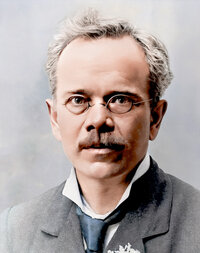
1865–1952
Summary
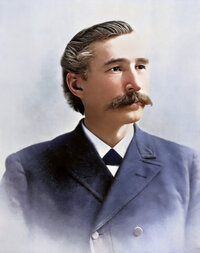
William Ambrose Spicer was a Seventh-day Adventist editor, missionary administrator, and the General Conference president who succeeded A. G. Daniells in 1922 and served until 1930. Born February 19, 1865, in Freeborn, Minnesota, he came up through the editorial ranks — first at the Review and Herald in his teens, then as foreign mission secretary, then as president — and gave his life to building the church’s worldwide mission infrastructure. He died at his home in Takoma Park, Maryland, on October 17, 1952, at the age of eighty-seven.
Editorial Beginnings (1880s)
Ellen White’s first surviving mention of the young Spicer is from 1887, when he was a copy clerk in her office. She wrote on May 12, 1887, after concluding a long letter to D. M. Canright: “I will say my letter to Canright was copied by Brother Spicer on thick copying paper” (Manuscript Releases, Letter 51c, 1887, par. 5; refcode 5LtMs, Lt 51c, 1887, par. 5).
Foreign Mission Secretary (1893–1903)
In March 1891 Spicer was speaking at the General Conference session on the work in Britain and her colonies. The General Conference Daily Bulletin of March 12, 1891, records: “WEDNESDAY morning at 9 o’clock, Elder H. P. Holser requesting, on account of ill health, to be excused from speaking in regard to the work in Russia, the hour was occupied by Brother W. A. Spicer and Elder S. N. Haskell on the work in England and the British colonies. Of the progress of the work in England, Brother Spicer spoke as follows” (General Conference Daily Bulletin, March 12, 1891, page 76.1; refcode GCDB March 12, 1891, page 76.1).
By 1893 he had been chosen as Foreign Mission Secretary. The General Conference Daily Bulletin of March 5, 1893, records D. A. Robinson’s request that Spicer return to London to help E. J. Waggoner with the Present Truth: “D. A. Robinson spoke to the name of W. A. Spicer as Foreign Mission Secretary, and asked that it be reconsidered as he wished to have the General Conference send Brother Spicer back to London to assist Dr. Waggoner on the editorial work of the Present Truth, which was voted to be changed to a weekly paper” (General Conference Daily Bulletin, March 5, 1893, page 475.28; refcode GCDB March 5, 1893, page 475.28).
Spicer served at the Present Truth in London for several years before returning to the General Conference offices.
Ellen White’s Counsel (1902)
In 1902 Ellen White wrote a letter that named Spicer (alongside C. H. Lane) as one in need of a “re-formation of character” — a counsel offered in love and not as criticism: “I ask you, as one who has a deep interest in your soul, to seek the Lord, and to urge Brother Lane and Brother Spicer to seek Him. All our ministers need a reconversion, a re-formation of character. Higher and still higher let your aspirations rise. Close the windows of the soul earthward, and open them heavenward” (Manuscript Releases, Letter 175, 1902, par. 14; refcode 17LtMs, Lt 175, 1902, par. 14).
General Conference President (1922–1930)
Per the Encyclopedia of Seventh-day Adventists (and the historical record), Spicer succeeded A. G. Daniells as president of the General Conference in 1922 and served two consecutive terms — 1922 to 1930. Under his administration the church’s worldwide mission expanded across Africa, Asia, Latin America, and the South Pacific, and the General Conference was reorganized to meet the growing complexity of its global work. He was a prolific writer and authored several books, including Beacon Lights of Prophecy, Our Story of Missions, The Hand That Intervenes, and The Gospel in All Lands.
Final Years (1930–1952)
After leaving the GC presidency in 1930 Spicer continued to serve in editorial capacities and to write extensively for the Review and Herald and other publications. He died at his home in Takoma Park, Maryland, on October 17, 1952, at the age of eighty-seven.