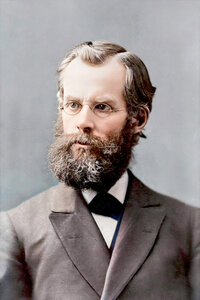
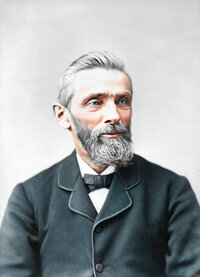
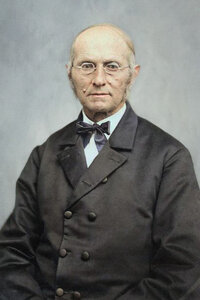
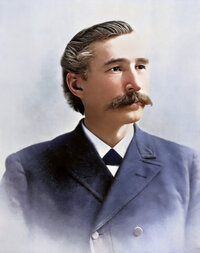
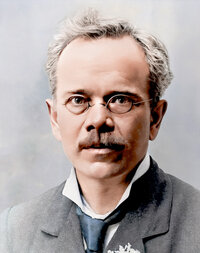
1865 — 1952
Summary
William Ambrose Spicer was a Seventh-day Adventist minister, missionary, administrator, editor, and author who served the church for more than six decades. Born into a Seventh Day Baptist home in Minnesota, Spicer became one of the most recognized personalities in the church during the first half of the twentieth century. He served as secretary of the General Conference (1903–1922) alongside President A. G. Daniells, then succeeded Daniells as president (1922–1930), and continued as a general field secretary until 1941. Spicer Adventist University in Pune, India, bears his name.
Early Life and Education
William Ambrose Spicer was born December 19, 1865, in Freeborn, Minnesota, to Ambrose Coats Spicer and Susan M. (Coon) Spicer. The family belonged to the Seventh Day Baptist Church. Spicer enrolled at Battle Creek College in Michigan, where he developed the editorial skills that would define much of his career. He married Georgia Harper.
Editor in England
Spicer’s first major assignment came in 1887, when at twenty-two he was sent to London to serve as editor of The Present Truth. This came through his work as secretary to Stephen Nelson Haskell. He served in England from 1887 to 1890, returned briefly as secretary of the Foreign Mission Board (1891–1892), and went back to London from 1893 to 1897.
Pioneer Missionary to India
In 1898, Spicer sailed for India, arriving to serve as editor for the International Tract Society. He began regularly publishing The Oriental Watchman, a sixteen-page monthly magazine. When Dores A. Robinson succumbed to smallpox in December 1899, Spicer also took on the role of superintendent of the mission. His two years in India were foundational, and the institution later named in his honor — now Spicer Adventist University in Pune — became the premier educational institution of the Southern Asia Division.
General Conference Secretary (1903–1922)
As secretary, Spicer was “frequently at Daniells’s side.” The two men complemented each other: Daniells the forceful administrator; Spicer the meticulous organizer with a passion for missions. Together they navigated the Kellogg crisis, the relocation to Washington, D.C., the establishment of divisional structures, and explosive missionary growth. Spicer became one of the most prolific contributors to the Review and Herald.
General Conference President (1922–1930)
After Daniells’s long presidency, Spicer was elected at the 1922 San Francisco session. In a unique arrangement, Daniells then served as secretary during Spicer’s presidency, just as Spicer had served as secretary during Daniells’s. Spicer continued to champion worldwide missions during his eight years of leadership. He warmly introduced his successor, Charles Henry Watson, in 1930.
Later Years and Legacy
After his presidency, Spicer served as a general field secretary until 1941, traveling extensively and continuing his prolific writing. His approximately eighteen published works included The Hand of God in History, Our Day in the Light of Prophecy, Miracles of Missions, and Pioneer Days of the Advent Movement.
William Ambrose Spicer passed away on October 17, 1952. Since he had passed away that year, the institution in Pune was changed from “Spicer Missionary College” to “Spicer Memorial College” — a fitting tribute to a man whose life was dedicated to advancing the Adventist mission around the world.
Source: Encyclopedia of Seventh-day Adventists, encyclopedia.adventist.org.