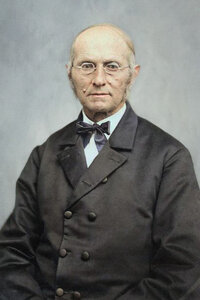
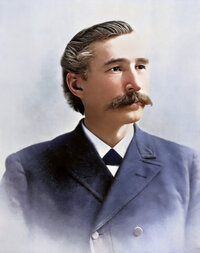
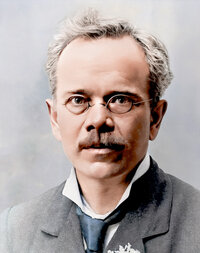
1832–1903
Summary
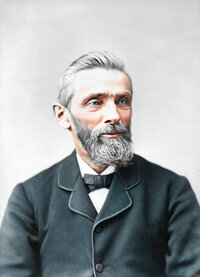
Uriah Smith was the youngest of four children of a New England farming family, and at twenty-one — on May 3, 1853 — he began fifty years of unbroken service at the Review and Herald. As resident editor, associate editor, and finally editor-in-chief, he shaped the paper’s voice for half a century. He served five intermittent terms as secretary of the General Conference (twenty years total — longer than any of the fifteen men who held the position after him). He was the church’s first college Bible instructor, the author of Thoughts on Daniel and Thoughts on the Revelation (later combined into the standard subscription volume Daniel and the Revelation), an inventor (he held US patents on a jointed prosthesis and a school seat), and a hymn-writer. He died of a sudden paralytic stroke on March 6, 1903, while on his way to the Review office with editorial material.
Boyhood and the Lost Leg (1832–1851)
Steinweg’s Lest We Forget preserves the bare outline: “Uriah, the youngest of four children, was born on May 2, 1832. When he was about twelve or thirteen years old, he was treated during an illness with what must have been an overdose of calomel. As a result there developed in his left leg a sore which became so aggravated that amputation was thought necessary. The limb was removed at a point about half way between the knee and the thigh.” (Lest We Forget, ch. 148, p. 293, ¶ 4).
Steinweg’s portrait of the young Uriah notes that “The lad Uriah that year passed through the disappointment. His mother, a godly women, was a devout believer in the expected coming of Christ on October 22, 1844” (Lest We Forget, ch. 148, p. 293, ¶ 5).
After 1844 the young man took a different path for a few years: “After the disappointment Uriah Smith lost touch with the message and devoted himself earnestly to securing the highest education possible” (Lest We Forget, ch. 148, p. 293, ¶ 6).
Steinweg notes the height of his ambitions on the eve of his decision for the Sabbath: “he planned to continue his schooling at Harvard College, where he would have enrolled as a sophomore” (Lest We Forget, ch. 148, p. 293, ¶ 7).
Froom captures the man and the moment well: “editor, author, and Bible teacher, was born in West Wilton, New Hampshire, and possessed the characteristic grit of the Granite State. When but a lad of twelve, with his parents he passed through the tense days of the Disappointment of 1844, which made an impression on his mind that was never effaced. He had had high teaching aspirations, graduating from Phillips Academy at Exeter when he was twenty. He then began to teach public school. But a childhood illness and infection led to the loss of his left leg, and this misfortune turned his thoughts toward sedentary occupations. He began drafting and sketching, and was skilled as a wood engraver.” (The Prophetic Faith of Our Fathers, vol. 4, p. 1109, par. 2; refcode PFF4 1109.2).
Conversion and the First Sabbath (1852)
In the autumn of 1852, the twenty-year-old Smith attended the Adventist conference at Washington, New Hampshire, and heard the Sabbath truth presented for the first time. Steinweg records the three months of struggle and the decision: “On December 1 his father passed away. Undoubtedly his mother’s and sister’s influence and prayers at this time of family sorrow had their effect, for in early December Uriah Smith kept his first Sabbath—and set the current of his life in the advent movement” (Lest We Forget, ch. 148, p. 294, ¶ 12).
In January 1853 Smith received a $1,000-a-year offer to join the faculty of a new academy at Mount Vernon, New Hampshire — and turned it down. Steinweg records his first published piece in the paper he would soon edit: “On March 17, 1853, the first literary production of Uriah Smith appeared in the paper he was later to edit.” (Lest We Forget, ch. 148, p. 294, ¶ 14).
Fifty Years at the Review (1853–1903)
Steinweg records the start of a half-century at the editor’s desk: “On May 3, 1853, at twenty-one years of age, Uriah Smith began fifty years of service at the Review. In a very short time he had mastered many of the printing skills, and his ingenuity helped the office through many a crisis. Elder White soon recognized in this youth a valuable helper in editorial work, and laid much of that work upon his young shoulders when he and Mrs. White were away on their travels” (Lest We Forget, ch. 148, p. 294, ¶ 15).
Loughborough’s The Great Second Advent Movement records the same beginning: “It was during the publication of Volume III of the Review that Uriah Smith began the observance of the Sabbath, and became connected with the Review office, in which he was writer and editor for so many long years.” (The Great Second Advent Movement, p. 320, par. 2; refcode GSAM 320.2).
In 1855 he moved with the Review to Battle Creek. Steinweg records: “In 1855, the Review was moved to Battle Creek, and Uriah Smith’s name appeared in the first issue—December 4, for the first time as” Resident Editor (Lest We Forget, ch. 148, p. 294, ¶ 16). The same paragraph continues: “From that time forward he took a leading part in shaping the policies of the Review, and his life was inseparably linked with the progress of the church paper. Later he became associate editor, then editor-in-chief” (Lest We Forget, ch. 148, p. 294, ¶ 16).
Marriage, Family, and Twenty Years as General Conference Secretary (1857–1888)
On June 7, 1857, Smith married Harriet M. Stevens, whose sister Angeline had married J. N. Andrews. They had five children, plus a girl who lived with the family. Steinweg adds: “It entailed considerable ingenuity to feed, clothe, and house a household of eight on a salary of from ten to twelve dollars a week.” (Lest We Forget, ch. 148, p. 295, ¶ 17).
In May 1863 the General Conference was constituted with John Byington as first president and Uriah Smith as first secretary. Steinweg records the breadth of his secretarial service: “He served five intermittent terms, totaling a secretarial tenure of twenty years, longer than any tenure of the fifteen men who have served the church in that capacity. In 1863, following his selection as secretary, he began to exercise his gift in public speaking. In 1866 he was ordained to the ministry and soon began to travel, attending conferences and camp meetings, and making trips abroad” (Lest We Forget, ch. 148, p. 295, ¶ 20).
Smith’s mechanical inventiveness produced a patent for a jointed wooden leg on July 28, 1863, that he wore the rest of his life: “His invention served him so well that many who saw him walk believed that he was only lame.” (Lest We Forget, ch. 148, p. 295, ¶ 21).
Froom names him “doubtless the greatest writer and editor of the Adventists in their formative years” (The Prophetic Faith of Our Fathers, vol. 4, p. 1112, par. 1; refcode PFF4 1112.1), and his commentary on Daniel and the Revelation became, in Froom’s assessment, “a skilled piece of expositional architecture, which, after nearly a century, is still regarded as a conspicuously able and balanced exposition” (The Prophetic Faith of Our Fathers, vol. 4, p. 1052, par. 3; refcode PFF4 1052.3).
Death (1903)
Steinweg records the day of the stroke: “He was an indefatigable worker and devoted to the work to the very day, almost the hour, of his sudden death. On his way to the office with editorial material, he was smitten down by a paralytic stroke. The burning of the Review office of December 30, 1902 may have precipitated the stroke of Friday, March 6, 1903. He was taken to his home, where he passed away two hours later.” (Lest We Forget, ch. 148, p. 296, ¶ 25).
Smith was eulogized in his own paper. The closing words of the Lest We Forget sketch quote John O. Corliss’s 1923 Review tribute that “His work will not only live through probationary hours to spur on the halting, but in the ages to come many will be able to say” (Lest We Forget, ch. 148, p. 296, ¶ 26).