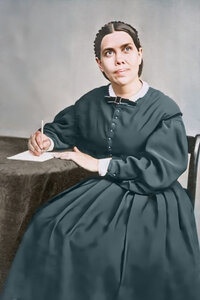
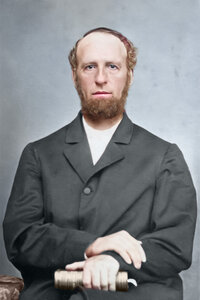
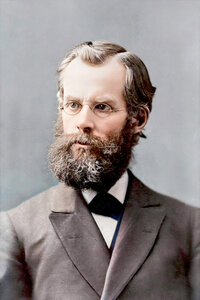
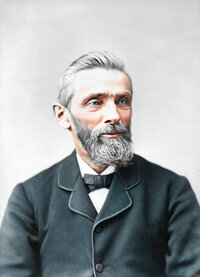
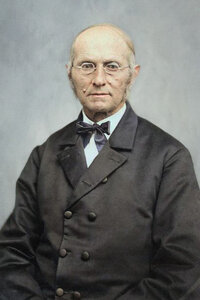
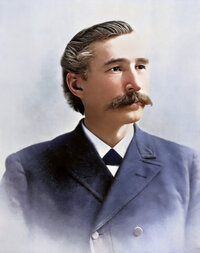
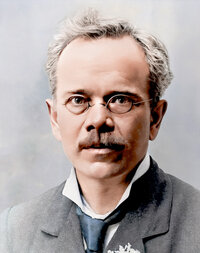
Uriah Smith was a pioneering Seventh-day Adventist writer, editor, and author who served the church for fifty years. Best known for his landmark book Daniel and the Revelation, he was the first secretary of the General Conference of Seventh-day Adventists and served as editor of the Advent Review and Sabbath Herald for most of his career — the longest editorial tenure in the history of the denomination. An inventor, poet, educator, and defender of the faith, he has been called “one of the giants” in the history of the Adventist Church.
Early Life
Uriah Smith, the youngest of four children, was born on May 2, 1832, in West Wilton, New Hampshire, to Samuel and Rebekah Smith. His mother was a godly woman and a devout believer in the expected coming of Christ on October 22, 1844, making twelve-year-old Uriah a participant in the Great Disappointment.
His older sister, Annie Rebekah Smith (1828-1855), would also leave her mark on the Adventist movement as a gifted poet and hymn writer, contributing such beloved hymns as “How Far From Home?” and “The Blessed Hope” before her early death at age twenty-seven.
When Uriah was about twelve or thirteen years old, he was treated during an illness with what was likely an overdose of calomel, a mercury-based medicine commonly used at the time. As a result, a sore developed in his left leg that became so aggravated that amputation was necessary. The limb was removed at a point about halfway between the knee and the thigh. This severe disability would have crushed many, but Uriah transformed it into an opportunity. Later in life, he designed and perfected an articulated artificial limb with flexible knee and ankle joints, on which he received a patent (No. 39,361, dated July 28, 1863). His invention served him so well that many who saw him walk believed he was only lame.
After the Disappointment, Uriah lost touch with the Advent message and devoted himself earnestly to securing the highest education possible. In 1848, he entered Phillips Academy at Exeter, New Hampshire, having previously attended the academy at Hancock. When he finished his work at Exeter in 1851, he planned to continue at Harvard College, where he would have enrolled as a sophomore.
Conversion and Commitment
Uriah’s sister Annie came to faith in 1851 through a remarkable dream and soon entered the Review office at Saratoga Springs, New York. In August 1852, Uriah contributed a woodcut illustration — the only illustration — for the first issue of The Youth’s Instructor. That fall, he attended a conference of Adventist believers at Washington, New Hampshire, where the twenty-year-old heard the reason for the Disappointment explained for the first time and the Sabbath truth presented.
For three months he studied, struggling over the problem. He was ambitious to become a success in the world, yet he knew that if he became an Adventist, he must throw himself, with all his energy and talent, into that movement. On December 1, 1852, his father passed away. His mother’s and sister’s influence and prayers at this time of family sorrow had their effect, and in early December, Uriah Smith kept his first Sabbath — setting the current of his life in the Advent movement.
In January 1853, an offer came to join the faculty of a new academy at Mount Vernon, New Hampshire, for $1,000 a year and board on a three-year contract — a substantial income in those days. He declined this offer, choosing instead the path of service. His first contribution to the Review was “The Warning Voice of Time and Prophecy,” a remarkable 35,000-word poem that demonstrated his prodigious literary talents.
Fifty Years at the Review
On May 3, 1853, at twenty-one years of age, Uriah Smith began fifty years of service at the Review and Herald. He quickly mastered many printing skills, and James White soon recognized in this youth a valuable helper in editorial work. In 1855, the Review was moved to Battle Creek, Michigan, and Smith’s name appeared for the first time as “Resident Editor.” He later became associate editor, then editor-in-chief, serving in editorial capacities for approximately fifty years — the longest such tenure in the denomination’s history.
Smith served as “pastor” to thousands of isolated Adventists who had no local church, through the weekly editorials and articles that shaped their faith and understanding of prophecy. His gifted pen made the Review and Herald the authoritative voice of the denomination for half a century.
Marriage and Family
On June 7, 1857, Uriah married Harriet M. Stevens, who was also the sister-in-law of John N. Andrews. To this union were born five children, including Leon Albert Smith (1863-1958), and an additional girl lived in the Smith home as one of the family. It required considerable ingenuity to feed, clothe, and house a household of eight on a salary of ten to twelve dollars a week. Despite the financial constraints, the Smith household was known for its warmth and hospitality.
Church Leadership
In 1863, Smith became the first secretary of the newly organized General Conference of Seventh-day Adventists. He served five intermittent terms, totaling a secretarial tenure of twenty years — longer than any of the fifteen men who have served the church in that capacity. He also served as General Conference treasurer for one year.
In 1866, he was ordained to the ministry and soon began to travel, attending conferences, camp meetings, and making trips abroad. He served on the General Conference Executive Committee and was the denomination’s first college Bible instructor at Battle Creek College, where he taught from 1874 until his death. He held Bible institutes, served as Sabbath school superintendent and music leader at Battle Creek.
Daniel and the Revelation
Smith’s most significant literary achievement was his commentary on the prophetic books of Daniel and Revelation. Thoughts on the Revelation was published in 1865, followed by Thoughts on Daniel in 1873. The combined work, Thoughts on Daniel and the Revelation, appeared in 1880 and became a cornerstone of Adventist prophetic interpretation. In 1899, Ellen White endorsed the book alongside two of her own, saying it “has done great work in this country.” When his books were translated into foreign languages, Smith generously donated all royalties from the translations to foreign mission advance.
His other major publications included a book defending Ellen White’s prophetic gift, The Visions of Mrs. E. G. White (1868), in which he wrote: “Every test which can be brought to bear upon such manifestations, proves these genuine. The evidence which supports them, internal and external, is conclusive. They agree with the word of God, and with themselves. They tend to the purest morality. They discountenance every vice, and exhort to the practice of every virtue…. They lead us to Christ…. They lead us to the Bible.”
He also wrote extensively on conditional immortality and other doctrinal topics, and advocated religious liberty, the abolition of slavery, and noncombatancy for Adventists.
Inventor and Poet
Beyond his artificial limb, Smith was granted another patent (No. 163,611, dated May 25, 1875) for a school seat and desk that folded up from the rear instead of the front, which he sold for $3,000.
Smith was also a prolific poet. He wrote many poems, several of which became hymns included in the Adventist hymnal. His longest poem, The Warning Voice, spans forty-one pages. His New Year’s poem of 1871 captured the Adventist hope: “Yet glad we hail each New Year’s morn; / For from the great high throne of Heaven / A royal fiat forth has gone, / A glorious word to earth is given: / Behold, says He who looks creation through, / Where sin has marred my works, I make anew.”
The 1888 Crisis and Spiritual Renewal
Smith initially opposed the message of righteousness by faith presented by E. J. Waggoner and A. T. Jones at the 1888 Minneapolis General Conference session. Ellen White labored earnestly for him regarding this opposition. On January 6, 1891, he read a letter she had written to him before a select few and accepted it as from the Lord. He went back in his confession to the Minneapolis meeting and acknowledged the spirit he had occupied.
Ellen White wrote of this experience: “Brother Smith has fallen on the Rock, and is broken, and the Lord Jesus will now work with him. He took my hand as he left the room, and said, ‘If the Lord will forgive me for the sorrow and burdens I have brought upon you, I tell you this will be the last…. The testimonies of God shall hold this place in my experience.'”
Death and Legacy
Uriah Smith was an indefatigable worker, devoted to the work to the very day — almost the hour — of his sudden death. The Review and Herald publishing office had been destroyed by fire on December 30, 1902, a devastating blow. On the morning of March 6, 1903, Smith was on his way to the temporary Review office with editorial material when he was smitten by a paralytic stroke. He was taken to his home, where he passed away two hours later, at the age of seventy.
To Adventists, it seemed hard to realize that there would be no more editorials with the familiar signature “U. S.” As one tribute stated: “Like the patriarch of old, whose life course had pleased God, so it may be said of the subject of this sketch, ‘He being dead yet speaketh.’ His work will not only live through probationary hours to spur on the halting, but in the ages to come many will be able to say, ‘His labors prompted me to be loyal to the message of truth.'”
Smith’s contributions to the denomination were manifold. As editor, he shaped the voice of the church for half a century. As an author, his commentary on Daniel and Revelation guided generations of Adventist prophetic understanding. As the first General Conference secretary, he helped establish the administrative foundations of the denomination. As an inventor, he demonstrated the creativity and practical ingenuity that characterized the best of the pioneer spirit. And as a defender of the faith, his writings on the Spirit of Prophecy and Adventist doctrine provided intellectual foundations for the growing church.