1839–1900
Summary
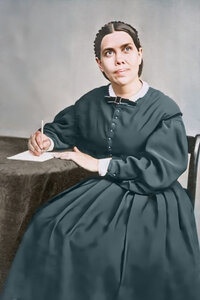
Sarepta Myrenda Irish Henry was a national evangelist of the Woman’s Christian Temperance Union, an author and poet, the architect of the first organized “woman ministry” in the Seventh-day Adventist Church, and one of the most remarkable late-life converts in Adventist history. Born in Albion, Pennsylvania, on November 4, 1839, daughter of Methodist minister Horatio Nelson Irish, widowed at thirty-two, mother of three surviving children, she rose through the ranks of the WCTU to a national platform; bedridden by enlarged-heart disease through the late 1880s, she entered the Battle Creek Sanitarium in the summer of 1896, was miraculously healed by anointing on April 13, 1897, and became a Seventh-day Adventist. Through the last three years of her life she labored at Battle Creek and on a national platform — preaching, writing, organizing women’s work, and corresponding warmly with Ellen G. White (whom she never met in person, White being then in Australia) — until pneumonia at Graysville, Tennessee, took her on January 16, 1900, at the age of sixty.
From Albion, Pennsylvania, to the WCTU Platform (1839–1896)
Per Michel Sun Lee’s article in the Encyclopedia of Seventh-day Adventists, Sarepta Myrenda Irish was born on November 4, 1839, in Albion, Pennsylvania, daughter of Methodist minister Horatio Nelson Irish and his wife Mary Allis Clark Irish. Her brother Orsamus H. Irish later served as Lincoln’s Superintendent of Indian Affairs for Utah and as Garfield’s chief of the Bureau of Engraving and Printing. She enrolled in 1859 at the Rock River Seminary in Mount Morris, Illinois, met fellow teacher James W. Henry there, and married him in 1861. James enlisted in the Union Army in 1864 and died of an illness in 1871, leaving Sarepta a widow at thirty-two with four young children — the youngest of whom died only months after his father. She supported herself and the surviving three children by publishing stories and poetry, sometimes under the pen-name Lina Linwood.
In 1874, alarmed to find that her young son Arthur had been lured into a Rockford, Illinois, saloon, she organized a local temperance society — the kernel of her lifelong work in the WCTU. Though by nature shy and reserved, she became a national evangelist of the WCTU, traveled and lectured for two decades, and through the late 1880s was bedridden by an enlarged heart that physicians had pronounced incurable.
Battle Creek and Conversion to Adventism (1896–1898)
Per ESDA, Henry entered John Harvey Kellogg’s Battle Creek Sanitarium in the summer of 1896 for treatment of her heart condition. On April 13, 1897, after an anointing and prayer session conducted by A. T. Jones, W. W. Prescott, several physicians, and two other patients, she was instantly and permanently healed; J. H. Kellogg and Lauretta Kress confirmed her recovery. She accepted the Sabbath, joined the Seventh-day Adventist Church, and through the last two and a half years of her life laid down a labor on a national scale that no Adventist woman of her generation matched.
The 1899 General Conference Daily Bulletin preserves her own testimony of her conversion: “I feel that it would be impossible for me to allow this morning to pass without saying a word. The greatest marvel of all the mercies that God has given in my life is that I am here this morning. I have been thinking of the last General Conference. I was an invalid in my wheel-chair, at the sanitarium, and had been but three months in the Sabbath. That had come to me as by a flash of light. It had been with me all the time, but I had not seen it. But as God flashed his light upon it in my sight, I had no rebellion against it, but believed and loved it” (General Conference Daily Bulletin, February 16, 1899, p. 3, par. 8; refcode GCDB February 16, 1899, page 3.8).
“How the Sabbath Came to Me” and the WCTU Memorial (1897)
E. J. Waggoner’s Present Truth of August 5, 1897, recorded the title and substance of the booklet she wrote almost immediately after her conversion — How the Sabbath Came to Me — and described it as follows: “This is the title of a little booklet recently received from America, written by Mrs. S. M. I. Henry, who is, we understand, the superintendent of the Evangelistic department of the Women’s Christian Temperance Union in the United States” (Present Truth, August 5, 1897, p. 496, par. 18; refcode PTUK August 5, 1897, page 496.18).
Per ESDA, at the WCTU’s 1897 Buffalo convention Henry presented a memorial signed by approximately thirteen thousand women requesting either the dissolution of the WCTU’s Sabbath Observance Department or its abandonment of the lobby for Sunday legislation. The WCTU leadership received the memorial but did not grant her request, and she tendered her resignation as a national evangelist; the national officers refused to accept it. Through her continued work the WCTU eventually drew up a resolution at its 1899 Seattle convention favoring the amendment of state Sunday laws to exempt seventh-day Sabbathkeepers — a partial victory she did not live to see fully achieved.
Ellen White’s Counsel — Stay in the WCTU
Ellen White, then in Australia, sent Henry letter after letter through 1898 and 1899 — though they never met face to face. Ellen White’s December 1899 letter to Henry, preserved in Manuscript Releases, vol. 1: “There are very many precious souls whom the Lord would have reached by the light of truth. Labor is to be put forth to help them to understand the Scriptures. I have felt an intense interest in the W. C. T. U. workers. These heroic women know what it means to have an individuality of their own. I desire so much that they shall triumph with the redeemed around the great white throne. My prayers shall rise in your behalf that you may be given special opportunities to attend their large gatherings, and that your voice may be heard in defense of the truth” (Manuscript Releases, vol. 1, p. 127, par. 1; refcode 1MR 127.1).
Ellen White’s 1899 manuscript records the regular pattern of her correspondence with Henry: “I awoke at one o’clock and thought of the letters I ought to write. Rose and dressed and, committing myself to God, began my work. Wrote six pages letter paper to Sister Henry; two pages to my sister Mary P. Foss, West Minot, Maine; three pages to Edson White” (Letters and Manuscripts, vol. 14, Manuscript 183, 1899, par. 1; refcode 14LtMs, Ms 183, 1899, par. 1).
“Woman Ministry” and Henry’s General Conference Questions (1898–1899)
Per ESDA, Henry wrote a regular column titled Woman’s Gospel Work for the Review and Herald through the last years of her life and championed an organized program for the involvement of Adventist women in personal evangelism. Her supplement to the Review and Herald of December 6, 1898, set out her vision for “woman ministry”; the General Conference Committee voted her ministerial credentials on March 30, 1898 — a remarkable recognition of her work. A. W. Spalding later wrote that Henry led “the first semblance of an organized effort to train parents and to give help in their problems.”
The General Conference Daily Bulletin of February 19, 1899, preserves a question she asked from the floor about the moral question that had pressed on her since her own conversion: “There is one other question I would like to ask. In view of this, would it be right, supposing I wanted to separate myself, and come into this denomination, — to this church, — for any one to say, You would better remain where you are, because of the work which you can do in that denomination?” (General Conference Daily Bulletin, February 19, 1899, p. 32, par. 14; refcode GCDB February 19, 1899, page 32.14).
She pressed the question further in the same session, framing it as a question one might bring her: “But what would you say if one should come to you, and say” (General Conference Daily Bulletin, February 19, 1899, p. 32, par. 16; refcode GCDB February 19, 1899, page 32.16) — “Shall I leave my old church? or shall I stay in it for the sake of the work I might do there?”
The Abiding Spirit and Henry’s Educational Vision (1898)
The 1899 Bulletin recommended her short Holy Spirit volume — The Abiding Spirit — to the church: “Why? – Because it is just the book you need to help you in your every-day life. It is a small book, and is so full of good things, that many will read it through at one sitting. There are doubtless many things in regard to the Holy Spirit and its mission which this book can teach you” (General Conference Daily Bulletin, February 16, 1899, p. 8, par. 43; refcode GCDB February 16, 1899, page 8.43).
The same Bulletin preserves her own account of how she had been taught to use the Bible from earliest childhood: “The Bible is to use every other book in the world. We are not to use other books with the Bible; but we are to allow the Bible to use every other book. It has to do with every book ever printed; and if the child is properly taught, he will be taught how to deal with every line that was ever written, in accordance with the principles that are here taught, and not only that, but everything else” (General Conference Daily Bulletin, February 20, 1899, p. 35, par. 17; refcode GCDB February 20, 1899, page 35.17).
Death (1900)
While attending a meeting at Graysville, Tennessee, in January 1900, Henry caught the flu, which developed into pneumonia and pleurisy. She died there on January 16, 1900, at the age of sixty. Her funeral was held at the Battle Creek Tabernacle and she was buried beside her parents at Pecatonica, Illinois.
Ellen White’s manuscript of February 28, 1900 — the report of her death sent to the Review and Herald: “We have been made very sad by tidings of the death of our much beloved Sister S. M. I. Henry. I had hoped that our sister might be spared to continue the work which the Lord had raised her up and miraculously restored her to do in His cause” (Letters and Manuscripts, vol. 15, Manuscript 3, 1900, par. 1; refcode 15LtMs, Ms 3, 1900, par. 1).
Legacy
The General Conference Bulletin of April 7, 1901 — eighteen months after her death — recorded the impact her work had already exerted on the wider WCTU: “Early in 1900 extensive plans were laid for educational work among the members of the W. C. T. U., owing to the fact that Sister Henry’s amendment relating to the Sabbath Observance Department was before that Organization. The effort involved numerous difficulties and large expense, but we received hearty support on the part of many who were deeply interested in the work that lay so near the heart of our lamented Sister Henry” (General Conference Bulletin, April 7, 1901, p. 110, par. 9; refcode GCB April 7, 1901, page 110.9).
Henry’s daughter Mary Henry Rossiter published a biography of her mother — My Mother’s Life: The Evolution of a Recluse (Fleming H. Revell, 1900); her granddaughter Margaret Rossiter White-Thiele (who married James Henry White, the grandson of Ellen G. White) wrote a fuller life, Whirlwind of the Lord: The Story of Mrs. S. M. I. Henry (Review and Herald, 1953). Her published works on Adventism include How the Sabbath Came to Me (1897), Studies in Home and Child Life (1898), The Abiding Spirit (1898), and A Woman-Ministry, or The Gospel in the Home (1899).