1809–1868
Summary
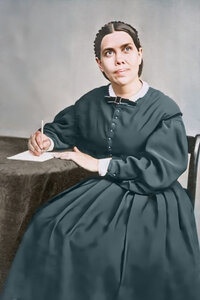
Rachel Oakes Preston was a Seventh Day Baptist widow whose insistence in 1844 that the Adventist preacher Frederick Wheeler “set that communion table back” until he kept God’s commandments was the catalyst by which the seventh-day Sabbath entered Adventist conviction. Through Wheeler the message reached T. M. Preble, whose 1845 tract reached Joseph Bates, whose 1846 tract reached James and Ellen White. Rachel never formally joined the Seventh-day Adventist Church but was credited by James White himself with providing the impulse that launched Sabbatarian Adventism. She died in 1868.
Early Life
Spalding records Rachel’s birthplace and early life: “Here was born, March 2, 1809, Rachel Harris, daughter of Sylvanus Harris. Here she married Amory Oakes, and removed with him to Verona, New York, where was born their daughter Rachel Delight Oakes, afterward to become the wife of Cyrus Farnsworth” (Footprints of the Pioneers, p. 37, par. 1; refcode FOPI 37.1).
Froom records her conversions and the path that led her toward the seventh-day Sabbath: “Mrs. RACHEL OAKES, nee Harris (1809-1868)-later married to Nathan Preston-was born in Vernon, Vermont. She was baptized at seventeen, joining the Methodist Church. In 1837 she became interested in the seventh-day Sabbath and purposed to join the Seventh Day Baptists. But on such a move she was opposed by her Methodist pastor, who finally told her she might keep her seventh-day Sabbath if she must” (The Prophetic Faith of Our Fathers, vol. 4, p. 948, par. 2; refcode PFF4 948.2).
Douglass adds the move to Washington, New Hampshire: “In 1837 Rachel Harris Oakes and her daughter joined the Seventh Day Baptist church in Vernon, Vermont. Evidently her husband, Emory, died there although there isn’t any account of it. In 1843 Rachel Oakes and her daughter, Delight, moved to Washington, New Hampshire. Delight taught school, and her mother lived with her and became the instrument in God’s hands in bringing the Sabbath light to that company of Adventists” (Advent Pioneers Biographical Sketches and Pictures, p. 18, par. 4; refcode APBP 18.4).
The Communion Table at Washington (Spring 1844)
Douglass preserves the conversation at the William Farnsworth home in spring 1844 that brought Frederick Wheeler under conviction. Wheeler had remarked at communion that everyone partaking should be ready to keep all the commandments of God. Visiting at the Farnsworth home soon after, he was met by Rachel Oakes:
“Visiting in the family later, the minister met Mrs. Rachel Oakes, mother of young Rachel Delight Oakes, the school teacher. Direct in speech as in gaze, she said to him, ‘You remember, Elder Wheeler, that you said everyone who confesses Christ should obey all the commandments of God?’
(Advent Pioneers Biographical Sketches and Pictures, p. 18, par. 8; refcode APBP 18.8)
Douglass records her continuation:
“‘I wanted to tell you that you had better set the communion table back and put the cloth over it, until you begin to keep the commandments of God,’ said Rachel Oakes.
(Advent Pioneers Biographical Sketches and Pictures, p. 19, par. 1; refcode APBP 19.1)
Wheeler accepted the seventh-day Sabbath shortly after, becoming the first Sabbatarian Adventist minister.
The Sabbath at the Christian Connexion Church (1844–1845)
Froom traces the chain by which Rachel’s witness reached the wider Millerite movement: “Methodist Rachel Oakes began the observance of the seventh-day Sabbath and joined the Seventh Day Baptists. She then brought the Sabbath to Washington, New Hampshire, center of a devout Adventist group, where it was accepted by two clergymen. The first was the Methodist-Adventist circuit rider, Frederick Wheeler, in the spring of 1844. He, in turn, brought it in August of that year to Free-will Baptist-Adventist Thomas M. Preble” (The Prophetic Faith of Our Fathers, vol. 4, p. 942, par. 1; refcode PFF4 942.1).
Froom records the moment the church at Washington divided over the Sabbath: “Finally, during a Sunday service in the Washington church, after the Disappointment-but before the close of the year 1844-William Farnsworth arose during the meeting and stated publicly that he had been studying the Bible and was convinced that the seventh day of the week was the Sabbath, and had decided to keep it. He was immediately followed by his brother Cyrus and several others.” (The Prophetic Faith of Our Fathers, vol. 4, p. 949, par. 1; refcode PFF4 949.1).
Death (1868)
Rachel and her daughter were never formally received back into the Seventh Day Baptist church at Verona after 1845, and she did not formally join the Seventh-day Adventist church either. She died in 1868, three years after a “Christmas revival” of the Washington church under James and Ellen White’s labors. James White’s January 28, 1868 Review and Herald travel report credited her with providing the initial impetus for the Sabbatarian Adventist movement.