Summary
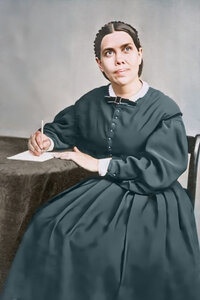
Rachel Oakes Preston was a Seventh Day Baptist who introduced the seventh-day Sabbath to Advent believers, initiating the growing Sabbatarian Adventist movement. Her bold challenge to Elder Frederick Wheeler at the small Christian Connexion church in Washington, New Hampshire, set in motion a remarkable chain of events: Wheeler became the first Sabbatarian Adventist minister, his influence led Thomas M. Preble to write in favor of the Sabbath, and Preble’s pamphlet in turn convinced Captain Joseph Bates — who then carried the Sabbath truth to the wider body of Advent believers. Through this single woman’s principled action and independent spirit, the seventh-day Sabbath became one of the foundational pillars of the Seventh-day Adventist Church.
Early Years
Rachel was born on February 22, 1809, in Vernon, Vermont, to Captain Sylvanus Harris, Jr. and Nancy Johnson Harris. Sylvanus may have named Rachel after his first wife, Rachel Peeter, who died in 1802 after only one and a half years of marriage. The third of five children, Rachel’s siblings were Sylvanus Harris (1804–1857), Charles Harris (1806–1813), Rumina Dorman (1811–1875), and Charles Sidney Harris (1814–1895). The older Charles died at the age of six, only four days after Rachel’s fourth birthday.
On October 25, 1824, Rachel, age 15, married Amory Oaks (1801–1835) from Marlow, New Hampshire. Ten months later she gave birth to her first child: Rachel Delight Oaks (1825–1858), who would later marry Cyrus K. Farnsworth (1823–1899) on June 14, 1847, at Worcester, Massachusetts. The year after her daughter was born, Rachel accepted Jesus as her Savior, was baptized, and joined the Methodists, likely in an adjoining town since Vernon never had a Methodist church.
In 1825, the Erie Canal was completed, and stories spread of “cheap virgin land… east from central New York.” Amory and Rachel followed many other families to the Utica and Rome area and settled there. On September 19, 1834, they had a second daughter, Sarah (1834–1863), who married Ashley Wiswall in 1850. Historians have generally overlooked Rachel’s second child because she was not listed in any church records, but several vital records attest to her existence.
Less than seven months after Sarah’s birth, Amory suddenly passed away on April 8, 1835. Since he had not left behind a last will, a surrogate court took up the case and made Rachel Oaks and Nathaniel Fitch the estate administrators. The 1835 New York state census shows Rachel “as a land owner with twelve acres but as having no livestock.” Merlin D. Burt notes that in Verona, New York, “Rachel was remembered as a widowed school teacher with some property” who “taught in various places, among them… Stacy Basin” (located about two miles west from the Seventh Day Baptist Church in Verona).
Sabbath Conviction
Meanwhile, Rachel became interested in the subject of the seventh-day Sabbath but experienced a lot of opposition from her Methodist minister. Seeing her conviction on the subject, he finally acquiesced to her keeping the Sabbath if she would not separate from the Methodist Church. She decided to part with the Methodists anyway and joined the Seventh Day Baptist Church at Verona on December 26, 1835. Two years later, on January 20, 1838, her daughter Delight followed her mother’s decision and joined the church as well.
The Seventh Day Baptist Church at Verona took their responsibility towards widows and orphans seriously. The appraiser Caleb Green and Samuel Marsh, another Seventh Day Baptist from Verona, had entered an agreement with Rachel Oaks after the passing of her husband. Yet by the summer of 1838, Marsh owed her $10 in rent and appeared to be unwilling to pay her the money. The church took up the case, and after extended and contentious debate, March was removed from membership. Years later the church readmitted him after he proved he had paid the $10 to the church. In 1859 (after more than 20 years), the church finally forwarded the money to her.
Meanwhile, in the fall of 1843, Seventh Day Baptists felt a religious duty to share the Sabbath truth more broadly. The General Conference of Seventh Day Baptists called for a special day of prayer and fasting for November 1, and resolved to produce publications on the Sabbath to be circulated among other denominations, urging them to study the subject closely and see its importance. The church at Verona responded positively to the call and resolved to follow suit.
Introduction of the Sabbath to Adventists
In September 1843, Rachel’s daughter Delight, at age 18, went “to Washington, New Hampshire to take charge of a rural school” there. Rachel went to visit Delight later in the Fall of 1843, around Thanksgiving time, and together they attended the Christian Connexion church. A large portion of the members of this church had embraced the Advent message and thus Christ’s second coming was likely a frequent topic of discussion. While in Washington, Rachel and Delight accepted the belief in the soon second coming of Christ.
By early 1844, Rachel had moved to Washington to be closer to her daughter Delight. Inspired by the recent activities of the Seventh Day Baptists, she brought their publications on the Sabbath along and endeavored for a while to share the Sabbath truth with the Advent believers in the Christian Connexion church. To her disappointment, though, the church members were interested more in the second coming of Jesus than in the Sabbath as the true Lord’s day.
Rachel reportedly “kept tactfully but irrepressibly after Elder [Frederick] Wheeler,” the Millerite Methodist minister who preached at the church. At a quarterly meeting in the spring of 1844, Wheeler administered the communion and remarked that all those partaking in “the communion should be ready to follow Christ, and keep all of God’s commandments.”
A couple of days later, he met Rachel Oaks at the home of the family of William Farnsworth. She reminded Wheeler of his remarks and then told him, “I came near getting up in that meeting at that point… and saying something.” She said, “I wanted to tell you that you would better set that communion table back and put the cloth over it until you begin to keep the commandments of God.” Those words “cut him deeper than anything that he had ever had spoken to him,” Wheeler later told another minister.
Returning home, Wheeler pondered the question and, soon convinced, began to observe the seventh-day Sabbath. He thus became the first Sabbatarian Adventist minister.
Through Wheeler’s efforts, another Millerite minister, the Freewill Baptist Thomas M. Preble, accepted the Sabbath in August 1844. Six months later, Preble sent to the editor of the Hope of Israel an exposition on the perpetuity of the Sabbath commandment, which was fully printed on February 28, 1845. In the following weeks, he would reprint that article in pamphlet form, which attracted the interest of various Millerites, among them Joseph Bates (1792–1872), a cofounder and early Sabbath theologian of the Seventh-day Adventist Church.
After the Great Disappointment of October 1844, Rachel presumed that the Adventist believers would rethink the matter and show more openness to the Seventh Day Baptist publications on the Sabbath doctrine, which she had shared with them. But she was again disappointed and saddened over this lack of interest. Yet, sometime in late 1844 or early January 1845, her efforts to introduce the Sabbath to those Advent believers in the Washington church eventually paid off. More than two decades later, she told Stephen N. Haskell that one Sunday during the service, a member got up and said he had been studying the Bible and was convinced that the seventh day of the week was the Sabbath instead of the first day, and that he was going to keep it. He was followed by another, and then another, until a small company took their stand to keep the seventh-day Sabbath.
The first members to profess their acceptance of the Sabbath were William Farnsworth (1807–1888) and his wife Sarah (1812–1855). A week later, William’s brother Cyrus Farnsworth (1823–1899) stated that he too had embraced the Sabbath, and soon William’s oldest son, John P. Farnsworth (1834–1919), joined the small group of Sabbath keepers. Not long after, their parents, Daniel Farnsworth (1782–1864) and Patty Farnsworth (1785–1875), followed their sons’ example. Soon a dozen or more people were keeping the Sabbath as a result of Rachel Oaks’ witness.
Request to Leave the Seventh Day Baptist Church
Less than five months after the Great Disappointment of October 1844, Rachel and her daughter Delight asked the Seventh Day Baptist Church in Verona to remove their names from the church record book. At a regular business meeting on March 20, 1845, “the requests of Sister Rachel Oakes [sic] and Delight Oakes [sic] were laid before the Church.” After discussion, “it was Resolved that the clerk write and inform them that the Church cannot consistently grant them their request while they walk by faith and in obedience to the laws of God.”
Their names remained on the membership roll, with the word “deceased” entered into the records upon receipt of information about their deaths. Thus, Rachel and her daughter never formally left the Seventh Day Baptist Church.
Changing Relationship With Seventh-day Adventism
In Washington, Rachel got to know the brickmaker or brick layer Nathan T. Preston (1814–1871) and married him sometime between 1844 and 1847. During that time, she frequently heard people, such as Stephen Smith and Worcester H. Ball, talk against James and Ellen White and, as a result, she became gradually “cold in religion and prejudiced to some extent against the Testimonies, having never seen Bro[ther] and S[iste]r White.” Some of the locals presumed it was “due to the criticism against the Testimonies” that she “became somewhat indifferent to our church” and decided to relocate with her husband and her younger daughter Sarah to Worcester, Massachusetts.
By 1860, Rachel and Nathan had nevertheless returned to the vicinity of Worcester. About 1863 they all moved back to Vernon, Vermont. Her daughter Delight had passed away five years earlier at the age of 33, and now her second daughter Sarah also passed away at the age of 29. Rachel’s own health began to fail and she became “helpless.” Her mother passed away in September 1864 and her father in November 1867. Those closest to her — her first husband, her daughters, and her parents — were one after another disappearing from her life, certainly traumatic experiences that may have left her with a feeling of loneliness.
In late 1867, however, a friend sent her Ellen White’s 80-page book Testimony for the Church, no. 13. While reading that book “her mind underwent a decided change.” On December 20–25, the Whites visited the Seventh-day Adventist Church at Washington and the meetings had an impressive spiritual effect on the believers and their children, resulting in the conversion of about 16 young people. The “Christmas revival” was significant since church members no longer gathered for worship and the church had fallen into disarray. This revival remained in the corporate memory as a wonderful awakening that “turn[ed] the hearts of the fathers to the children, and the hearts of the children to their fathers” (Mal 4:6).
Rachel heard of the revival at the church and “her heart… rejoice[d].” On January 28, 1868, the Review printed a travel report by James White, in which he mentioned Rachel Preston very favorably, crediting her with providing the initial impetus to the growing Sabbatarian Adventist movement.
Rachel was glad for the revival of her own spiritual experience and she stated that she was finally ready to die, giving expressions such as “Jesus is good” and “Jesus is my friend.” On February 2, 1868, and thus only a few days after her mention in the Review, she passed away at the age of 59. Although she was not a baptized member of the Seventh-day Adventist Church, the Review printed a sizable obituary of her, written by S. N. Haskell who had visited her shortly before and also credited her for introducing the Sabbath to the Adventists. Her husband, Nathan T. Preston, passed away three years later, on January 19, 1871. Both are buried at Tyler Cemetery in Vernon, Vermont.
Key Quotes
Rachel’s challenge to Elder Wheeler: “I came near getting up in that meeting at that point… and saying something. I wanted to tell you that you would better set that communion table back and put the cloth over it until you begin to keep the commandments of God.”
Wheeler’s response: Those words “cut him deeper than anything that he had ever had spoken to him.”
Legacy
Rachel Oakes Preston introduced the seventh-day Sabbath to Frederick Wheeler, who became the first Sabbatarian Adventist minister, and to a group of Millerites in Washington, New Hampshire, that became the first Sabbatarian Adventist congregation. Her humble efforts to share the Sabbath truth resulted in a growing movement of Sabbath-keepers around the world now known as the Seventh-day Adventists.
It is noteworthy that in 1843, the General Conference of Seventh Day Baptists set apart November 1 as a day for fasting and prayer that God would “arise and plead for His holy Sabbath.” They did not anticipate the manner nor magnitude of the answer God had been preparing. Rachel Oakes, who moved to Washington, New Hampshire, that same year, was to be one of God’s instruments for answering this prayer.
The impact of Rachel’s bold words to Elder Wheeler, her persistent witness in favor of the seventh-day Sabbath in Washington, New Hampshire, and the precise timing of the introduction of Sabbath-keeping in relation to the Great Disappointment, all worked together to lead the pioneers of the Seventh-day Adventist Church into the understanding that the seventh-day Sabbath is a distinctive feature of the third angel’s message.