1820–1912
Summary
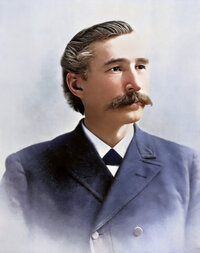
Owen R. L. Crosier (later Crozier) was a Millerite preacher and writer of Canandaigua, New York, whose 1846 article “The Law of Moses” — published as the Day-Star Extra of February 7, 1846 — became the foundational exposition of the doctrine of the heavenly sanctuary that distinguished Sabbatarian Adventism from the broader post-Disappointment Millerite movement. The article, written out of an extended Bible study with Hiram Edson and Dr. F. B. Hahn at the Edson home in western New York during the winter of 1844–1845, was endorsed by Ellen White in her April 21, 1847 letter to Eli Curtis (published as part of A Word to the Little Flock, p. 12). For a season Crosier also kept the seventh-day Sabbath, but by 1847 he had repudiated both the Sabbath and the heavenly-sanctuary view, and from 1847 through 1853 he served on the staff of Joseph Marsh’s Advent Harbinger in Rochester. He died in 1912.
Early Life and Conversion (1820–1843)
Steinweg, in Lest We Forget, records the basic outline of Crosier’s early life: “Owen R. L. Crosier was born in Canandaigua, New York, in 1820.” (Lest We Forget, ch. 97, p. 183, ¶ 5). She continues, in the same paragraph: “At sixteen he was converted at a Methodist revival. Sometime during his youth, Dr. Franklin B. Hahn and Hiram Edson befriended the orphan. They provided him a home and encouraged him in his studies” (Lest We Forget, ch. 97, p. 183, ¶ 5).
Steinweg records his education and his acceptance of the Millerite doctrine: “After attending Genesee Academy and Wesleyan Seminary at Lima, Crosier taught in Gorham, Rochester, East Avon, and Lima, New York. In the Fall of 1843, he accepted the Millerite doctrine of the imminent return of Christ to cleanse the earth and was baptized by E. R. Pinney.” (Lest We Forget, ch. 97, p. 183, ¶ 6).
The Day After the Disappointment (October 23, 1844)
Steinweg records the morning of October 23, 1844, when Hiram Edson and Crosier rode out from Port Gibson to comfort their disappointed brethren. The two men had just been studying together when, walking through a cornfield, Edson received the impression that the sanctuary to be cleansed was not the earth but the temple in heaven.
Loughborough, who knew Edson personally, gives the substance of that morning: “Hiram Edson, of Port Gibson, N.Y., told me that the day after the passing of the time in 1844, as he was praying behind the shocks of corn in a field, the Spirit of God came upon him in such a powerful manner that he was almost smitten to the earth” (The Great Second Advent Movement, p. 193, par. 1; refcode GSAM 193.1). The same paragraph continues: “He communicated this thought to O. R. L. Crosier, and they together carefully investigated the subject. In the early part of 1846 an elaborate exposition of the sanctuary question from a Bible standpoint, written by Mr. Crosier, was printed in the Day Star, a paper then published in Canandaigua, N.Y.” (The Great Second Advent Movement, p. 193, par. 1; refcode GSAM 193.1).
The Bible Study at the Edson Home (Winter 1844–1845)
The investigation that followed the October 23 ride was a sustained collaborative Bible study at the Edson home in Port Gibson. Steinweg records its outcome: “O. R. L. Crosier was twenty-four when he rode with Edson to take the news on the cleansing of the Sanctuary.” (Lest We Forget, ch. 97, p. 184, ¶ 9). Steinweg, citing Froom, characterizes Crosier in the same paragraph as “a keen Bible student and promising writer” (Lest We Forget, ch. 97, p. 184, ¶ 9).
Arthur White’s compilation Christ in His Sanctuary describes the study and Crosier’s role in writing up its conclusions: “There followed a careful investigation of the scriptures that touched on this subject—particularly those in Hebrews—by Hiram Edson and two close associates, Dr. F. B. Hahn, a physician, and O. R. L. Crosier, a teacher. The result of this joint study was written up by Crosier and was published, first in The Day Dawn, a paper of limited circulation, and then in rewritten and enlarged form in a special issue of the Day-Star, on February 7, 1846. This was a more widely read Adventist journal, published at Cincinnati, Ohio. Through this medium it reached a number of the disappointed Advent believers. The rather lengthy presentation, well supported by Scripture, brought hope and courage to their hearts as it clearly showed that the sanctuary to be cleansed at the end of the 2300 days is in heaven, and not on earth, as they had believed earlier” (Christ in His Sanctuary, p. 8, par. 1; refcode CIHS 8.1).
The Ellen G. White Estate’s Letters and Manuscripts explanatory note records the substantive theological core of Crosier’s article: “O.R.L. Crosier, Emily Clemons, and others began to argue for an extended final atonement period in a heavenly sanctuary, while Samuel Snow aggressively argued for a single-day atonement” (The Ellen G. White Letters and Manuscripts: Volume 1, p. 44, par. 2; refcode 1EGWLM 44.2).
The Day-Star Extra of February 7, 1846 (“The Law of Moses”)
Crosier’s article — usually known as “The Law of Moses” — was published as a special edition of Enoch Jacobs’s Day-Star on February 7, 1846. Crosier’s published opening to the body of the article was a reminder of the law’s enduring importance, citing Malachi 4:4: “Remember ye the Law of Moses, my servant, which I commanded unto him in Horeb for all Israel, with the statutes and judgments.” (The Law of Moses, p. 37, par. 2; refcode LOM, page 37.2).
Crosier’s reasoning about the Mosaic types is summarized in his own words: “That some of the legal types have met their antitypes is beyond controversy. By learning the manner of their fulfillment, and the principle as to time on which they are fulfilled; we can the more understandingly proceed to the investigation of the other types. There are two classes of yearly types — the Vernal and the Autumnal; Leviticus 23. The former met their antitypes at the first Advent, but the latter are to be fulfilled in connection with and after the second Advent.” (The Law of Moses, p. 37, par. 12; refcode LOM, page 37.12).
He spelled out the consequence in the same paragraph series: “From analogy we must conclude that the autumnal antitypes will occupy a period of time relative to that occupied by their types in somewhat the proportion of the vernal antitypes. In other words, the period of their fulfillment must constitute a dispensation of many years.” (The Law of Moses, p. 37, par. 20; refcode LOM, page 37.20).
Ellen White’s Endorsement (April 21, 1847)
In her April 21, 1847 letter to Eli Curtis — published in James White’s broadside A Word to the “Little Flock” (May 30, 1847) — Ellen White endorsed Crosier’s article. Her words are preserved verbatim in A Word to the Little Flock: “I believe the Sanctuary, to be cleansed at the end of the 2300 days, is the New Jerusalem Temple, of which Christ is a minister. The Lord shew me in vision, more than one year ago, that Brother Crosier had the true light, on the cleansing of the Sanctuary, &c; and that it was his will, that Brother C. should write out the view which he gave us in the Day-Star, Extra, February 7, 1846. I feel fully authorized by the Lord, to recommend that Extra, to every saint.” (A Word to the Little Flock, p. 12, par. 8; refcode WLF 12.8).
The same endorsement is preserved in Ellen White’s manuscripts at WLF 12.8: “I believe the Sanctuary, to be cleansed at the end of the 2300 days, is the New Jerusalem Temple, of which Christ is a minister. The Lord shew me in vision, more than one year ago, that Brother Crosier had the true light, on the cleansing of the Sanctuary, &c; and that it was his will, that Brother C. should write out the view which he gave us in the Day-Star, Extra, February 7, 1846. I feel fully authorized by the Lord, to recommend that Extra, to every saint.” (Word to the Little Flock, p. 12, par. 8; refcode WLF 12.8).
Arthur White records the historical consequence of the endorsement: “The pioneers of the movement saw the sanctuary truth as basic to the whole structure of Seventh-day Adventist doctrine. James White, in 1850, republished the essential portions of the first presentation of the subject by O. R. L. Crosier, and commented” (Christ in His Sanctuary, p. 12, par. 3; refcode CIHS 12.3).
Separation from the Sabbatarians (1847)
Steinweg records that Crosier, after a period of Sabbath observance, separated from the Sabbatarian Adventists in 1847. The same paragraph notes that Joseph Bates had visited Port Gibson in 1845 for a conference on the sanctuary question and had shared his Sabbath conviction with the Edson-Crosier-Hahn group: “Crosier even advocated Sabbath keeping in the December, 1846 issue of the Day-Dawn. But by 1847, he had repudiated the Sabbath and the early view on the Sanctuary and separated from the group that would eventually become the Seventh-day Adventist Church” (Lest We Forget, ch. 97, p. 184, ¶ 12).
Steinweg records Crosier’s subsequent course: “From 1847 through 1853, Crosier was on the staff of Joseph Marsh’s Advent Harbinger and Advocate, Rochester, New York” (Lest We Forget, ch. 97, p. 184, ¶ 13). Steinweg adds, in the same paragraph: “He also wrote several very serious articles including his fiercest attacks against the seventh-day Sabbath which sought to establish the position that the law of the ten commandments was abolished at the cross of Christ” (Lest We Forget, ch. 97, p. 184, ¶ 13).
Later Life and Death (1858–1912)
Steinweg records Crosier’s later ministry under the Advent Christian banner and his late-life witness in Grand Rapids, Michigan: “In 1858, Crosier served as evangelist for the Michigan conference of the Advent Christian church and continued preaching that Christ would soon come. He was practically unheard of by Seventh-day Adventists until 1904, when he attended a meeting in Grand Rapids, Michigan.” (Lest We Forget, ch. 97, p. 185, ¶ 14).
Steinweg records the closing assessment from Seventh-day Adventists. Although Crosier “did not follow on into other truths that came to light in early days” — the source-preserved ellipsis precludes the longer attribution — Steinweg’s own concluding sentence records the assessment plainly: “Seventh-day Adventists remember and recognize the part he played in establishing the doctrine of the Sanctuary. What he wrote on Christ, the High Priest, and the Sanctuary helped explain the time error in Miller’s interpretation of the 2300 day prophecy, and laid the foundation for this distinctive doctrine of the Seventh-day Adventist Church” (Lest We Forget, ch. 97, p. 185, ¶ 15).
Crosier spent his last decades quietly in the Advent Christian community of western New York and southern Michigan. He died in 1912 at the age of ninety-two.