1827–1893
Summary
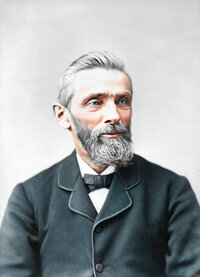
Merritt Eaton Cornell was a tent evangelist, debater, and author of five doctrinal books whose forty-year ministry from 1852 onward took the third angel’s message from Maine to California. Converted to the seventh-day Sabbath under Joseph Bates’s preaching at the Palmer home in Jackson, Michigan, in the summer of 1852, Cornell — together with J. N. Loughborough — pitched the first tent meetings ever sponsored by Sabbatarian Adventists at Battle Creek in July 1854. He was a hard-hitting evangelist sometimes nicknamed the “Stormy Petrel,” and his debates with Age-to-Come, spiritualist, and First-day adventist opponents drew large audiences across the Midwest and New England. He died in 1893.
Early Life and Conversion (1827–1852)
Froom records the basic outline of Cornell’s life: “MERRITT E. CORNELL (1827-1893) was born in New York State, moving to Michigan with his parents in 1837. He became a Bates’s convert to the Sabbatarian faith in 1852. At first opposed to the seventh-day-sabbath teaching, he became an earnest advocate and soon raised up a company of Sabbatarian believers.” (The Prophetic Faith of Our Fathers, vol. 4, p. 1103, par. 1; refcode PFF4 1103.1).
The Ellen G. White Estate biographical sketch in Letters and Manuscripts fills in the dates and the path of his early Adventism: “An ardent evangelist and debater, Merritt E. Cornell, originally from Chili, New York, preached widely in many states of the Union from 1852 to the 1870s. He married Angeline Lyon, daughter of Henry and Deborah Lyon, in 1849. After an earlier affiliation with an Adventist group headed by Joseph Marsh, the Cornells became Sabbatarians in 1852 following contacts with Joseph Bates. Cornell’s evangelism in the 1850s was in the mid-West, expanding in the 1860s to include New England. In the early 1870s he preached for three years in California and, for a short time (1878-1879), in Colorado” (The Ellen G. White Letters and Manuscripts: Volume 1, p. 812, par. 1; refcode 1EGWLM 812.1).
Loughborough records the moment of Cornell’s conversion at the Palmer home in Jackson, Michigan: “We will call attention to his labors in Jackson, Michigan, in 1851, when he made his visit to that state. After about one week’s labor with the Adventists in Jackson, all that company save one embraced the Sabbath truth and the third angel’s message.” (The Great Second Advent Movement, p. 547, par. 2; refcode GSAM 547.2). Loughborough adds, in the same paragraph, that Cornell — “being then a First-day Adventist preacher” who with his wife had been converted three years earlier — “called at Brother Palmer’s and was introduced to Brother Bates, who gave them thorough instructions on the third angel’s message. They accepted the truth, and were Seventh-day Adventists until their death” (The Great Second Advent Movement, p. 547, par. 2; refcode GSAM 547.2).
The First Sabbatarian Tent Meetings (1853–1854)
In January 1853 Cornell joined James White in ordaining the young J. N. Loughborough at Grand Rapids. Soon thereafter he and Loughborough were sent on a three-month preaching tour of Illinois, Wisconsin, and northern Indiana. Loughborough preserves a first-person record of that tour: “As an illustration of eastern prejudice against the Seventh-day Adventists in those early times, I will refer to some experience of Elder Cornell and myself in the year 1853. At the meeting held by Brother and Sister White in Jackson, it was decided that Brother Cornell and myself should travel for three months with horse and carriage in Illinois, Wisconsin, and northern Indiana, visiting Seventh-day Adventists.” (The Great Second Advent Movement, p. 549, par. 2; refcode GSAM 549.2).
In July 1854 — out of the planning that began at Locke, Michigan — Cornell and Loughborough pitched the first tent meeting ever sponsored by Sabbatarian Adventists, on the corner of Tompkins and Van Buren streets in Battle Creek. Loughborough records the planning of those tent meetings in May 1854: “1854 May: large interest in Locke, MI, leads the Whites, M. E. Cornell, and JNL to plan tent meetings” (The Great Second Advent Movement, p. 568, par. 3; refcode GSAM 568.3).
Steinweg, in Lest We Forget, preserves a vivid first-hand vignette from Cornell’s evangelistic ride during this period — when, as he passed J. P. Kellogg’s hayfield by Jackson, Michigan, he handed his wife the reins, leapt from the wagon, and ran across the field to share the new Sabbath truth he had just learned. Steinweg quotes Cornell’s exclamation as he greeted Kellogg: “Angie, hold the horse!” (Lest We Forget, ch. 131, p. 251, ¶ 3).
Steinweg records the substance of his report to Kellogg, citing Cornell’s letter in the Review and Herald of September 16, 1852: “He and Angie meant to keep Saturday, the true Bible Sabbath, from then on” (Lest We Forget, ch. 131, p. 251, ¶ 4).
Steinweg gives the impetuous character that became his hallmark: “There was no hesitancy on the part of this modern Peter. Impetuous, daring—a perceptive, effective evangelist—Merritt E. Cornell had just begun over four decades of Sabbatarian advent evangelism” (Lest We Forget, ch. 131, p. 251, ¶ 6).
Steinweg also records, in the same chapter, that Joseph Bates announced in the Review and Herald of June 17, 1852, a conference at Jackson, Michigan, beginning June 25 — and that “J. O. Corliss narrated Cornell’s experience at that meeting” (Lest We Forget, ch. 131, p. 251, ¶ 10).
The Hard-Hitting Evangelist (1854–1880)
Froom captures the character of Cornell’s ministry: “Bold, enthusiastic, and dynamic, he was a hard-hitting evangelist and an ardent debater” (The Prophetic Faith of Our Fathers, vol. 4, p. 1103, par. 1; refcode PFF4 1103.1). The same paragraph continues: “He fitted into the tempo of the times, preached all the way from Maine to California, conducting the first full-fledged tent meeting held by the Sabbatarian Adventists, in 1854.” (The Prophetic Faith of Our Fathers, vol. 4, p. 1103, par. 1; refcode PFF4 1103.1).
Steinweg records his date of birth and marriage: “Cornell was born January 29, 1827, in Chili, New York; moved to Livingstone County, Michigan, when he was nearly 10 years old; and early believed the advent message. He was 17 in October of 1844. About five years later, he married Angeline M. Lyon, June 23, 1849. They dedicated their lives to preaching the advent” (Lest We Forget, ch. 131, p. 251, ¶ 8).
Death (1893)
Per the Encyclopedia of Seventh-day Adventists (Brian E. Strayer), Cornell died in 1893 — only one year after Cottrell’s death and a few months before his Review and Herald obituary appeared on January 23, 1894. He and his wife Angeline (1828–1901) had pioneered the tent-evangelism methodology that would shape Adventist evangelism for the next two generations.