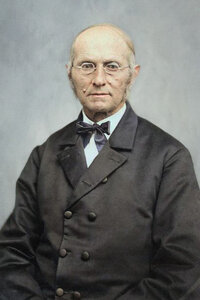
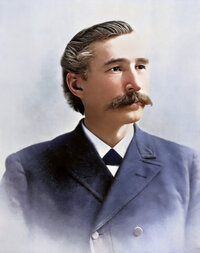
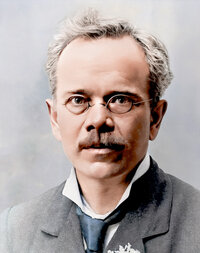
Merritt Eaton Cornell was a tent evangelist, leading debater, and author of five doctrinal books whose impetuous, daring spirit and perceptive preaching led many to embrace the third angel’s message across more than four decades of ministry. Widely recognized as one of the most fruitful soul winners in early Adventism, he purchased the first tent ever used in Sabbatarian Adventist evangelism and pioneered the advent message in California. Uriah Smith asserted that Cornell “has defended the views of Seventh-day Adventists more extensively, probably, in public debate, than any man among us.”
Early Life
Merritt Eaton Cornell was born on January 29, 1827, in Chili, New York. He had at least one younger brother, Myron J. Cornell (1829-1920). In 1837, when Merritt was ten, the family moved to Michigan.
During the 1840s, the Cornells accepted William Miller’s prediction that the Second Coming of Jesus would occur in 1843 or 1844. Merritt was seventeen years old in October 1844 when the Great Disappointment occurred. After the Disappointment, Merritt joined the Age-to-Come Adventists, who taught that the Jews would return to Israel and that individuals would have a second chance to be saved during the millennium. For the next eight years, from 1844 to 1852, Cornell became a self-supporting itinerant Age-to-Come preacher, earning his living as a builder and contractor.
In 1849, Cornell married Angeline M. A. Lyon (1828-1901), the daughter of Henry M. Lyon (1796-1872) and Deborah Lyon (1796-1874), early Adventist believers from Plymouth, Michigan. Angeline was also the sister of Cornelia A. Lyon, whom Merritt’s brother Myron would later marry, strengthening the family bonds between the two families.
Conversion to Sabbatarian Adventism
Cornell’s acceptance of the Sabbath truth came in dramatic fashion. In August 1852, Joseph Bates announced in the Review and Herald a conference of the brethren in Jackson, Michigan. The Cornells were passing through Jackson by horse and carriage on their way to an appointment as pastor of a small church when they stopped at the Daniel and Abigail Palmer home. The young man was told that a preacher inside was trying to prove that the seventh day of the week should be observed as the Sabbath. Satisfied that he could quickly show the falsity of such a view, he decided to go in and listen for a few moments while his wife remained sitting in the carriage.
“He did not return as quickly as he thought to do; for he was at once carried away with the clearness of the argument presented.” When he rejoined his wife, he could not withhold from her his strong conviction of the truth.
“‘Merritt,’ she questioned with concern, ‘what could we do if we were to observe the seventh day! You… would be obliged to resign the pastorate to which you are called.'”
His reply was quick and characteristic: “‘Angie, if this is the truth, the Lord will open some way for us….'”
From that meeting, Cornell went directly to share the news with others, including J. P. Kellogg and Angeline’s father, Henry Lyon. He told Kellogg “that the Sabbath has been… and always will be binding…. Praise the Lord, ‘whereas I was blind, now I see.'” That same year, Merritt convinced his in-laws and the farmer and broom shop owner Joseph P. Kellogg of Tyrone, Michigan, to join the Sabbatarian Adventist group in Jackson.
Early Ministry and Impact
Two weeks after accepting the Sabbath message, Cornell was in Tyrone, Michigan, preaching the Sabbath truth, with the result that “four have commenced to keep the seventh-day Sabbath. Others are investigating.” He humbly declared, “I am struck with astonishment that men of good judgment should in so short a time embrace, and stand out firm on the message when so imperfectly presented.”
In Grand Rapids, Michigan, in January 1853, Cornell and James White ordained the young J. N. Loughborough, who had also become a Sabbath-keeping Adventist the year before. James and Ellen White then persuaded both men to go on a preaching tour of Indiana, Illinois, and Wisconsin in the summer of 1853. During this tour, they converted J. H. Waggoner of Wisconsin and combated opposing views, especially the Age-to-Come teachings that Cornell had previously espoused.
The First Tent for Evangelism
In July 1854, following a meeting at Locke, Michigan, where attendance was so high that only half the congregation fit in the schoolroom, Elder White suggested it might be wise to purchase a tent by the next year. Cornell enthusiastically urged, “Why not have one at once?” Money was raised at Sylvan and Jackson, and Cornell volunteered to make the trip to purchase the tent.
He purchased a ten-ounce circular tent, sixty feet in diameter, from E. C. Williams in Rochester for $160. Williams also gave them “a nice bunting flag 15 ft. in length with the motto on it ‘What is Truth?'” Cornell and J. N. Loughborough held the first Sabbatarian Adventist tent meetings on the corner of Tompkins and Van Buren streets in Battle Creek, Michigan, in July 1854, and they also pioneered the selling of thirty-five-cent packets of tracts. Following these meetings, at Loughborough’s request, Cornell rebaptized him in the Kalamazoo River, as Loughborough’s infant Methodist baptism he considered invalid. The tent method of evangelism that Cornell pioneered became a hallmark of Seventh-day Adventist outreach.
Establishing Battle Creek as Headquarters
Kellogg and Lyon, first fruits of Cornell’s enthusiastic sharing of the Sabbath truth, together with two other believers, Cyrenius Smith and Dan Palmer, were “the agents for bringing Seventh-day Adventist headquarters to Battle Creek.” They financed the purchase of the original lot and building of the first publishing house in Battle Creek, Michigan. Thus Cornell’s spontaneous witness at the Jackson conference set in motion a chain of events that established the denominational center.
Organizer, Evangelist, and Debater
During the late 1850s and 1860s, Merritt and Angeline Cornell held tent meetings throughout the Midwest and with Moses Hull in Iowa. A dramatic speaker and convincing debater, Merritt soon gained a reputation not only as one of the most fruitful soul winners, but also as one of the hardest-hitting evangelists in Adventist ranks. In September 1856, for example, Bates and Cornell held tent meetings in Hillsdale, Michigan, where no Sabbath-keepers lived, and baptized fifty converts.
In the years leading up to the formation of the General Conference, Cornell was a strong proponent of church organization and ably defended James White’s position against “disorganizers” in the Review. In May 1862, he organized the believers of Bucks Bridge, New York — who worshiped in the red chapel that John Byington had built in 1855 — into the first Seventh-day Adventist church in St. Lawrence County. In May 1863, Cornell was chosen as one of the delegates representing the Michigan Conference at the formation of the General Conference.
His five published works covered a significant range of topics. The Last Work of the True Church (1855) was one of the final publications printed on the press in Rochester before it moved to Battle Creek. Facts for the Times: Extracts from the Writings of Eminent Authors, Ancient and Modern (1858) was a 137-page self-published compilation. Miraculous Powers: Scripture Testimony on the Perpetuity of Spiritual Gifts (1862) defended the Adventist position on the prophetic gift. Spiritualism a Satanic Delusion (1872) warned against spiritualist dangers. He also wrote The State of the Churches for the Seventh-day Adventist Publishing Association.
View of Ellen White and Spiritual Gifts
In 1855, Cornell, Joseph Bates, and J. H. Waggoner addressed delegates at a Battle Creek conference on the subject of spiritual gifts in the church. Fearing that the gift of prophecy had been neglected within the Adventist movement, they expressed concern that “we have grieved the Spirit” by so doing. Once accepted, however, spiritual gifts brought “meekness and humility and holy living” as well as “deep heart-searching before God, and a confession of our wrongs.” Cornell acknowledged that Ellen White’s messages came from God and agreed with the Bible. Consequently, he declared, “we must acknowledge ourselves under obligation to abide by their teaching, and be corrected by their admonitions.”
Civil War Era
In May and June 1863, when Cornell and R. J. Lawrence were holding tent meetings in Otsego, Michigan, they were eyewitnesses to Ellen White in vision at the nearby home of Aaron Hilliard when the importance of health reform was made clear to her. Later that year, Cornell officiated at the funeral of James and Ellen White’s son Henry in the Baptist Church across the street from the Howland home in Topsham, Maine. Facing “war excitement” during the Civil War, Cornell occasionally suspended his evangelistic meetings and, like his colleague J. N. Loughborough, allowed his tent to be used by the U.S. Army as a recruitment station.
Pioneering in California
In 1871, Cornell accepted Loughborough’s invitation to join him in California when Daniel T. Bourdeau left to work among the French-speaking population in New England and Canada. During 1871 and 1872, Loughborough and Cornell held evangelistic meetings in San Francisco, in Yolo County, and in the Napa Valley area. Cornell delivered dozens of discourses, sold over $125 worth of literature, debated the infamous Miles Grant on the Sabbath-Sunday issue, and helped to reconvert Merritt G. Kellogg’s wife. Soon his evangelistic accomplishments were receiving more newspaper coverage than those of Loughborough. Results across California were typical and gratifying:
- San Francisco: Seventy new members were added.
- Woodland: “The tent has been crowded to overflowing each evening, and the deepest interest is manifested.”
- St. Helena: “Elder Cornell is nightly drawing large, attentive, orderly, and appreciative audiences” — The Napa Register.
- Oakland: Twenty-three were buried in baptism.
- San Jose: Thirty-five persons accepted the advent faith.
- Santa Clara: A church of twenty-five was organized.
In 1874, Cornell joined Dudley M. Canright for tent meetings in Oakland where they battled spiritualism and “Demon Rum.” During the day, the two men permitted anti-alcohol advocates to use their tent for temperance meetings; then in the evening, Cornell and Canright preached Adventist doctrines.
His Wife Angeline — Pioneer Bible Instructor
Angeline M. A. Lyon Cornell is considered the pioneer of and pattern for today’s Bible instructors and pastors’ assistants. She was “a fit companion to her husband, a slender young woman of energy, initiative, and decided opinions which happily agreed with her husband’s, and with a gift of speech which shows in her letters to the Review and Herald.” Her work was to be “much with her husband in his labors, often remaining to visit and teach the interested ones after his meetings had closed and he had gone to the next place.” Their evangelistic partnership was a model for future ministry teams.
Trials and Restoration
Despite his many talents and successful ministry, Cornell’s career was marked by moral lapses that temporarily damaged his standing in the church. Ellen White sent Merritt letters expressing concern about his extravagant use of money and his jealousy of other ministers, and she admonished Angeline to bear more of life’s burdens as a minister’s wife.
In 1871, Cornell became involved in an inappropriate relationship in California. On January 28, 1872, Loughborough scheduled a church trial. The night before the hearing, however, Cornell received a letter from Ellen White based on a vision she had received on December 10, 1871, warning him that his soul was in danger. At a five-hour public gathering in the San Francisco Central Seventh-day Adventist Church, Cornell confessed his indiscretions, apologized for the hurt he had brought to the cause, and asked for forgiveness. He then declared in the Review: “My soul thirsts after God, and yields every idol…. A genuine conversion and new experience, I must have…. I know that nothing short of an entire consecration to the work will fit me to take part in this holy work…. The truth looks brighter, and I love it more and more.”
In 1875, Cornell left California and labored in the Dallas, Texas, area. In 1878, he conducted meetings in Boulder and Georgetown, Colorado, a rough mining settlement at 9,000 feet elevation, where he continued to preach until snow fell. He and Angeline then moved to Maryland. For the next eleven years, from 1878 to 1889, he was not paid by the denomination but continued doing “freelance preaching,” responding to invitations to speak.
Ellen White wrote on September 6, 1886, that Merritt Cornell was “a deeply repenting man, humbled in the dust.” In 1889, Merritt and Angeline returned to Battle Creek, Michigan, and he was reconciled with church leaders. During the next three years, he returned to active ministry, visiting local churches and preaching when invited.
Legacy
Merritt E. Cornell made contributions to the Seventh-day Adventist Church in three major areas. First, during four decades he was an extremely effective tent evangelist, working with several preaching partners across the United States, baptizing hundreds of converts and selling thousands of dollars of Adventist literature. Second, within the Church he was widely recognized as one of the best debaters of Adventist doctrines with non-Adventist ministers and other opponents. Finally, in his five doctrinal books, he ably defended the Adventist position on Bible prophecy, church organization, spiritual gifts, and the dangers of spiritualism.
Cornell retired in 1892 to care for his wife, who was partially paralyzed. He died on November 2, 1893, at the age of sixty-seven, of an internal hemorrhage. Uriah Smith presided at his funeral, held two days later in the Dime Tabernacle. Angeline survived him, passing away on January 7, 1902.
Like Peter of old, Cornell deeply repented, humbled himself, and was reconciled to his brethren. His life demonstrates both the power of God working through imperfect instruments and the importance of heeding divine counsel. His pioneering purchase of the first evangelistic tent launched a method of outreach that became a hallmark of Seventh-day Adventist evangelism, and his enthusiastic witness set in motion the chain of events that established the denominational headquarters in Battle Creek.