Summary
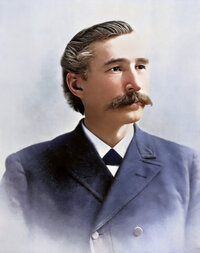
Milian Lauritz Andreasen was a prominent Seventh-day Adventist theologian, seminary professor, college president, pastor, conference president, and prolific author. Born in Copenhagen, Denmark, he immigrated to the United States and became one of the most influential theological voices in the denomination during the 1930s and 1940s. He authored at least thirteen books, including the widely read The Sanctuary Service (1937, 1947) and The Book of Hebrews (1948), and served in an extraordinary range of positions — from conference president to college dean to seminary professor. He is perhaps best known for developing what became known as “Last Generation Theology” and for his vigorous opposition to the landmark publication Seventh-day Adventists Answer Questions on Doctrine (1957), a controversy that shaped the theological landscape of Adventism for decades and continues to reverberate within the church today.
Early Life in Denmark
Milian Lauritz Andreasen was born on June 4, 1876, in Copenhagen, Denmark. His parents, Laurence Andreasen and Carolina Thorgens, were both tailors. The family lived at Sortedamsgade 13, a beautiful block of apartments on “The Lakes” — three artificial lakes that then separated “the old city” from the Andreasen neighborhood. Looking out his front door, young Milian would have been able to see the University of Copenhagen across the lake.
In his private writings, Andreasen reflected on his earliest days with characteristic candor: “To the great disgust of my mother, and indeed of the whole family, I arrived in this world.” It was a wry observation from a man who would spend his life arriving in places where he was not always welcome — and making an impact that could not be ignored.
The circumstances of Andreasen’s childhood in Denmark and the details of his immigration to the United States are not fully documented in surviving records. What is known is that he made his way to America and was drawn to the Seventh-day Adventist faith, attending Battle Creek College following his conversion. He earned both bachelor’s and master’s degrees from the universities of Chicago and Nebraska, along with teacher’s certificates, equipping himself with the academic credentials that would underpin his long career in denominational education and theology.
Marriage and Family
In 1896, Andreasen married Annie Nelson, who became his faithful companion for fifty-two years. Together they had two daughters: Vesta Andreasen and Eunice Philips. Annie’s death in 1948 was a deep personal loss after more than half a century of partnership. Two years later, in 1950, Andreasen married Gladys Grounds, who remained with him until his death.
Entry into Ministry
Andreasen entered organized church work in 1900 and was ordained to the ministry in 1902. His career trajectory was remarkable for its breadth: few individuals in Adventist history have served in as many distinct leadership roles as Andreasen occupied during his six decades of denominational service.
Conference and Institutional Leadership
Andreasen’s administrative career demonstrated both his versatility and the denomination’s confidence in his abilities:
Greater New York Conference (1909-1910). Andreasen served as president of this urban conference, navigating the challenges of ministry in America’s largest city.
Danish-Norwegian Seminary, Hutchinson, Minnesota (1910-1918). As the first president of this institution, Andreasen guided it during its formative years, serving the denomination’s significant Scandinavian constituency. A notable characteristic of his leadership was his refusal to ask others to do work he would not undertake himself. While president, he personally painted the eaves of the four-story seminary building — despite being “a short man” — using only toeholds above the windows. It was a small act that spoke volumes about his character.
Atlantic Union College, South Lancaster, Massachusetts (1918-1922). Andreasen served as dean, bringing his theological depth and administrative experience to one of the denomination’s oldest institutions.
Washington Missionary College, Takoma Park, D.C. (1922-1924). As dean, Andreasen was now working at the doorstep of denominational headquarters, positioning him at the center of Adventist institutional life.
Minnesota Conference (1924-1931). Returning to pastoral and administrative leadership, Andreasen served as conference president for seven years, overseeing the church’s work across the state.
Union College, Lincoln, Nebraska (1931-1938). As president, Andreasen encouraged faculty members to seek graduate education, raising the academic standards of the institution. His tenure was marked by a commitment to scholarly excellence and the integration of faith with learning.
The Theological Seminary (1937-1950)
Andreasen’s appointment to the faculty of the Seventh-day Adventist Theological Seminary in Takoma Park, Washington, D.C. (now located at Andrews University), marked the culmination of his academic career. He taught at the seminary from 1937 to 1950, eventually serving as one of its most prominent deans. During this period, he exercised his greatest theological influence, shaping the minds of a generation of Adventist pastors and teachers.
Simultaneously, from 1941 to 1950, he served as a field secretary of the General Conference, combining his seminary role with broader denominational responsibilities.
Theological Contributions
Andreasen was a theologian of depth and conviction. His special area of interest was the doctrine of the sanctuary — the distinctively Adventist teaching centered on Christ’s ministry in the heavenly sanctuary — and he was considered one of the foremost authorities in that field. He articulated his theological perspectives in considerable detail in his widely read books, particularly The Sanctuary Service (first published in 1937, revised in 1947) and The Book of Hebrews (1948). Among his other significant works were A Faith to Live By, Prayer, What Can a Man Believe?, and Saints and Sinners. In total, he authored countless articles for various church papers and at least thirteen books.
#### Last Generation Theology Andreasen’s most distinctive and controversial theological contribution was what became known as “Last Generation Theology.” He combined an emphasis on character perfection with developments in Adventist theological thought and produced a comprehensive theological system with several key components:
In Andreasen’s view, the last generation of believers, living under the great stress of the time of trouble just before the return of Christ, would give a demonstration of faithful, perfect law-keeping. He interpreted Ellen White’s statement about Christ “waiting with longing desire” to see His character “perfectly reproduced in His people” before returning as supporting this scheme.
Andreasen grounded this teaching in his conviction that Christ took upon Himself a sinful nature like that of fallen humanity, and that therefore Christian believers could likewise be victorious over sin and live a perfect, sinless life. In the last days, they would need to achieve this level of sinless living because there would come a time when they would have to live “without a mediator” after Christ had finished His mediatorial work in the heavenly sanctuary.
By their sinless living, Andreasen taught, these faithful saints would prove that God’s law could be kept. God would thus be vindicated, and “in the remnant Satan will meet his defeat.” Only after an entire generation of end-time believers clearly demonstrated this level of faithful living would Christ return.
This theological system was comprehensive, internally coherent, and deeply influential. It gave Adventist believers a framework for understanding their role in cosmic history and provided a powerful motivation for holy living. It also raised profound questions about the nature of salvation, the humanity of Christ, and the relationship between human effort and divine grace — questions that the denomination would grapple with for decades.
The Questions on Doctrine Controversy
The most dramatic chapter of Andreasen’s career came in his retirement years. In the mid-1950s, a series of conversations between Adventist leaders (principally LeRoy Froom and Roy Allan Anderson) and evangelical scholars (Walter Martin and Donald Grey Barnhouse) led to the publication of Seventh-day Adventists Answer Questions on Doctrine (QOD) in 1957.
The book was intended to present Adventist beliefs in language that evangelicals could understand and to demonstrate that Adventism was a legitimate Christian denomination rather than a cult. Historian George Knight later observed that QOD “is almost entirely made up of clear restatements of traditional Adventist theology that are phrased in such a way that the book remained faithful to Adventist beliefs while at the same time speaking in a language that those outside of Adventism could understand more easily.”
But Andreasen saw it very differently. He viewed the publication as a sellout to evangelicals and a gross denial of what was distinctive about Adventism. He called it “the most subtle and dangerous error” and “a most dangerous heresy.”
Two aspects of QOD particularly troubled Andreasen. First, when LeRoy Froom, in introducing some of the book’s themes to Ministry magazine readers, described Christ’s act of atonement at the cross as a “complete, perfect and final” sacrifice, Andreasen charged that Froom had undercut what Adventists had traditionally taught about Christ’s work of atonement beginning in 1844 in the heavenly sanctuary.
Second, and more crucially, the book’s move away from speaking of Christ as having a sinful nature — adopting instead a prelapsarian (pre-fall) view of Christ’s humanity — directly undermined Andreasen’s theological system of end-time sinless perfectionism. If Christ did not take fallen human nature, the foundation of Last Generation Theology was removed: believers could no longer point to Christ’s example as proof that sinful humans could achieve sinless perfection.
Seeing his life’s theological work under threat, Andreasen launched an aggressive pamphlet and letter campaign attacking the General Conference leadership. He alleged a conspiracy to change the church’s core beliefs and called for the revision of QOD. His campaign was passionate, relentless, and increasingly confrontational.
The General Conference officers responded by requesting White Estate Board President A. V. Olson to circulate his thirty-three-page analysis of Andreasen’s criticism. Olson strongly disputed Andreasen’s claims and pointed out where Andreasen had misread his sources.
Suspension and Reconciliation
Andreasen’s agitation eventually became, in the denomination’s judgment, schismatic in nature. His campaign attracted a large following, but it also created deep divisions. In 1961, the General Conference took the extraordinary step of suspending his ministerial credentials — a painful action against one of the denomination’s most distinguished theologians.
Ten months later, shortly before his death, Andreasen agreed to restrain his followers and apologized for the divisive nature of his campaign. He reconciled with church leadership, and his ministerial credentials were restored posthumously.
His final written words reflected the faith that had sustained him through decades of service and controversy: “So, dear ones, be faithful and true, even to the end. I shall rest in hope, looking forward to the day of glad reunion.”
Death
Milian Lauritz Andreasen died on February 19, 1962, at the Glendale Sanitarium in Glendale, California. He was eighty-five years old. He was buried at Forest Lawn Memorial Park in Glendale.
Legacy
The impact of the Questions on Doctrine controversy extended far beyond Andreasen’s lifetime. The commitment of those who shared his viewpoint eventually developed, as historian George Knight observes, into a separate movement within Adventism. The result was “prolonged alienation” as the church found itself coping with “two permanently warring factions.” The debates Andreasen helped ignite led to the formation of independent advocacy groups claiming to represent “historic” (meaning pre-1950s) or “authentic” Adventism, each with their own educational enterprises and publishing ministries.
Andreasen’s influence on Adventist theology has been deep and lasting. His books on the sanctuary doctrine remain in print and continue to be studied. His articulation of Last Generation Theology provided a comprehensive framework that resonated with many Adventists’ self-understanding and their sense of participating in a cosmic drama. Whether one agrees or disagrees with his theological conclusions, his role in shaping the denomination’s theological identity is undeniable.
At the same time, his story illustrates the profound tensions that can arise when deeply held theological convictions collide with institutional authority and denominational change. Andreasen sincerely believed he was defending the truth; denominational leaders sincerely believed they were clarifying the truth for a wider audience. The resulting conflict — conducted through pamphlets, letters, and administrative actions — left scars that the denomination has never fully healed.
Perhaps the most fitting summary of Andreasen’s complex legacy comes from his own pen. In one of his final messages, he did not revisit the theological battles or relitigate the controversies. Instead, he simply urged faithfulness: “Be faithful and true, even to the end.” Whatever one makes of his theology or his methods, that exhortation — born from a life of intense conviction, tireless service, and ultimate reconciliation — remains a worthy aspiration for every generation.