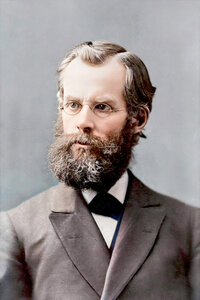
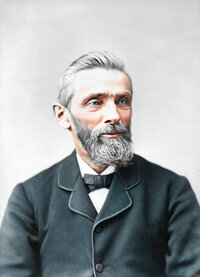
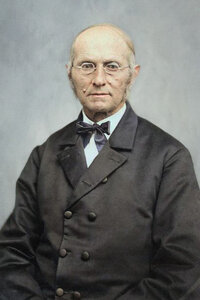
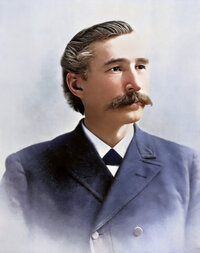
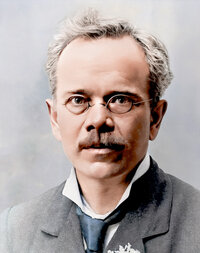
1856–1939
A Cautionary Biography — A Faithful Pioneer Who Did Not Endure to the End
For nearly fifty years Ludwig Richard Conradi was the most prominent Seventh-day Adventist worker in Europe — pioneer of the German, Russian, and Hamburg missions; founder of the Hamburg publishing house and Friedensau training school; vice-president of the General Conference; the man Ellen White, in 1883, named as “thoroughly in earnest in the work” (4LtMs, Ms 5, 1883, par. 13). Yet at the close of his life, in May 1932, Conradi formally severed his ties with the Seventh-day Adventist Church, repudiated Ellen White’s prophetic gift, and joined the Seventh Day Baptists. His late example is not to be followed. His apostasy is recorded here so that the reader may distinguish the early laborer who built up the cause from the later man who turned against the Spirit of Prophecy by which his early labors had been guided.
Summary
Born at Karlsruhe, Germany, in 1856, Conradi emigrated to America in his youth, worked as a farm laborer in Iowa, was converted to Adventism in 1878, attended Battle Creek College, and in 1885 was sent to the Central European field. The next thirty years saw him pioneer the Adventist work in Russia (the first Adventist church in the empire was organized at Berdebulat in 1886), suffer five weeks’ imprisonment with his colleague G. Perk at Perekop, found the Hamburg mission in 1889, edit Herold der Wahrheit and Zions-Wächter, organize the European General Conference in 1901 and the European Division in 1909, and serve as one of the foremost mission administrators of the church. From 1918 he served as a vice-president of the General Conference, but his 1931 published doubts concerning the sanctuary message and Ellen White’s authority brought him to the parting of ways; in May 1932 he submitted his resignation and was rebaptized into the Seventh Day Baptist Church. He died in 1939.
From Iowa Farmhand to European Pioneer (1856–1886)
Loughborough’s Great Second Advent Movement records the launching of his European career: “In 1885 Elder L. R. Conradi left America for the Central European field, to labor among the Germans” (The Great Second Advent Movement, p. 409, par. 2; refcode GSAM 409.2). The same paragraph records the founding of the first Russian Adventist church: “On June 28, 1886, he left Basel for the Crimea, Russia. Here, in company with Elder Perk, he journeyed to Berdebulat, where two sisters were baptized and a church of nineteen members was organized, this being the first Seventh-day Adventist church in Russia” (The Great Second Advent Movement, p. 409, par. 2; refcode GSAM 409.2).
The Crimean church plant was followed almost at once by Russian persecution. Loughborough’s same chapter records: “Immediately after this Elders Conradi and Perk were arrested for teaching contrary to the orthodox faith, and were imprisoned for five weeks in Perekop. After his release (by the intervention of the United States minister) Elder Conradi visited Eastern Russia, and then returned to Switzerland” (The Great Second Advent Movement, p. 409, par. 3; refcode GSAM 409.3).
Hamburg, Friedensau, and the German Work (1889–1918)
Loughborough’s Great Second Advent Movement records the founding of the Hamburg mission: “In May, 1889, the mission work was opened up in Hamburg, Germany, by Elder Conradi, and in a very short time a training-school for workers was instituted. The following October a Sabbath-school of twenty-eight members was organized. It was during this year that Elder Haskell visited the mission and a church of twenty members was organized, and a book depository established” (The Great Second Advent Movement, p. 410, par. 1; refcode GSAM 410.1).
Loughborough’s quotation of Conradi’s own report on the German-Russian work at the close of 1895: “Since Jan. 1, 1895, twelve new canvassers have entered the field. In June, 1895, the report showed fifty per cent. increase in sales. At present a special effort is being made with Harold der Wahrheit, our German paper” (The Great Second Advent Movement, p. 412, par. 5; refcode GSAM 412.5).
Ellen White’s Encouragement of His Early Work
Ellen White’s manuscript of 1883 — written after she heard Conradi address the General Conference at the very beginning of his denominational service — preserves her personal commendation: “When I listened to the testimony of Brother [L. R.] Conradi, I could see how he was so successful. He was thoroughly in earnest in the work. He takes hold of it as though he meant to do something. It is not ability alone that gives success, although sanctified talent and ability are as polished instruments in the hands of God; it is to be thoroughly in earnest in the work” (Letters and Manuscripts, vol. 4, Manuscript 5, 1883, par. 13; refcode 4LtMs, Ms 5, 1883, par. 13).
Two years later, while in Switzerland, Ellen White urged that Conradi join the Basel work: “I hope that Brother Conradi will come to work awhile with Brother Ertzenberger. When he shall come, we will have meetings here in Basel; and I believe souls will embrace the truth” (Letters and Manuscripts, vol. 4, Letter 38, 1885, par. 17; refcode 4LtMs, Lt 38, 1885, par. 17).
In 1886 she recorded his actual arrival and his missionary projection toward Russia: “Brother Conradi is here now, and he thinks of visiting Russia soon as there is a deep interest already awakened there through reading. I am glad Brother Conradi has come, for he is a successful worker among the Germans. After he shall spend a few months in Russia, he intends to return to Basel and labor in this place, the Lord willing” (Letters and Manuscripts, vol. 4, Letter 29, 1886, par. 6; refcode 4LtMs, Lt 29, 1886, par. 6).
The same year, Ellen White recorded their joint preaching at Lausanne: “I spoke for the first time in Lousanne Sabbath forenoon, followed by two interpreters Brother Bourdeau and Brother Conradi. After the sermon, we had an excellent social meeting. There were four bore testimony they were keeping their first Sabbath” (Letters and Manuscripts, vol. 4, Letter 7, 1886, par. 17; refcode 4LtMs, Lt 7, 1886, par. 17).
The 1887 record from Vohwinkel, Germany, in which Ellen White and Conradi labored together over divisions among the German believers: “The people are intelligent and in every way different than those in Italy. But Satan has been and is still at work here to set the believers at variance one with another. Our meeting all day yesterday was to help the believers. I spoke in the forenoon, and then Elder Conradi said they had never had a social meeting. I told him now was the time to break them in” (Letters and Manuscripts, vol. 5, Letter 83, 1887, par. 4; refcode 5LtMs, Lt 83, 1887, par. 4). The same letter, in the next paragraph: “In the afternoon Brother Conradi held a meeting three hours long and I think labored hard. I lay down. At eight o’clock I spoke again to the people and then left Elder Conradi to finish the meeting, seeking to adjust difficulties” (Letters and Manuscripts, vol. 5, Letter 83, 1887, par. 5; refcode 5LtMs, Lt 83, 1887, par. 5).
The “Daily” Controversy and the First Cracks (1899–1919)
Per Lest We Forget, the seeds of Conradi’s later departure were sown long before his formal break. The chapter on W. W. Prescott records that the “new view” of “the daily” — the interpretation that Daniel 8’s tamid was the mediatorial ministry of Christ rather than paganism — “dated at least to Conradi’s book on prophecy published in German, and to Prescott’s discussions with fellow workers in England in 1899” (Lest We Forget, ch. 174, p. 430, ¶ 33). The same chapter, much later, records the basis on which Prescott was reluctant to issue a public condemnation of his German colleague: “This request apparently resulted from Prescott’s comments to some of the officers that Ballenger and Fletcher had not been adequately answered, and from his lack of a blanket condemnation of Conradi” (Lest We Forget, ch. 174, p. 435, ¶ 68). The deeper question for Conradi was not the “daily” but the sanctuary message itself; and as the years passed his confidence in the Adventist sanctuary doctrine eroded.
The 1931–1932 Apostasy and Departure
Per the Encyclopedia of Seventh-day Adventists and contemporary General Conference Committee records, in the autumn of 1931 Conradi, then seventy-five years old and recently retired from active denominational service, published a series of articles in which he repudiated the historic Adventist understanding of Daniel 8:14, the heavenly sanctuary, the 1844 atonement, and the prophetic authority of Ellen G. White. A General Conference Committee delegation — including W. A. Spicer, A. G. Daniells, and C. H. Watson — met with him at length in Hamburg through the spring of 1932 in an attempt to recover him. He refused. On May 9, 1932, he submitted his formal resignation. He was rebaptized into the Seventh Day Baptist Church in Sweden later that year and spent the last seven years of his life in opposition to the very church he had built up.
Death (1939) and the Lesson
Per ESDA, L. R. Conradi died at Hamburg on May 30, 1939, in his eighty-third year. His Hamburg publishing house, the Friedensau seminary, and the European Division all continued in the Adventist faith — long outliving his late-life retreat from it. The pattern by which a man labors fifty years for the cause of God only to repudiate it at the end is the pattern of which the Lord through Ezekiel warned: “When the righteous turneth away from his righteousness, and committeth iniquity, and dieth in them; for his iniquity that he hath done shall he die” (Ezekiel 18:26).
Conradi stands here as a witness to both possibilities — that genuine and Spirit-blessed labor at the beginning is no guarantee of endurance, and that the warnings of Ellen White concerning those who once received the message and then drew back are not theoretical. His early labors are honored; his late example is not to be followed.