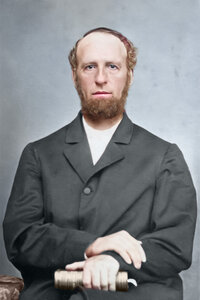
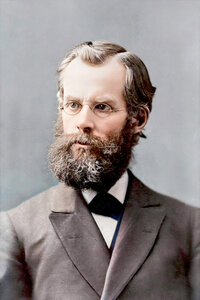
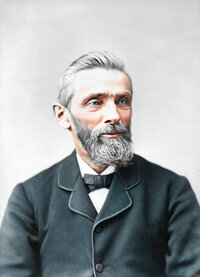
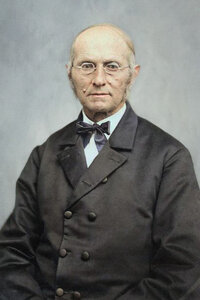
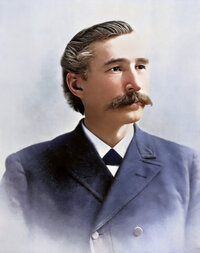
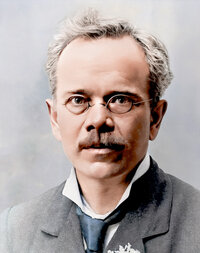
Ludwig Richard Conradi (1856–1939)
Apostle to Europe — A Builder Who Abandoned His Own Foundation
Ludwig Richard Conradi was arguably the most influential figure in the establishment and growth of Seventh-day Adventism in Europe. Born in Karlsruhe, Germany, he emigrated to America as a teenager, was converted to the Adventist faith in the Midwest, and returned to Europe as a missionary, where he spent four decades building the Adventist Church from a tiny presence into a continent-spanning movement. He organized unions and conferences, established publishing houses and training schools, and personally carried the Adventist message into Russia, the Ottoman Empire, and Africa. His cultural sensitivity and native fluency in European languages gave him advantages that few American-born missionaries could match.
Yet Conradi’s story does not end in triumph. During World War I, under his leadership, German Adventists were officially committed to bearing arms and working on the Sabbath — a betrayal of fundamental Adventist principles that produced a bitter schism resulting in the formation of the Seventh Day Adventist Reform Movement. In 1932, at the age of seventy-six, Conradi himself left the Seventh-day Adventist Church and became a minister of the Seventh Day Baptists, rejecting the prophetic ministry of Ellen White — the very gift through which God had guided the movement Conradi had labored so long to build.
His life stands as both a remarkable testimony to the power of missionary zeal and a sobering illustration of how even decades of service cannot sustain a man whose heart is not fully surrendered to the Lord’s appointed channels of guidance.
Early Life and Conversion
Ludwig Richard Conradi was born on March 20, 1856, in Karlsruhe, in the Grand Duchy of Baden, Germany. As a young man, he began studies for the Roman Catholic priesthood, but at the age of seventeen he emigrated to the United States, joining the great wave of German immigration to America in the 1870s.
In the American Midwest, Conradi found work as a farmhand. In 1878, while working for a farmer named James Burton, he was converted to the Seventh-day Adventist faith. The following year, in 1879, he met Ellen G. White — an encounter that profoundly shaped his initial sense of mission. He enrolled at Battle Creek College, and after completing his studies he began evangelistic work among the German-speaking communities scattered across the American Midwest, quickly demonstrating exceptional gifts for evangelism.
In 1882, Conradi was ordained to the gospel ministry. His effectiveness among German-speaking populations and his command of multiple European languages made him an ideal candidate for European missions.
Missionary Pioneer in Europe
In 1886, the General Conference sent Conradi to Europe, initially to Basel, Switzerland, where the small Adventist mission had been struggling. Conradi brought a fundamentally different approach. Rather than simply transplanting American methods, he adapted his missionary techniques to European culture. This cultural sensitivity, combined with his native fluency in German, gave him an advantage that few American-born missionaries could match.
Convinced that Basel was not the ideal base for reaching central Europe, Conradi chose Hamburg as his strategic headquarters. Hamburg, though part of the German Empire, was an organized free republic that granted greater religious freedom than many other parts of Germany.
Building the Institutional Framework
In 1889, Conradi founded the International Tract Society in Hamburg, establishing it as a branch of the Basel-based publishing house. This venture became the seed of what would grow into the German Publishing House. On June 17, 1889, he founded a mission school in Hamburg to train colporteurs — literature evangelists who would carry Adventist publications door to door across the continent.
Conradi’s energy was prodigious. He traveled constantly, mounting evangelistic campaigns across Germany, Switzerland, Russia, Turkey, Romania, and Hungary. His journeys into the Russian Empire were particularly daring. In an era when religious dissent was severely punished by the Tsarist authorities, Conradi risked arrest and imprisonment to bring the Adventist message to communities across the vast Russian landscape. Contemporary accounts noted that he was “often pursued by the police.”
He also established the Friedensau Missionary Seminary near Magdeburg, which became a training center for workers across the European field. The institutional framework he built — union conferences, publishing houses, training schools, health institutions — formed the backbone of European Adventism for decades.
Reorganizing European Adventism
On July 23, 1901, on Conradi’s initiative, a major reorganization of the mission work was implemented in Europe. The fast-growing churches in Germany were organized into a union conference, initially encompassing thirteen additional countries. Conradi served as the first chairman of the new European General Conference.
In 1911, he wrote to the General Conference recommending that the various sections of the denomination be divided into “self-supporting divisions” with constitutional rights. This advocacy bore fruit at the 1913 General Conference session, when the European Division was officially founded with its administrative headquarters in Hamburg, comprising nine unions with their constituent conferences and twenty-six mission fields. Conradi served as president of the European Division and as a vice-president of the General Conference.
A Vision Beyond Europe
Conradi’s missionary vision extended far beyond Europe. In 1903, he articulated a vision for reaching East Africa with the Adventist faith. Between 1909 and 1914, he conducted extensive missionary journeys to South America, Africa, and the Middle and Far East. His written works included a substantial revision and enlargement of John Nevins Andrews’s History of the Sabbath, adding seven new chapters. He also wrote expositions of the books of Daniel and Revelation that were translated into several languages.
Health Work
In 1920, under Conradi’s leadership, the Waldfriede Hospital opened in the Zehlendorf district of Berlin with thirty-nine beds, twenty-seven hospital rooms, and an operating room. This institution became an important center of Adventist medical ministry in Germany.
The World War I Crisis: A Betrayal of Principle
The achievements described above were genuine and substantial. Yet the most consequential chapter of Conradi’s leadership came during World War I, when decisions made under his authority inflicted lasting damage upon European Adventism.
When war broke out suddenly in August 1914, Conradi and other European leaders made an abrupt accommodation with the German state. On August 2, 1914, a circular letter signed by G. Dail, secretary of the European Division, instructed German Adventists: “We should do our military duties cheerfully whilst we are in service or being called to serve, so that the officers in charge will find in us valiant and true soldiers who are ready to die for their homes, for our army, and for our fatherland.”
Two days later, on August 4, 1914, the East German Union submitted a declaration to the Ministry of War, signed by Union president H. F. Schuberth, which went even further: “We have bound ourselves together in the defense of the Fatherland, and under these circumstances we will also bear arms on Saturday (Sabbath).”
These declarations were issued without the counsel, consent, or knowledge of the General Conference. They represented a direct repudiation of the denomination’s historic noncombatant position — a position rooted in the sixth commandment and affirmed by Ellen White during the American Civil War, when she was shown that God’s people “cannot engage in this perplexing war, for it is opposed to every principle of their faith.”
A small minority of German Adventists — approximately two percent — refused to comply with these directives, holding fast to their convictions regarding the Sabbath and the commandment “Thou shalt not kill.” Rather than defending these conscientious members, Conradi had them disfellowshipped from the church. These expelled members eventually organized themselves into what became known as the Seventh Day Adventist Reform Movement in 1925.
It is also significant that according to L. E. Froom’s Movement of Destiny, Conradi had been present at the 1888 General Conference session in Minneapolis, where he was among the most vocal opponents of both the message of righteousness by faith and the Spirit of Prophecy. This earlier resistance to the Lord’s guidance through Ellen White may help explain why, decades later, he was willing to set aside fundamental principles when political pressure demanded it.
When the General Conference learned what had happened, it sent W. A. Spicer to Germany at great personal risk — crossing the Atlantic during the height of the submarine peril — to investigate the situation firsthand. After the war, General Conference president A. G. Daniells led a delegation to Friedensau, Germany, in July 1920 to attempt reconciliation between the church and the disfellowshipped minority. The effort failed. The breach was never fully healed.
In 2005, and again in 2014, the German Adventist unions issued formal apologies for the actions of their leaders during World War I — an acknowledgment, after a century, of the wrong that had been done.
Separation from the Church
The aftermath of World War I brought Conradi into increasing conflict with General Conference leadership. He attempted to justify his wartime decisions and resisted accountability. His long-standing tendency toward independence — which had served him well as a pioneer evangelist — now manifested itself as stubbornness in the face of correction.
In 1922, Conradi was released from his position as president of the European Division. Over the following decade, his theological views continued to shift. He increasingly questioned distinctive Adventist doctrines, including the prophetic interpretation of Daniel and Revelation and the Spirit of Prophecy ministry of Ellen White.
In 1932, at the age of seventy-six, Conradi formally separated from the Seventh-day Adventist Church and became a minister of the Seventh Day Baptists. He wrote a document titled “Some Reasons for Separating from the SDA Denomination,” in which he laid out his objections to the faith he had once championed across an entire continent.
His departure was a bitter blow — though by this time, the seeds of his separation had been evident for many years. The man who had built the institutional framework of European Adventism had ultimately rejected the prophetic foundations upon which that framework rested.
Death
Ludwig Richard Conradi died on September 16, 1939, in Germany, at the age of eighty-three — a Seventh Day Baptist minister, separated from the movement to which he had given the most productive decades of his life.
Legacy: Greatness and Warning
Conradi built much for European Adventism — union conferences, publishing houses, training schools, health institutions — and these structures continue to serve the church. But the lessons of his life are far more important than the institutions he left behind.
His story carries solemn warnings that the church must never forget.
First, Conradi’s World War I decisions demonstrate the catastrophic consequences of subordinating God’s truth to political expediency. When the pressure of the state demanded compromise on the Sabbath and the commandment against killing, Conradi chose the path of least resistance — and in doing so, betrayed the very members who had been most faithful to the principles he had taught them. The resulting schism caused wounds that took a century to address and that have never been fully healed.
Second, his eventual departure from the church illustrates a pattern that Ellen White described with remarkable clarity: “It is Satan’s plan to weaken the faith of God’s people in the Testimonies. Next follows skepticism in regard to the vital points of our faith, the pillars of our position, then doubt as to the Holy Scriptures, and then the downward march to perdition” (Testimonies for the Church, vol. 4, p. 211). Conradi’s trajectory followed this sequence almost exactly — from resistance to the Spirit of Prophecy at Minneapolis in 1888, to the compromise of biblical principles during the war, to the rejection of Ellen White’s prophetic ministry, and finally to his departure from the Advent movement altogether.
Third, Conradi’s story reminds us that no amount of institutional achievement can substitute for personal faithfulness to revealed truth. The man who built more for European Adventism than any other individual ultimately walked away from the faith that had given his life its greatest purpose. The institutions remained; the builder departed.
The Advent movement in Europe owes an immense debt to Conradi’s pioneering labors. But the lessons of his later years must be remembered alongside the accomplishments of his earlier ones. The same God who called him and blessed his work also sent warnings through His prophet — warnings that, had Conradi heeded them, might have preserved both his ministry and the unity of the European church.