1859–1938
Summary
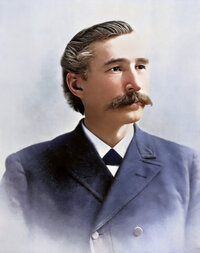
Lewis Charles Sheafe was, in the words of the Encyclopedia of Seventh-day Adventists (Douglas Morgan), “Adventism’s foremost black evangelist during the formative years of the church’s work among African Americans around the turn of the 20th century.” Born to formerly enslaved parents in Baltimore, Maryland, on November 16, 1859, he grew up in Massachusetts, was a Baptist minister before he heard the third angel’s message, and accepted the Sabbath through the witness of Adventist health-reform principles he learned at a sanitarium. From his first General Conference appearance in 1899 — when he had been “in the truth only about three years” — until his last decade, he was one of the most widely heard preachers in the Adventist church. He died in 1938.
Early Life and Conversion (1859–1896)
Per the Encyclopedia of Seventh-day Adventists, Sheafe was born November 16, 1859, in Baltimore, Maryland, to Joseph and Louise Beaulette Sheafe — both born into slavery but freed before his birth. His father fought for the Union in the Civil War but did not return to the family. In 1865 his mother moved with Lewis and his younger brother Joseph to Boston, Massachusetts. An eye injury in 1869 limited Lewis’s classroom education, and most of his early learning came from his mother. As a young man he took up farming in West Dedham, Massachusetts.
Per ESDA, before becoming a Seventh-day Adventist Sheafe served as a Baptist minister. He came into the Adventist faith through the influence of a sanitarium where he received treatment.
“I Have Been in the Truth Only About Three Years” (February 16, 1899)
When the General Conference of 1899 convened in South Lancaster, Massachusetts, Sheafe — newly received into the Adventist ministry — addressed the brethren. The General Conference Daily Bulletin of February 16, 1899, preserves his words. He began with thanksgiving: “I can truly say that I am glad to be with you. As I have listened to the testimonies from these brethren who have been a long time in the third angel’s message, my heart has been filled with joy” (General Conference Daily Bulletin, February 16, 1899, page 5.3; refcode GCDB February 16, 1899, page 5.3).
He continued, in the same address: “I have been in the truth only about three years; and although it seems as if every day is brighter than the one preceding, I have often wondered whether this is so in the experience of those who have been in the truth for so many years” (General Conference Daily Bulletin, February 16, 1899, page 5.3; refcode GCDB February 16, 1899, page 5.3).
His prayer for his own people followed in the same paragraph: “I am glad that he permitted this light to come to me, and that he gave me grace to accept it; and to-day my heart’s desire and prayer is that this message may go to my people all over the United States” (General Conference Daily Bulletin, February 16, 1899, page 5.3; refcode GCDB February 16, 1899, page 5.3).
Health Reform as the “Entering Wedge” (1899)
Less than a week later, on February 22, 1899, Sheafe addressed the same conference on the role of the sanitarium and health reform in his evangelism. He testified: “This work appeals especially to me, because it was largely through benefit derived from treatment at the sanitarium, what I learned from its health foods and principles, that fully opened my eyes to present truth” (General Conference Daily Bulletin, February 22, 1899, page 50.4; refcode GCDB February 22, 1899, page 50.4).
He went on, in the same paragraph: “In my short experience since I have been in the truth, and the little knowledge I gained while at the sanitarium in regard to treatment and helping people, I have found it to be very helpful as an entering wedge to open the way for presenting the truth” (General Conference Daily Bulletin, February 22, 1899, page 50.4; refcode GCDB February 22, 1899, page 50.4).
He told the delegates of an exchange with a white physician in Kentucky who had asked from which medical school Sheafe had graduated, and on hearing that the answer was none, said: “They are the grandest people on the earth. If they show people how to live right, they will be sure to die right” (General Conference Daily Bulletin, February 22, 1899, page 50.4; refcode GCDB February 22, 1899, page 50.4).
A few days later, on February 28, the same conference recorded that the meeting opened with “Prayer by Elder L. C. Sheafe” (General Conference Daily Bulletin, February 28, 1899, page 104.9; refcode GCDB February 28, 1899, page 104.9).
Ellen White’s Witness (1902)
In a 1902 letter, Ellen White records her gladness at hearing Sheafe preach during a campaign in the South: “Last night Brother Sheafe preached an excellent discourse in their own church,—a good, nice church which has been secured for the colored people.” (Manuscript Releases, Letter 3, 1902, par. 9; refcode 17LtMs, Lt 3, 1902, par. 9).
Per ESDA, Sheafe by 1902 was widely regarded across denominational lines for the power of his preaching, including a 1902 campaign in the District of Columbia that opened the doors to Adventist work in the federal capital and led to the organization of the People’s Church there.
Later Counsel (1907)
In 1907, as Sheafe began to drift in the direction of independent congregational governance, Ellen White wrote him a long testimony — preserved in Manuscript Releases, Letter 44, 1907. She affirmed God’s blessing on his life and ministry while urging him back to the path of Christ: “The Lord has greatly blessed you, Brother Sheafe, and He desires that you shall no longer walk in the path you have been treading, but step back into the path that Christ has formed by His own example” (Manuscript Releases, Letter 44, 1907, par. 7; refcode 22LtMs, Lt 44, 1907, par. 7).
In the same letter, paragraph 18, she returned to the warning: “My brother, the Lord desires you to guard against any doctrines that would lead to dissension and strife. You are charged to hold the beginning of your confidence firm unto the end. There is need of much prayer” (Manuscript Releases, Letter 44, 1907, par. 18; refcode 22LtMs, Lt 44, 1907, par. 18).
Later Years and Death (1908–1938)
Per the Encyclopedia of Seventh-day Adventists, Sheafe’s later years included a separation from the Adventist denomination — though his preaching continued — and a return toward older friendships in his last years. He died in 1938.