1842–1923
Summary
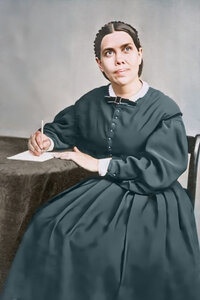
Catharine “Kate” Lindsay was the most influential pioneer female physician in Seventh-day Adventist medical work. After graduating from the University of Michigan Medical School in 1875 — at a time when only a handful of medical schools admitted women — she returned to the Battle Creek Sanitarium as Head of Obstetrics, Women’s Health, and Pediatrics, and in 1883 founded the Sanitarium Medical Missionary and Training School, the first Seventh-day Adventist school of nursing. She served at sanitariums in Battle Creek (1875–1896), Claremont, South Africa (1897–1899), and Boulder, Colorado (1901–1923, including a year as medical superintendent in 1902). She authored the Kate Lindsay Pledge that for decades became standard for Seventh-day Adventist nurses’ graduations. She was the first to conceive of electric-light therapy as a medical treatment — the idea that inspired J. H. Kellogg’s electric-light bath cabinet of 1891. She died at Boulder, Colorado, on March 31, 1923, at the age of eighty.
Early Life and Conversion (1842–1867)
Per the Encyclopedia of Seventh-day Adventists (Lorena M. Jeske), Catharine Lindsay was born on September 11, 1842, in Dane County, Wisconsin, to Thomas and Catherine McIntyre Lindsay — both natives of Glasgow, Scotland, who had married on June 28, 1841 and sailed for the United States the next day. After two years in a log cabin near Madison, Wisconsin, the family settled on a Dane County farm that would be their home thereafter.
Lindsay was a Sabbath-keeping Adventist by 1865 — the Advent Review and Sabbath Herald of January 17, 1865, records a $5.00 donation from her among a list of contributors (Advent Review and Sabbath Herald, January 17, 1865, page 64.37; refcode ARSH January 17, 1865, page 64.37).
Medical School (1870–1875)
Per ESDA, Lindsay was twenty-eight years old when she entered the University of Michigan Medical School at Ann Arbor in 1870, having self-financed her education through years of teaching. She graduated in 1875 in the second class of women admitted to the university’s medical program. The University of Michigan records show that during October 1875 she was thirty-three years old and a senior.
Battle Creek Sanitarium (1875–1896): Head of Obstetrics, Founder of the School of Nursing
Lindsay returned to the Western Health Reform Institute (renamed Battle Creek Medical and Surgical Sanitarium in 1877) late in 1876. She became Head of Obstetrics, Women’s Health, and Pediatrics, and remained at Battle Creek for twenty years.
Ellen White’s correspondence preserves an outside testimony to Lindsay’s reputation in this period. Writing to Ellen White, Dr. Maxson said of his own wife: “All the institutions I have visited have their leading lady physicians, and I can assure you that none are as well equipped as my wife is for the work, except it be Dr. [Kate] Lindsay, for she certainly is a remarkable woman, and Dr. Kellogg could not well get along without her” (Manuscript Releases, Letter 55, 1888, par. 42; refcode 5LtMs, Lt 55, 1888, par. 42).
In the spring of 1883, Lindsay’s long-cherished plan was realized: the Sanitarium Medical Missionary and Training School opened — the first Seventh-day Adventist school of nursing. Her handwritten lecture notes, compiled into pamphlets, served as the school’s first textbooks; her own Lectures: The Sanitarium Medical Missionary School for Nursing Students, published around 1894, became the basis for the next decade of training.
In 1890 Ellen White wrote about her interaction with Lindsay in arranging training for a young woman: “I have mailed a letter to Dr. Lindsay in reference to her giving May special advantages and I hope May will spend her whole time at the institution, for this is the only way she can get the knowledge” (Manuscript Releases, Letter 105, 1890, par. 2; refcode 6LtMs, Lt 105, 1890, par. 2).
South Africa (1897–1899)
In December 1895 Lindsay received a call from the Seventh-day Adventist Medical Missionary Board to assist the medical and nursing staff in South Africa. She arrived in Cape Town in early 1897 and worked at the Claremont Sanitarium under Dr. R. S. Anthony. By December 1897 she had taken on a more difficult assignment — travelling some 1,460 miles by train and mule wagon to the Matabele Mission near Bulawayo in Southern Rhodesia (now Zimbabwe). When her wagon broke down in the rainy season she finished the journey by mule.
Within a month of her arrival at the Matabele Mission six residents died of pneumonia or malaria, their immune systems compromised by the famine of the recent Matabele War. Lindsay’s letters from the field to the Medical Missionary Board pressed for better preparation of foreign missionaries, malarial precautions, and consultation with local physicians and military surgeons. From her personal funds she provided the mission with a well and a windmill.
The 1899 General Conference Daily Bulletin preserves a moment when one of her South African letters was read aloud at a session: “I have a letter just received from Dr. Lindsay, of the South Africa Sanitarium, in which I find something directly on this point. With your permission, I will read a few lines” (General Conference Daily Bulletin, March 1, 1899, page 116.23; refcode GCDB March 1, 1899, page 116.23).
While Lindsay was still in South Africa, Ellen White — then in Australia — was urging her to come on once her work in Cape Town allowed. The first appeal was sent in mid-1899: “We are very desirous that you should come to Australia before you return to America, for help is greatly needed here. I know of no one whom I would be more pleased to have tarry with us awhile than yourself. So, understanding the needs of the field, I, as the steward of God, ask you to come” (Manuscript Releases, vol. 19, p. 144, par. 1; refcode 19MR 144.1).
The second appeal followed: “When are you coming to Australia? We need your assistance. We ask you to come just as soon as possible. You can help us much with your experience” (Manuscript Releases, vol. 19, p. 145, par. 1; refcode 19MR 145.1). And again, in the same letter, with regard to the training of young women: “I want you to write at once, and tell us what you can do to help our young women here. You could educate them as no man could do” (Manuscript Releases, vol. 19, p. 145, par. 3; refcode 19MR 145.3).
The Boer War forced Lindsay to leave South Africa earlier than planned. She travelled home via England, arriving in London on November 22, 1899.
North Carolina and Boulder, Colorado (1900–1923)
Lindsay returned to the United States in 1900 and chose to settle in North Carolina, where the climate was kinder to the asthma she had carried since childhood. Within about a year she had donated property near Hildebran, North Carolina, to the North Carolina Conference for what became the Piedmont Sanitarium.
In mid-1901 — at Kellogg’s encouragement — she moved to Boulder, Colorado, and joined the medical staff at Boulder Colorado Sanitarium. She served as medical superintendent in 1902, and continued to work in obstetrics, gynecology, and pediatrics there for more than two decades. She was the principal teacher in the Boulder school of nursing, lecturing into her seventies. F. M. Wilcox, writing in 1912, described her as the one “who, for the last twelve years, has done hard, faithful, and competent service in this sanitarium” (per ESDA).
The Kate Lindsay Pledge
About 1905 Lindsay wrote a nurses’ pledge that for many decades was familiar to all nurses graduating from Seventh-day Adventist schools of nursing. Per the Encyclopedia of Seventh-day Adventists, the pledge ran in part: “Realizing the serious nature of the duties and the grave character of the responsibilities of the professional nurse, and especially appreciating the solemn obligations of the missionary nurse, I hereby solemnly pledge myself, by the help of God, faithfully to perform the duties of my calling.” It was recited at her School of Nursing graduations into the mid-twentieth century.
Death (1923)
In her seventies Lindsay began to teach nurses’ classes from a wheelchair on account of arthritis; the students met in her home. Per the Encyclopedia of Seventh-day Adventists, she died at Boulder Colorado Sanitarium on March 31, 1923, at the age of eighty, and was buried in Dane County, Wisconsin, among her family.
The College of Medical Evangelists (now Loma Linda University) named the original girls’ dormitory at Loma Linda Kate Lindsay Hall in 1936 in her honor.