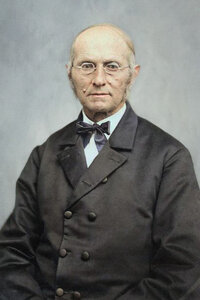
1809–1886
Summary
Josiah Litch was a Methodist minister and physician who, after embracing William Miller’s message in 1838, became one of the most influential expositors of the Millerite movement. His public prediction in early 1840 that the Ottoman Empire’s independent power would fall on August 11, 1840 — fulfilled almost to the day — gave the Millerite cause a striking validation of the year-day prophetic principle and helped transform a regional revival into a national movement. After the Great Disappointment of October 22, 1844, Litch helped found the American Evangelical Adventist Conference and later moved toward dispensationalist views; he died in Providence, Rhode Island, in 1886.
Embracing Miller’s Message (1838)
Loughborough records Litch’s entry into the Millerite cause and the substance of his early work: “In 1838 Dr. Josiah Litch, of Philadelphia, Pa., having embraced the truth set forth by William Miller, united in the work of giving greater publicity to the message. He prepared articles for the public print on the subject of the seven trumpets of the Revelation. He took the unqualified position that the sixth trumpet would cease to sound and the Ottoman power fall on the 11th day of August, 1840, and that that would demonstrate to the world that a day in symbolic prophecy represents a year of literal time” (The Great Second Advent Movement, p. 129, par. 2; refcode GSAM 129.2).
The Calculation (Revelation 9 and the Sixth Trumpet)
Loughborough preserves the prophetic chronology Litch laid out, beginning with the rise of Ottoman power in 1299: “The fifth trumpet presents the rise of Mohammedanism with its cloud of errors, but especially the period of “five months,” or one hundred and fifty literal years from the time they “had a king over them.” July 27, 1299, Othman, the founder of the Ottoman empire, invaded the territory of Nicomedia” (The Great Second Advent Movement, p. 128, par. 2; refcode GSAM 128.2).
The day-for-a-year reckoning produced a precise terminus: “Taking this as prophetic time, a day for a year, how long a time would it be? The problem is a simple one: a year, 360 days, or years; a month, 30 days, or years; and one day, one year,—in all 391 days, or, literally, 391 years. An hour being the twenty-forth part of a day, as a symbol would be half a month, or fifteen days. The whole time of Mohammedan independent rule of Eastern Roman territory would therefore be 391 years and 15 days. This added to July 27, 1449, brings us to August 11, 1840, for the termination of the period of Turkish independence, as set forth under the sixth trumpet” (The Great Second Advent Movement, p. 129, par. 1; refcode GSAM 129.1).
Froom condenses the same calculation: “the fifth extending from July 27, 1299, to 1449, and the sixth from July 27, 1449, to August 11, 1840, at the ceasing of the Turkish supremacy” (The Prophetic Faith of Our Fathers, vol. 4, p. 732, par. 2; refcode PFF4 732.2).
The Public Effect (After August 11, 1840)
The prediction was met with intense public attention. Loughborough records the response: “This striking fulfillment of the prophecy had a tremendous effect upon the public mind. It intensified the interest of the people to hear upon the subject of fulfilled and fulfilling prophecy. Dr. Litch said that within a few months after August 11, 1840, he had received letters from more than one thousand prominent infidels, some of them leaders of infidel clubs, in which they stated that they had given up the battle against the Bible, and had accepted it as God’s revelation to man” (The Great Second Advent Movement, p. 132, par. 2; refcode GSAM 132.2).
Boston General Conference and Editorial Work (1840–1843)
Litch was a featured speaker at the first Millerite General Conference. Bliss records that the conference opened in Boston “on the 14th of October, 1840” (Memoirs of William Miller, p. 152, par. 4; refcode MWM 152.4). Litch was also chairman of the second General Conference at Lowell in June 1841 (Bliss reports the Lowell conference dates immediately after the Boston conference) and a featured speaker at the May 1843 Boston Millerite Tabernacle conference: “It had an imposing list of speakers-Whiting, Fitch, Litch, Hawley, Hale, Barry, Himes, Brown, and Skinner” (The Prophetic Faith of Our Fathers, vol. 4, p. 619, par. 1; refcode PFF4 619.1).
The Anti-Annihilationist Controversy (1844)
When George Storrs’s Six Sermons on conditional immortality were widely distributed in 1842–1843, Litch became the most outspoken Millerite voice against annihilationism. Froom records: “Litch was so agitated by the issue that he went to the length of issuing a little paper against it, called the Anti-Annihilationist” (The Prophetic Faith of Our Fathers, vol. 4, p. 807, par. 4; refcode PFF4 807.4).
Death (1886)
After the Great Disappointment, Litch helped lead the Albany Conference of 1845 and later the American Evangelical Adventist Conference. Per the Encyclopedia of Seventh-day Adventists, he died of apoplexy on January 31, 1886, at his home in Providence, Rhode Island.