1805–1895
Summary
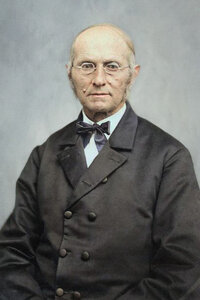
Joshua Vaughan Himes was the publisher, organizer, and lead promoter of the Millerite movement of 1840–1844. Pastor of the Chardon Street Chapel in Boston and a prominent abolitionist before he met William Miller, Himes turned a regional New England revival into a national mass movement through periodicals, conferences, and the largest tent of its time. He survived the Great Disappointment and continued in Adventist work for fifty more years, dying at Elk Point, South Dakota, on July 27, 1895.
Early Life (1805–1823)
Loughborough preserves Himes’s own recollection of his birthplace, his father’s trade, and the religious atmosphere of his childhood: “Joshua V. Himes was born at Wickford, R.I., May 19, 1805. His father was well known as a West India trader, and was prominent as a member of St. Paul’s Episcopal church in Wickford. His mother possessed an amiable disposition, and a love for the Saviour, which she poured into the willing ears of her son” (The Great Second Advent Movement, p. 121, par. 4; refcode GSAM 121.4). Dick provides the broader frame: “Joshua Vaughn Himes was born May 19, 1805, in North Kingston, Rhode Island. His father, a man of some means, was a West India trader and a prominent member of the Episcopal Church. It had been the plan of the elder Himes to educate Joshua for the Episcopal ministry at Brown University at Providence, Rhode Island” (Founders of the Message, p. 69, par. 1; refcode FOME 69.1).
The plan collapsed in 1817 when his father’s investment was lost at sea: “In 1817 he sent a valuable cargo to the West Indies under the charge of a ship captain who proved unfaithful to the trust, sold the ship laden with goods, and disappeared. This disaster ruined the father financially and was destined to change the whole life of Joshua, who was obliged to give up going to college” (Founders of the Message, p. 69, par. 1; refcode FOME 69.1). Joshua was apprenticed to a cabinet-maker in New Bedford, Massachusetts.
Conversion and Christian Connection Ministry (1823–1830)
Himes did not stay long with his master’s Unitarianism. Loughborough records: “There being at that time no Episcopal church in New Bedford, he decided to attend the First Christian church [not Disciple] and subsequently united with that body. ‘Here,’ he says, ‘I found the open Bible and liberty of thought, and made good use of both.’ This church was under the pastoral care of Rev. Moses Howe. Rev. Mr. Clough baptized Joshua V. Himes on Feb. 2, 1823. With a heart burning with zeal for his Master, he began at once, at the age of eighteen years, to tell the story of the cross and to urge men to repent” (The Great Second Advent Movement, p. 122, par. 2; refcode GSAM 122.2). Loughborough’s earlier paragraph preserves Himes’s own description of why the local Unitarianism could not hold him: “My master was a Unitarian, and he took me to his church. The Rev. Orville Dewey was the pastor. He was a late convert from orthodoxy. My training under Bishop Griswold and Rev. William Burge, rector of St. Paul’s, Wickford, and often hearing the eloquent Dr. Crocker of St. John’s, in Providence, R.I., quite unfitted me for accepting Mr. Dewey’s eloquent negations of the teachings” (The Great Second Advent Movement, p. 122, par. 1; refcode GSAM 122.1).
Meeting William Miller (November 1839)
The encounter with Miller at the Christian Connection conference in Exeter, New Hampshire, is recorded in Bliss’s Memoirs of William Miller: “On the 11th of November Mr. M. commenced a course of lectures in Exeter, N. H., which continued till the 19th. On the 12th a conference of the Christian Connection was in session there, and they called on Mr. Miller in a body” (Memoirs of William Miller, p. 139, par. 2; refcode MWM 139.2). Bliss continues: “It was on this occasion that he became acquainted with Elder Joshua V. Himes, then pastor of the Chardon-street church, Boston. Elder H. had written to Mr. M., on the 19th of October, inviting him to give a course of lectures in his chapel. He now renewed his invitation, and got the promise of a course of lectures in December” (Memoirs of William Miller, p. 139, par. 3; refcode MWM 139.3).
The compilation Lest We Forget preserves the famous exchange that followed Miller’s December series in Boston:
“Do you really believe this doctrine?”
(Lest We Forget, ch. 46, p. 93, ¶ 1)
“I certainly do, or I would not preach it.”
(Lest We Forget, ch. 46, p. 89, ¶ 3)
“Well then,”
(Lest We Forget, ch. 46, p. 89, ¶ 4) urged Himes, then continued, “what are you doing to spread it throughout the world?” (Lest We Forget, ch. 46, p. 89, ¶ 4).
LWF records Miller’s response: “What can an old farmer do?” (Lest We Forget, ch. 46, p. 89, ¶ 7). The same paragraph continues with Miller’s plea: “No one, as yet, seems to enter into the object and spirit of my mission, so as to render me aid. I have been looking for help. I want help” (Lest We Forget, ch. 46, p. 89, ¶ 7). And Himes’s reply that began the national campaign:
Then, Father Miller, Prepare for the campaign; for doors shall be opened in every city in the Union, and the warning shall go to the ends of the earth!
(Lest We Forget, ch. 46, p. 89, ¶ 8)
Signs of the Times and the National Campaign (1840–1844)
Bliss records the first Boston course at Chardon Street Chapel: “He arrived in Boston on the 7th of December, and from the 8th to the 16th lectured in the Chardon-street chapel, – his first course of lectures in that city” (Memoirs of William Miller, p. 139, par. 4; refcode MWM 139.4). The third Boston course in February 1840 produced the journal that would carry the movement: “FROM the 8th to the 29th of February, Mr. M. gave his third course of lectures in Boston, in the Marlboro’ Chapel and other places, as the doors opened. It was during this series of meetings that the publication of a journal, devoted to the doctrine of the Advent, was effected” (Memoirs of William Miller, p. 144, par. 1; refcode MWM 144.1). Miller himself recorded the agreement that launched it: “On my visit to Boston in the winter of 1840, I mentioned to Brother Himes my wishes respecting a paper, and the difficulties I had experienced in the establishment of one. He promptly offered to commence a paper which should be devoted to this question, if I thought the cause of truth would be thereby advanced. The next week, without a subscriber or any promise of assistance, he issued the first No. of the Signs of the Times, on the 20th of March, [28th of February,] 1840” (Memoirs of William Miller, p. 144, par. 3; refcode MWM 144.3).
The first of approximately fifteen general conferences that gave the movement coherence followed in October. Bliss records: “the first General Conference of believers in the second coming of Christ, which was to assemble on the 14th of October, 1840, in Boston” (Memoirs of William Miller, p. 152, par. 4; refcode MWM 152.4).
Death (1895)
Himes outlived almost all of his Millerite contemporaries. Dick records his last days: “In spite of the best of care, his disease proved incurable, and on July 27, 1895, the great foe of the human race, death, carried him away at his home at Elk Point, South Dakota” (Founders of the Message, p. 100, par. 2; refcode FOME 100.2). The same paragraph quotes Uriah Smith’s obituary, written from the perspective of those who had grown up reading Himes’s Signs of the Times: “All through that movement [1844 movement] he was the leading and most aggressive human instrumentality, pushing on the cause of publishing, preaching, and organizing the various enterprises connected with that work. Mr. Miller acknowledged and appreciated his great services, and Seventh day Adventists have always respected and honored him for the noble part he acted in that great prophetic religious awakening.” (Founders of the Message, p. 100, par. 2; refcode FOME 100.2).