1820–1889
Summary
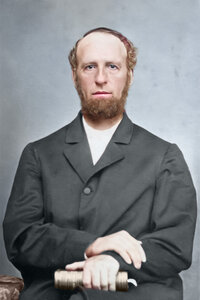
Joseph Harvey Waggoner was a Pennsylvania-born printer turned Sabbatarian Adventist preacher, evangelist, editor, and theologian whose thirty-seven-year ministry shaped the doctrinal and publishing infrastructure of the early Seventh-day Adventist Church. Converted to the third angel’s message in December 1851 in Baraboo, Wisconsin, he was ordained in 1854 and rose rapidly to a place of leadership: corresponding editor of the Review and Herald (from 1855), founding editor of the Pacific Health Journal (1885) and the American Sentinel (1886), and editor of the western Signs of the Times in succession to James White. He proposed the formation of a General Conference Association in June 1862 and helped draft its constitution the following May. He authored The Atonement in the Light of Reason and Revelation and several other influential pamphlets and books. He was the father of Ellet J. Waggoner, prominent in the 1888 righteousness-by-faith revival. Joseph H. Waggoner died of a brain aneurysm on April 17, 1889, in Basel, Switzerland, where he was serving as editor of the German Herold der Wahrheit and the French Les Signes des Temps.
Early Life and Conversion (1820–1851)
The General Conference Daily Bulletin obituary preserves the bare outline of Waggoner’s early life: “Joseph Harvey Waggoner was born in Pittston, Pennsylvania, June 30, 1820. His parents being poor, his early advantages for schooling were very meager. At the age of twelve he was apprenticed to learn the printing trade; and in this practical school nearly all of his education was obtained. After working at his trade as a young man in Pittsburg, he went West, settling in Wisconsin, where he conducted a newspaper and naturally took an active part in politics. Though brought up a Presbyterian, he early united with the Baptists, after closely examining the various evangelistic creeds.” (General Conference Daily Bulletin, February 20, 1899, page 33.9; refcode GCDB February 20, 1899, page 33.9).
The Ellen G. White Estate’s biographical sketch in Letters and Manuscripts records his Wisconsin residency at the moment of his conversion: “A prominent early Adventist editor, author, and evangelist, Joseph H. Waggoner was born in Pennsylvania and married Maryetta Hall in 1845. Among their 10 children was Ellet J. Waggoner, who, with A. T. Jones, was prominent in the 1888 righteousness by faith revival. At the time of their conversion to Sabbatarian Adventism in the winter of 1851-1852, Waggoner was editor of the newspaper Sauk County Democrat in Baraboo, Wisconsin.” (The Ellen G. White Letters and Manuscripts: Volume 1, p. 900, par. 5; refcode 1EGWLM 900.5).
Steinweg, in Lest We Forget, summarizes the December 1851 encounter that brought Waggoner into the Adventist faith: “It was a wintry December in 1851, when Waggoner, editor and publisher of a political newspaper in Baraboo, Wisconsin, first learned of the Adventist message.” (Lest We Forget, ch. 103, p. 192, ¶ 4). The same paragraph records the manner of his exposure to the message — Brothers H. S. Case and W. Phelps presenting the prophetic outline to him in a single hour.
Froom corroborates the same swift initial presentation: “JOSEPH HARVEY WAGGONER (1820-1889) was a product of the West, and a Baptist. He was editor and publisher of a political paper in Wisconsin, first hearing of the advent faith in 1851 from H. S. Case—previously noted—who in an hour’s time sketched over with him the entire range of the major prophetic periods, as well as the third angel’s message, the United States in prophecy, and the Sabbath in outline!” (The Prophetic Faith of Our Fathers, vol. 4, p. 1105, par. 1; refcode PFF4 1105.1).
Ordination and Early Itinerant Ministry (1852–1858)
Loughborough records Waggoner’s transition from journalism to itinerant ministry: “In the year 1852 Elder J. H. Waggoner, who had been conducting a county paper in Wisconsin, accepted present truth, and in the following year gave himself fully to the work of the ministry. In 1857 he wrote two very important pamphlets of about two hundred pages each. The first of these was entitled, The Nature and Tendency of Modern Spiritualism, and the second, A Refutation of the Age-to-Come” (The Great Second Advent Movement, p. 333, par. 2; refcode GSAM 333.2). The same paragraph records the impact of the first pamphlet: “The former has not only been a means of saving many from falling into that snare of Satan, but, with God’s blessing, it has opened the eyes of many who knew not what to make of these modern manifestations” (The Great Second Advent Movement, p. 333, par. 2; refcode GSAM 333.2).
The Ellen G. White Estate biographical sketch fills in the early itinerancy and editorial work: “Within a few months he began to propagate his new faith. Too poor to afford transportation, Waggoner often undertook his early evangelistic journeys on foot.” (The Ellen G. White Letters and Manuscripts: Volume 1, p. 900, par. 5; refcode 1EGWLM 900.5). The same paragraph adds: “After 1855 his preaching itineraries took him to various Midwestern states, and later, in the mid-1870s, to California. Waggoner was also a lucid and prodigious writer, publishing several hundred articles and a number of theological books, including The Nature and Tendency of Modern Spiritualism (1857), The Atonement (1884), and From Eden to Eden (1890).” (The Ellen G. White Letters and Manuscripts: Volume 1, p. 900, par. 5; refcode 1EGWLM 900.5).
The Crane’s Grove Sabbath Debate (August 1858)
Ellen White records, in Spiritual Gifts, the August 1858 conference at Crane’s Grove, Illinois, where Waggoner debated the Sabbath against J. M. Stephenson, a leader of the Age-to-Come faction: “In August, 1858, we attended a conference at Crane’s Grove, Ills. This was a meeting of considerable interest. It was immediately followed by a discussion of the Sabbath question between Elders J. H. Waggoner and J. M. Stephenson.” (Spiritual Gifts, vol. 2, p. 273, par. 1; refcode 2SG 273.1).
The same paragraph records the consequence of the debate: “The discussion resulted in some good in the place, as it established one dear sister who had become unsettled as to the Sabbath by Eld. S., and another sister, who was much prejudiced when we first visited the place by the statements of Eld. S., came out decided upon the truth.” (Spiritual Gifts, vol. 2, p. 273, par. 1; refcode 2SG 273.1).
Doctrinal Work and the Atonement (1863–1868)
Steinweg records the manner of Waggoner’s doctrinal collaboration with the central pioneers — James White, J. N. Andrews, Uriah Smith, and Ellen G. White: “Waggoner was instrumental in establishing the fundamentals of the truth of the Seventh-day Adventist Church.” (Lest We Forget, ch. 103, p. 193, ¶ 9). The same paragraph quotes J. O. Corliss’s recollection of the working method: “for Bible study on the points in question, and after much deep thought and free counsel together, they would all kneel, and plead the help of God for a correct understanding of what had been studied. At the next meeting Elder Waggoner would give clear-cut expression to the views arrived at” (Lest We Forget, ch. 103, p. 193, ¶ 9).
Steinweg records Waggoner’s own statement, in his preface to Atonement: In the Light of Nature (Reason) and Revelation, of his motive: “arrive at and disseminate truth, and to benefit the truth-loving people of God” (Lest We Forget, ch. 103, p. 193, ¶ 8). And his disclosure that the volume itself was a compilation of Review and Herald articles: “a series published in the Review and Herald from June 2, 1863 to September 13, 1864, written generally amidst a press of other labors” (Lest We Forget, ch. 103, p. 193, ¶ 8).
Health, Camp Meeting, and Ellen White’s Affirmation (1873)
Ellen White records the special operation of providence at one of the camp meetings to which both James White and Waggoner attended: “At our last camp meeting the angels of God in a special manner came with their power to lighten, to heal, and to bless both my husband and Brother Waggoner. A precious victory was there gained which should never lose its influence. I have been shown that God had in a most marked manner given my husband tokens of His love and care, and also of His sustaining grace. He has regarded his zeal and devotion to His cause and work. This should ever lead to humility and gratitude on the part of my husband” (Testimonies for the Church, vol. 3, p. 505, par. 1; refcode 3T 505.1).
California, the Signs of the Times, and the Pacific Press (1875–1885)
Loughborough records Waggoner’s 1875 move to California with James and Ellen White: “On Feb. 2, 1875, Elder James White and his wife, accompanied by Elder J. H. Waggoner and other efficient workers, arrived in Oakland. On the 12th of the same month a special session of the California Conference was called, to take into consideration a location upon which to erect buildings for the office of the Signs of the Times. After due deliberation, the decision was made to secure lots on the west side of Castro St., between 11th and 12th Sts.” (The Great Second Advent Movement, p. 292, par. 2; refcode GSAM 292.2).
Steinweg records Waggoner’s place at the heart of the church’s publishing work in the 1870s and 1880s: “By 1853, Waggoner had dedicated his life unreservedly to preaching the third angel’s message. His talents in the publishing field were employed many times, often in editorial capacities. In 1871, he was placed in charge of publications at Battle Creek. In 1881, he followed James White as editor of the western Signs of the Times. He was the first editor in 1885, of the Pacific Health Journal, (precursor of Vibrant Life), and, in 1886, of the American Sentinel, precursor of Liberty magazine” (Lest We Forget, ch. 103, p. 192, ¶ 6).
Arthur White records Waggoner’s standing among the senior ministers in the mid-1880s: “Joseph H. Waggoner, the senior minister, 64 years of age, a Sabbathkeeping Adventist since 1851. He was joint editor and publisher of a political newspaper in Wisconsin when he joined the church. In 1884 he was editor of the Signs of the Times” (Ellen G. White: The Lonely Years 1876-1891, vol. 3, p. 255, par. 4; refcode 3BIO 255.4).
Death (1889)
The General Conference Daily Bulletin obituary records Waggoner’s last move and his death: “In January, 1887, he went to Basel, Switzerland, and was connected with the publishing work there until his death, which occurred very suddenly, from aneurysm, after a long, hard day’s work, April 17, 1889” (General Conference Daily Bulletin, February 20, 1899, page 33.9; refcode GCDB February 20, 1899, page 33.9).
Spalding marks the loss for the early Adventist movement: “In 1883 John N. Andrews, laboring valiantly in the burgeoning cause in Europe, laid down his life. Joseph H. Waggoner, who took his place, fell six years later. Younger men were taking the places of the fallen veterans.” (The Story of Adventist Light, p. 79, par. 1; refcode TSAL 79.1).