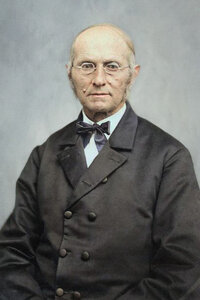
Joseph Harvey Waggoner’s thirty-seven-year ministry as an evangelist, editor, author, organizer, and administrator had a major impact in shaping the Seventh-day Adventist Church. A man of remarkable literary ability with only six months of formal schooling, he pioneered the Adventist message across four regions of the world and edited more newspapers and periodicals than any other Adventist pioneer.
Early Life and Education
Joseph Harvey Waggoner was born on June 29, 1820, in Pittston, Luzerne County, Pennsylvania, the second of eight children of Jacob Waggoner (1785-1858), a farmer, and Christiana Waggoner (1781-1850). His siblings included Levi, David, Phillipena, Mary, Hannah, Israel, and Malinda. The family had emigrated from England to America in the eighteenth century, migrating from Connecticut to New York and then to Pennsylvania.
On November 13, 1833, the thirteen-year-old Joseph witnessed an event that would mark his memory for life — the “falling of the stars,” an impressive Leonid meteor shower visible until dawn. Half a century later, he recalled the event: “Such a scene of glory I never expect to behold again until the heavens depart as a scroll, and Jesus with his myriads of shining angels appears.”
Joseph received only six months of formal schooling, primarily because elementary education in Pennsylvania was not free until 1834 and his help was needed on the family farm. Yet he developed remarkable practical and intellectual skills. He worked as a painter, carpenter, and construction worker, and labored part-time in a printshop setting type, where he learned correct grammar, spelling, sentence structure, and how to craft meaningful paragraphs. His early life was shaped by his family’s Presbyterian faith, their Anti-Masonic and abolitionist views, and the fact that the Underground Railroad passed near their home. These countercultural influences may in part explain why he was later willing to join the Sabbatarian Adventists.
Move to the Midwest and Marriage
In 1845, the Waggoners left Pennsylvania and moved to Portland, Illinois. There, on April 16, 1845, Joseph, age twenty-five, married Marietta Hall (1823-1908), age twenty-two. Marietta was the daughter of Samuel Hall and Betsey Elizabeth Martin, and the granddaughter of Ichabod Martin and a Narragansett Indian woman from Connecticut, making Marietta one-quarter Native American. After their wedding, Joseph and Marietta moved to the Wisconsin Territory, where their first six children were born: David (1846), Christiana (1848-1884), Ruby (1850-1913), Maryetta (1851-1921), Ellis (1853-1855), and Ellet (1855-1916) — this last son would later become one of the most prominent proponents of righteousness by faith in the Adventist Church.
In the 1840s, the Wisconsin Territory was a rugged, heavily forested wilderness where Native Americans roamed freely and the scattered settlers traveled by foot, horseback, or stagecoach. The Waggoners were so poor that they could not afford a horse and buggy. When John N. Loughborough first met Joseph Waggoner, he noticed that his boots were “badly worn.” To better provide for his family, Waggoner in 1851 became co-editor with George Clark of the Sauk County Standard in Baraboo, Wisconsin. He used the paper to advance the goals of the Liberty Party — abolition of slavery and equal rights for Blacks — and the Free-Soil Party, opposing the extension of slavery to western territories. But in March 1852 he resigned due to ill health and financial hardship.
Conversion and Early Ministry
In December 1851, a former Millerite invited Joseph and Marietta to hear Heman Case and Waterman Phelps, two Michigan Sabbatarian Advent preachers, speak on the seventh-day Sabbath, the Third Angel’s Message, the United States in Bible prophecy, and the end-time prophecies in Daniel and Revelation. After studying these subjects for a week, the Waggoners became Sabbatarian Adventists. As a result, they were expelled from the Baptist Church in Baraboo. Convinced that he should stop smoking, Joseph threw his pipes and cigars into the woodburning stove.
Some Adventist leaders initially doubted whether Waggoner could be saved because he had not been part of the 1844 movement. Ellen White, however, received a testimony encouraging him “to hope in God and to give his heart fully to Jesus, which he did.” His commitment was decisive and complete.
Waggoner began speaking in Adventist meetings and, “by circumstances rather than by choice,” became a preacher of Present Truth. From 1852 to 1855, he traveled around Wisconsin, Illinois, and Indiana, sometimes walking fifty to one hundred and ten miles between appointments. His shoes and clothes often wore out from these extensive travels. His preaching colleagues included Joseph Bates, John N. Loughborough, Merritt E. Cornell, and others. Waggoner quickly gained a reputation as a successful debater against Disciples of Christ and Age-to-Come opponents.
At a conference in Rosendale, Michigan, in April 1854, Waggoner was ordained to the gospel ministry. Three months later, the Review press in Rochester, New York, published 6,000 copies of his pamphlet The Law of God to combat antinomianism and promote the seventh-day Sabbath.
However, the lapse into Age-to-Come fanaticism by several of his colleagues in 1854 so depressed Waggoner that for a few months he quit preaching. In 1855, James White invited him to work in Michigan, so the family moved to Saline and later to Burlington in 1858, where believers raised $125 to purchase a house for the Waggoners — their home for the next thirty years.
Establishing Fundamental Truths
Waggoner played a central role in establishing the foundational doctrines of the Seventh-day Adventist Church. According to Elder J. O. Corliss, Waggoner met with Elders White, Andrews, and Smith, and Ellen G. White, “for Bible study on the points in question, and after much deep thought and free counsel together, they would all kneel, and plead the help of God for a correct understanding of what had been studied. At the next meeting Elder Waggoner would give clear-cut expression to the views arrived at, which, taken in conjunction with special instruction received from God through Sister White, would be accepted by all as positive truth. After this manner most of the fundamentals of the truth, as now held, became a part of the message.”
As a proponent of “Gospel Order,” Waggoner established several local churches and encouraged believers to convene regional gatherings in the 1850s. In 1858, he memorized the books of Daniel and Revelation as he traveled to meetings. He engaged in a six-month written debate on the Sabbath with the Baptist minister N. Fillio in Battle Creek, published in the Review and at the Israelite Office in Cincinnati.
Role in Church Organization
Waggoner was instrumental in the formal organization of the Seventh-day Adventist Church. In 1860, he was elected to the Review and Herald Board of Trustees. In June 1862, he was the first to propose forming a General Conference Association, and he helped draft its constitution in May 1863. In 1867, he was elected president of the Ohio Conference. As a member of the three-man General Conference Committee, he frequently served on its hymnbook, nominations, resolutions, publication, and auditing committees. In 1869, he helped organize the New England Conference.
Between 1870 and 1875, Waggoner’s administrative duties grew exponentially. He was reelected to the General Conference Executive Committee in 1870 and was sent as the Church’s delegate to the North American Advent Christian Conference session. He served as president of the Seventh-day Adventist Publishing Association, organized Tract and Missionary societies across the Midwest, wrote the constitution for the New England Tract and Missionary Society, and helped organize the first Health Reform Institute’s “hygienic festival” that hosted 750 Battle Creek citizens at an Adventist feast. In 1872, he chaired the contentious Dress Reform Convention that decided the specifications for the “reform dress.” He also cooperated with James White in organizing the first Battle Creek Biblical Institute for 150 ministers. At the General Conference session in Rome, New York, in 1882, Waggoner made the motion to increase the General Conference Committee from three to five men — the first change in twenty years.
A Prolific Writer
Waggoner unified the movement theologically by writing over 1,500 articles on doctrinal and practical subjects between 1852 and 1889 in the Advent Review and Sabbath Herald, Signs of the Times, Health Reformer, Pacific Health Journal, and the American Sentinel. His favorite topics included the Sabbath, God’s law, apocalyptic prophecy, spiritualism, healthful living, spiritual gifts, the atonement, baptism, religious liberty, and church order. He also composed three songs: “Trust” (1882), “Why?” (1882), and “Faith, Hope, and Love” (1883).
His published books covered a remarkable range of subjects. The Law of God: An Examination of the Testimony of Both Testaments (1854) was among the earliest Adventist doctrinal publications. The Nature and Tendency of Modern Spiritualism (1857) addressed the growing spiritualist movement. The Kingdom of God: A Refutation of the Age-to-Come (1859) was considered very timely. His Atonement in the Light of Nature and Revelation was praised for its clarity — originally published as a series in the Review and Herald from June 1863 to September 1864, “written generally amidst a press of other labors, and at intervals sometimes far apart.” Other works included Thoughts on Baptism (1881), The Church: Its Organization, Ordinances, and Discipline (1886), and his final book, From Eden to Eden (1888), which describes God’s plan for salvation from beginning to end.
On the relationship between law and gospel, Waggoner wrote with characteristic clarity: “The law, as a rule of right will form a perfect character, but cannot reform an imperfect one…. And there is precisely this difference between the law and the gospel. ‘By the law is the knowledge of sin;’ but the gospel is the remedy. The law points out the errors of character, the gospel reforms them.”
Ministry in California
In January 1875, Waggoner moved to California to pastor the Oakland and San Francisco Adventist churches. He and D. M. Canright held evangelistic meetings in Santa Rosa, Woodland, Vallejo, Stockton, Watsonville, and Gilroy. In 1876, Waggoner and Isaac D. Van Horn held evangelistic meetings in Oregon City and Salem, forming the North Pacific Mission. James White, Uriah Smith, and Waggoner organized a seventeen-day Biblical Institute at Oakland in 1877 for ministers.
In September 1878, he was elected editor of the Signs of the Times. His commitment to temperance led him to establish the first Health and Temperance Club at the Oakland Adventist church in October 1879, and he wrote the constitution for the California State Health and Temperance Society. In 1885, he was asked to edit the Pacific Health Journal and Temperance Advocate, and the next year he became editor of the American Sentinel — the precursor of Liberty magazine. He was thus editor or corresponding editor of more newspapers and periodicals than any other Adventist pioneer.
After the California Sunday law passed in 1882, Waggoner and William C. White were arrested and fined for operating the Pacific Press Publishing Company on Sunday. After 1,600 Jews, Seventh Day Baptists, Seventh-day Adventists, and Chinese workers were arrested and fined for Sunday labor, Waggoner and Uriah Smith organized a ten-week statewide campaign to abolish the Sunday law. A Democratic-elected Senate repealed the law on February 6, 1883.
Waggoner also helped establish Healdsburg College, chaired its board of trustees, and gave a ten-week series of lectures on biblical topics and church history to its twenty-six students in the fall of 1882.
Advocate of Health Reform and Religious Liberty
Waggoner was a strong advocate for health reform, which he viewed as integral to the Adventist message. He wrote that the health reform, “placed on a level with the great truths of the third angel’s message by the sanction and authority of God’s Spirit, and so declared to be the means whereby a weak people may be made strong to overcome, and our diseased bodies cleansed and fitted for translation, then it comes to us as an essential part of present truth, to be received with the blessing of God, or rejected at our peril.”
As an abolitionist and Free-Soil Democrat, Waggoner advocated for the freedom and equality of African Americans and against the spread of slavery. Throughout his career, he spoke, wrote, and debated in the interests of religious liberty and freedom of conscience against organizations that favored Sunday laws.
Champion of the Spirit of Prophecy
Waggoner was a firm champion of the prophetic gift given to the Adventist church through Ellen White. He helped Ellen revise the 1878 edition of her Testimonies and, in 1887, assisted Marian Davis in preparing Ellen White’s The Great Controversy for publication. The following year, he helped update the expanded edition of Life Sketches of James and Ellen White.
Ministry in Europe
In 1887, Waggoner and Marietta transferred their Burlington, Michigan, property to their children and left for Switzerland, where they resided in an upstairs apartment at the Imprimerie Polyglotte in Basel, the headquarters of the Adventist French and German publishing house.
In Europe, Waggoner served on the European Council and the Central European Publishing Board, helping decide what English books to translate into French and German and what journals to promote. In June 1888, he helped establish the Pieterlen School in Basel, the first Seventh-day Adventist educational institution in Europe. He preached at the first camp meetings on the European continent at Moss, Norway, and Tramelan, Switzerland.
Following the death of Buel Whitney in April 1888, Waggoner became editor-in-chief of the German paper Herold der Wahrheit and the French paper Les Signes des Temps. With the help of his multilingual staff, he published several tracts in French, German, and Russian, as well as German and French editions of the book Life of Christ. In March 1889, he completed his final book, From Eden to Eden, which appeared in French and German editions.
Death and Legacy
On Wednesday, April 17, 1889, Waggoner, feeling unwell, arose at 5:00 a.m. to stoke the fire and take some medicine in the kitchen. He died quietly in his sixty-ninth year of a brain aneurysm. He was buried on Sabbath, April 20, in a grave adjacent to that of John Nevins Andrews, his preaching partner in the 1850s and 1860s and his missionary predecessor to Switzerland. Their names were inscribed in gold letters on a common shaft of black granite.
On May 7, 1889, Marietta returned to Burlington, Michigan, where she lived with her son Ellery and his wife Nellie. Following a fatal fall, Marietta died on February 8, 1908, at the age of eighty-four.
Joseph Harvey Waggoner cast a lengthy shadow over the nineteenth-century Adventist Church. As an evangelist, he pioneered the Adventist message in the Midwest in the 1850s, in New England in the 1860s, on the West Coast in the 1870s and 1880s, and in Western Europe from 1887 to 1889. As an organizational innovator, he played key roles in incorporating local churches, building meetinghouses, establishing quarterly meetings, starting Tract and Missionary societies, forming Biblical Institutes, the Seventh-day Adventist Publishing Association, the General Conference, the Pacific Press Publishing Company, the Rural Health Retreat, the Pacific Coast Council, Healdsburg College, and the Pieterlen School. As a writer, he produced over 1,500 articles and twenty pamphlets and books, some translated into French and German. His son, Ellet Joseph Waggoner, continued his father’s theological legacy, becoming one of the most prominent proponents of righteousness by faith in the Seventh-day Adventist Church.
J. O. Corliss summed up the man with fitting words, calling him a “veritable tower of strength as a pioneer in the closing message of truth.”