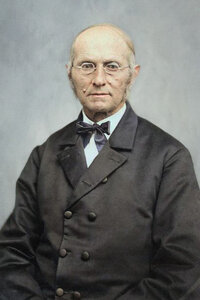
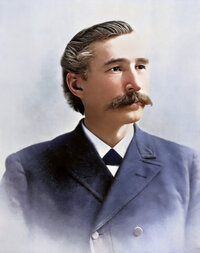
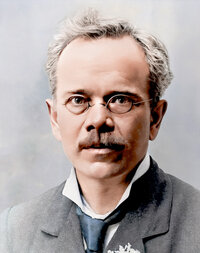
1807–1881
Summary
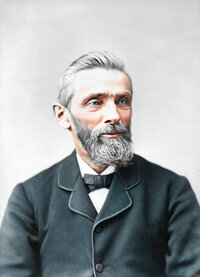
John Preston Kellogg was an early Sabbatarian Adventist farmer, broom-maker, and one of the four Michigan laymen whose July 1852 commitment of $300 each underwrote the relocation of the Review and Herald printing establishment from Rochester, New York, to Battle Creek, Michigan. He was the father of sixteen children — including Dr. Merritt Kellogg, Dr. John Harvey Kellogg, Albert Kellogg, and the cereal magnate Will K. Kellogg. He died in 1881.
Coming to the Sabbath (1852)
The Ellen G. White Estate’s biographical note on the Kellogg family records his trajectory: “The John P. Kellogg family eagerly followed truth as fast as they discovered it. By 1852 they were observing the seventh-day Sabbath through the efforts of Joseph Bates. In 1852 Kellogg had joined three other Adventist stalwarts in proposing to James White that they would underwrite the move of the printing establishment from Rochester, New York, to Battle Creek, Michigan, with a donation of $300 apiece—a heavy sum from their meager assets” (The Messenger of the Lord, p. 290, par. 4; refcode MOL 290.4).
The same paragraph names the broader contribution: “Later, Kellogg headed the list of subscribers for the first health institution of the Adventist Church. He fathered sixteen children, including Dr. Merritt Kellogg, Dr. John Harvey Kellogg, and Will K. Kellogg, the cornflake king. The Kellogg family was at the heart of the growing Adventist work in the midwest” (The Messenger of the Lord, p. 290, par. 4; refcode MOL 290.4).
Loughborough’s Great Second Advent Movement records Kellogg’s farm-sale sacrifice for the cause: “It was during this period that J. P. Kellogg, of Tyrone, and Henry Lyon, who lived near Plymouth, Mich., sold their farms, each worth about $3,500, for the sole purpose of having means to use in advancing the work; and thus did two more Michigan brethren step forward at an opportune time, with ready means and willing hearts to lift where help was most needed. The former engaged in the manufacture of brooms in Jackson, Mich., while the latter moved to Battle Creek, and labored at the carpenter’s trade to sustain his family” (The Great Second Advent Movement, p. 287, par. 1; refcode GSAM 287.1).
Ellen White’s 1856 Letter
Ellen White’s 1856 letter to Merritt E. Cornell, Dan R. Palmer, and John Preston Kellogg is preserved in Manuscript Releases. The Estate’s commentary on the letter records: “Letter to Merritt E. Cornell, Dan R. Palmer, and John Preston Kellogg.” (The Ellen G. White Letters and Manuscripts: Volume 1, p. 503, par. 4; refcode 1EGWLM 503.4). The letter dealt with Kellogg’s strained relationship with Brother Palmer in the Jackson, Michigan, group.
Death and Legacy (1881)
Spalding’s Footprints of the Pioneers records his pilgrimage to the Kellogg gravesite: “I trod as on sacred ground, in my itinerary in Michigan, when at Jackson I viewed these graves and at Battle Creek the resting places of Cyrenius Smith, John P. Kellogg, and the Cornells, daughters and sons-in-law of Henry Lyon” (Footprints of the Pioneers, p. 144, par. 1; refcode FOPI 144.1).
Per the Encyclopedia of Seventh-day Adventists, John P. Kellogg died in 1881 at the age of seventy-four. His sons John Harvey, Merritt G., and Will K. would each shape twentieth-century Adventism — Merritt as a pioneer physician at Battle Creek and the Pacific, John Harvey as the controversial superintendent of the Battle Creek Sanitarium (eventually disfellowshipped in 1907), and Will K. as the cereal magnate whose company would carry the Kellogg name into millions of breakfast tables.