1845–1923
Summary
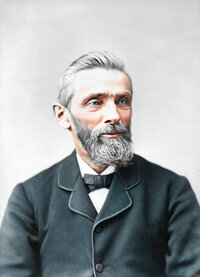
John Orr Corliss was a pioneering Seventh-day Adventist evangelist, editor, and religious-liberty advocate whose career spanned the United States, Australia, and Britain. Born in Topsham, Maine, on December 26, 1845, of Scottish and English ancestry, he served as a Union infantryman during the Civil War, was baptized into the Adventist faith by James White in 1868, and at twenty-three became chaplain and superintendent of the Battle Creek Health Reform Institute. From 1871 he labored as an evangelist in Michigan, Maine, Virginia, and California; sailed with S. N. Haskell’s pioneer company for Australia on May 10, 1885; helped establish the Echo Publishing House in Melbourne; organized the first Adventist church in Washington, D.C., in 1889; and contributed substantially to the standard Bible Readings for the Home Circle (1889). After a second Australian term (1893–1896) and decades of evangelistic, religious-liberty, and editorial service in California, he died at Glendale Sanitarium on September 17, 1923, in his seventy-eighth year.
From the Maine Coast to Battle Creek (1845–1868)
Per Milton Hook’s article in the Encyclopedia of Seventh-day Adventists, John Orr Corliss was born to Joseph and Jane (Morang) Corliss on December 26, 1845, at Topsham, Maine. His father died when John was scarcely five years old, and the boy passed through harsh treatment from an adopted father; at sixteen he entered an apprenticeship as a sailor and was converted to Christianity around 1862. He left the sea at nineteen, married twenty-year-old Susan Gowell in 1864, enlisted in the Thirtieth Regiment of the Maine Infantry, served through the closing year of the Civil War, and returned to Maine in 1865, where a Freewill Baptist minister baptized him in 1866. Susan died on November 16, 1867, and was buried at Oak Grove Cemetery in Bath. While grieving he came in contact with James and Ellen White, then evangelizing in New England with John Andrews; he accepted their invitation to Michigan, was baptized by James White in 1868, and that same year became superintendent and chaplain of the Battle Creek Health Reform Institute. He also married Julia Ann Burgess, an Ohio-born schoolteacher.
Arthur L. White’s Biography of Ellen G. White, vol. 3, records his connection to the Whites and Joseph Bates: “John O. Corliss, age 39. He became a Seventh-day Adventist in 1868; he was associated with James White for a time, and was tutored by Joseph Bates” (Ellen G. White: The Lonely Years, p. 256, par. 2; refcode 3BIO 256.2).
Corliss’s own testimony, preserved in Herbert E. Douglass’s Messenger of the Lord, recorded the unforgettable shape of life in the White household: “She was most careful to carry out in her own course the things she taught to others. For instance, she frequently dwelt in her public talks upon the duty of caring for widows and orphans, citing her hearers to Isaiah 58:7-10, and she exemplified her exhortations by taking the needy to her own home for shelter, food, and raiment. I well remember her having at one time, as members of her family, a boy and a girl and a widow and her two daughters” (Messenger of the Lord, p. 82, par. 1; refcode MOL 82.1).
The American Years (1868–1885)
Per ESDA, Corliss began his evangelistic career in 1871 in remote Michigan villages — Vernon, Mt. Pleasant, Le Roy — initially self-supporting (his wife Julia cooking for a saw-mill crew at two dollars a week). The Corlisses lost three of their first five children in those early years; Lulu (b. 1877) and William Burr (b. 1882) survived. He was ordained in October 1874 at the Lapeer, Michigan, camp meeting by James White, J. H. Waggoner, and Stephen Haskell. From 1878 to 1883 he evangelized in Virginia, Georgia, Minnesota, and Michigan; at the 1883 General Conference Session he moved the vote that admitted the new Virginia Conference into the denomination, and was granted the unusual privilege of selecting his own field of labor for 1884 — choosing California, where he worked at Healdsburg, Woodland, Oakland, and in Oregon.
Australia: The 1885 Pioneer Company
Loughborough’s Great Second Advent Movement records the moment of departure: “May 10, 1885, Elders S. N. Haskell, J. O. Corliss and his family, M. C. Israel and his family, Wm. E. Arnold, and Henry Scott sailed from San Francisco to open a mission in the Australian field” (The Great Second Advent Movement, p. 421, par. 1; refcode GSAM 421.1). The same paragraph preserves Ellen White’s prior testimony foreshadowing the work: “Eleven years before this time, in 1874, at a meeting held in Battle Creek, Mrs. White said that many nations would yet receive the truth, and that she had seen printing presses running, and books and papers being printed in various countries. When asked to specify what countries were referred to, the reply was that Australia was the only name she could remember” (The Great Second Advent Movement, p. 421, par. 1; refcode GSAM 421.1).
Ellen White’s own retrospective in 1885, sent to the wider church: “Now, in 1885, Elders S.N. Haskell and J.O. Corliss, with a company of workers, were sent to Australia to open up work in that southern continent” (Testimonies for the Church, vol. 5, p. 5, par. 2; refcode 5T 5.2).
A. G. Daniells’s later recollection, preserved in James R. Nix’s Passion, Purpose & Power: “Our work began in Australia in 1885, when Pastors [Stephen N.] Haskell, [John O.] Corliss, and [M. C.] Israel, also Brethren Henry Scott and William Arnold, came to this field” (Passion, Purpose & Power, p. 186, par. 1; refcode PPP 186.1).
Per ESDA, on arrival in Australia (Sydney, June 6, 1885) Corliss became managing editor of the Echo Publishing House at Melbourne (which he largely financed from his own funds), assisted M. C. Israel in five suburban Melbourne tent series through the 1885–1886 summer, transferred to Adelaide in October 1886 (where he organized the Adelaide church of thirty-four members in December), and conducted further series at Geelong, East St. Kilda, and elsewhere until his health collapsed in March 1887 and he returned to California.
Washington, D.C., the Bible Readings, and Religious Liberty (1887–1893)
Per ESDA, after recovery Corliss settled at Battle Creek and engaged in editorial and religious-liberty work. In 1889 he organized the first Seventh-day Adventist church in Washington, D.C., and joined A. T. Jones in appearances before a Senate committee opposing a constitutional amendment to “Christianize” public schools. He was a principal contributor and editor of Bible Readings for the Home Circle (1889), which became the denominational standard for the proof-text Bible-study method.
The Second Australian Term (1893–1896) and Ellen White’s Companion in Labor
The Corliss family returned to Australia at the close of 1893. Loughborough’s record of Ellen White’s Australian sojourn names Corliss among those who joined the work, the opening of the same paragraph: “In the fall of 1891, Mrs. E. G. White, her son, W. C. White, Elder Geo. B. Starr, and others left California for Australia, arriving there in December” (The Great Second Advent Movement, p. 422, par. 6; refcode GSAM 422.6). And in the same paragraph, after Loughborough’s tribute to Ellen White’s testimony in that field: “During the time they were in Australia Elder J. O. Corliss again connected with the work here, and W. A. Colcord and others entered the field as ministers, teachers, etc.” (The Great Second Advent Movement, p. 422, par. 6; refcode GSAM 422.6).
Ellen White’s own diary from 1895 records her companionship with Corliss in the Australian fieldwork: “On Sabbath, July 28, Brother Corliss was appointed to go to Seven Hills to meet with the little church in that place. Brother Hickox had left this place to join Brother Starr in Queensland in the beginning of the work there. For a week I had been feeling quite ill from exhaustion and heart-affection and as I felt sure that the more I was in the open air the better it would be for me, I decided to make the journey with Brother Corliss” (Ellen G. White in Australia, p. 178, par. 1; refcode EA 178.1).
The same diary continues in the next paragraph: “The meetings was held in a private house, and as the room was well filled, I did not venture to remain indoors, but sat in my carriage until Brother Corliss had finished his labors. He gave a Bible reading which interested the little flock” (Ellen G. White in Australia, p. 178, par. 2; refcode EA 178.2). And in the same diary, the next paragraph: “When Brother Corliss had concluded his reading, I went into the house, and spoke for a short time. The Lord strengthened and blessed me as I presented the all-sufficiency of our Saviour” (Ellen G. White in Australia, p. 178, par. 3; refcode EA 178.3).
Per ESDA, illness once more cut short his work; the Corlisses left Australia from Albany on April 18, 1896.
Final Decades and Death (1896–1923)
Per ESDA, Corliss taught Bible classes at Battle Creek Sanitarium for medical and nursing trainees in 1897 and 1898, served briefly in Canada, returned to California in 1899, served twelve months as vice-president of the British Union Conference (1902–1903), and through his last twenty years labored on the Pacific Union Conference executive committee and as field director and correspondence secretary for its religious liberty department. Julia Corliss died of pneumonia at the Glendale camp meeting on August 16, 1912; in 1913 John married her younger sister Florence Betsy Burgess.
His last Sabbath service was preached at the Pasadena church on September 8, 1923. He fell ill that same evening, was taken to Glendale Sanitarium, and died there on September 17, 1923, in his seventy-eighth year. He is buried at Forest Lawn Memorial Park, Glendale; his headstone bears the insignia of Union Army veterans. His daughter Lulu Gregory was at the time engaged in self-supporting missionary work in Brazil; his son Burr was a physician in California.