1829–1883
Summary
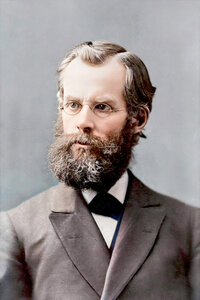
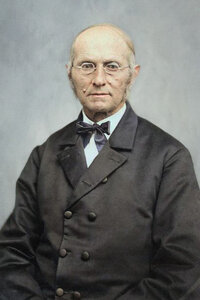
John Nevins Andrews was a pioneer Adventist scholar, evangelist, editor, and the first official overseas missionary of the Seventh-day Adventist Church. Born in Poland, Maine, on July 22, 1829, he embraced the seventh-day Sabbath as a teenager in 1845 and emerged as one of the central pioneers of Sabbatarian Adventism alongside James and Ellen White and Joseph Bates. Author of the standard History of the Sabbath and First Day of the Week (1859, expanded 1873), he served three separate terms on the General Conference Executive Committee, was president of the General Conference (1867–1869), edited the Review and Herald, and was sent to Switzerland as the church’s first official missionary in 1874. He died of tuberculosis at Basel, Switzerland, on October 21, 1883.
Early Life and Conversion (1829–1844)
Steinweg, in Lest We Forget, records the bare outline: “Andrews was born July 22, 1829 and spent his childhood and youth quietly with his parents and brother, William, in Paris, Maine” (Lest We Forget, ch. 135, p. 259, ¶ 13). And his early Methodist instruction: “His spiritual training included faithful attendance at Methodist meetings.” (Lest We Forget, ch. 135, p. 259, ¶ 14).
Steinweg records his entry into the Millerite movement and the disappointment: “In January of 1843, Andrews became a Christian and accepted the Advent message. His family was soon caught up in the Millerite teaching of Christ’s coming to cleanse the earth. When Christ failed to return to earth on October 22, 1844 as they believed, they, too, were deeply discouraged. In 1845, after reading Preble’s treatise on the Sabbath, Andrews began observing the seventh-day Sabbath” (Lest We Forget, ch. 135, p. 260, ¶ 16).
Steinweg also preserves a striking 1844 incident, surmised by date, when the fourteen-year-old Andrews defended a brother from an angry mob at the Paris bridge. The story is given in dramatic form, with Andrews’s recorded reply: “We are commanded to bear one another’s burdens. If you whip Brother Davis, you must whip me also.” (Lest We Forget, ch. 135, p. 259, ¶ 8).
Early Ministry (1850–1859)
Steinweg records Andrews’s first writings in the Present Truth and his appointment to the publishing committee: “Andrews first began writing in The Present Truth. In the fall of 1850, he was appointed to the publishing committee that supported editor, Elder James White. In the Review of May, 1851, a five-page commentary on the thirteenth chapter of Revelation was published by Andrews identifying for the first time the United States of America as the two-horned beast” (Lest We Forget, ch. 135, p. 261, ¶ 19).
Loughborough corroborates the May 1851 article on the two-horned beast and what it argued: “About this time J. N. Andrews, who resided in Paris, Maine, began his public labors as a minister of the gospel and a writer on religious topics. In the Review for May, 1851, he had an article occupying over five pages on the subject of the three messages. In this he applied the prophecy of the two-horned beast of Revelation 13 to the United States, taking the position, on the strength of the prophecy alone, that the enforcement of Sunday as the Sabbath would be the point on which a union of church and state would finally be founded in this nation” (The Great Second Advent Movement, p. 284, par. 2; refcode GSAM 284.2).
Froom places Andrews in the context of those who developed the two-horned-beast interpretation: “John N. Andrews, Adventist historian of the Sabbath, was one of the first, at this time, to develop this exposition in well-rounded form. We pause to consider Andrews first, and then turn to this intriguing symbol” (The Prophetic Faith of Our Fathers, vol. 4, p. 1093, par. 1; refcode PFF4 1093.1).
Steinweg records his early itinerancy with Samuel Rhodes and his ordination: “In December, 1851, at twenty-one, Andrews worked as a traveling evangelist with Samuel Rhodes.” (Lest We Forget, ch. 135, p. 261, ¶ 20). The same paragraph continues: “John N. Loughborough attended a series of conferences by Andrews in 1852 in Rochester, New York, where he learned and accepted Present Truth. In 1853, Andrews was ordained by Elder White” (Lest We Forget, ch. 135, p. 261, ¶ 20).
Steinweg records the cost of Andrews’s first three years of labor on his health: “Andrews was physically exhausted by 1855” (Lest We Forget, ch. 135, p. 261, ¶ 21).
The Disappointment Statement and the Sanctuary (1844–1851)
Loughborough preserves an introductory phrase to Andrews’s first-person account of October 22, 1844: “Elder J. N. Andrews, one who passed through this experience in 1844, thus speaks of the disappointment” (The Great Second Advent Movement, p. 196, par. 1; refcode GSAM 196.1).
Andrews’s own statement on the post-1844 sanctuary doctrine, as Loughborough preserves it: “The opening of the holiest of all in the temple of heaven by which the ark is seen, is an event that takes place under the sounding of the seventh angel. And as the ministration of our great High Priest is changed to that apartment at the termination of the twenty-three hundred days, we understand that the opening of the temple is marked by the termination of that period as represented by the proclamation of the first angel. The entrance of our High Priest to the most holy place to minister before the ark of God, calls the attention of the church to the commandments of God contained with that ark. The commandments of God have been shining out from the heavenly sanctuary since that time.” (The Great Second Advent Movement, p. 248, par. 1; refcode GSAM 248.1).
Loughborough also preserves Andrews’s eyewitness statement (from his September 1874 letter) on Ellen Harmon’s role with respect to the shut-door fanaticism in Paris, Maine: “J. N. Andrews, who resided in Paris, Maine, in 1844 and 1845, and who was fully conversant with the course of the people there, as well as with that of Joseph Turner, who taught that there was no more mercy for sinners, says of Miss Harmon’s position on the subject at that time” (The Great Second Advent Movement, p. 222, par. 2; refcode GSAM 222.2).
The First Overseas Missionary (1874)
Spalding, in The Story of Adventist Light, places Andrews at the head of the early circle of those drawn into Christian fellowship: “They joined forces with Joseph Bates as their doctrinal views came to coincide; they encouraged young and promising workers like John N. Andrews of Maine, George Holt of Connecticut, and John N. Loughborough of New York to enter the ministry” (The Story of Adventist Light, p. 35, par. 2; refcode TSAL 35.2).
Froom records Andrews’s selection as the first overseas Seventh-day Adventist missionary: “When the new transcontinental railway was opened up, he advocated pushing the work of the church to the West Coast. He wrote the first Sabbath school lessons in 1852. He promoted the church’s first overseas foreign missionary venture—sending John N. Andrews to Europe in 1874—and today Adventists operate one of the most extensive foreign mission enterprises in the world.” (The Prophetic Faith of Our Fathers, vol. 4, p. 1060, par. 2; refcode PFF4 1060.2).
Death (1883)
Per the Encyclopedia of Seventh-day Adventists (Gilbert M. Valentine), Andrews died of tuberculosis at Basel, Switzerland, on October 21, 1883, six years after his Swiss arrival, having established the European publishing work and seen the first European camp meetings. Spalding’s The Story of Adventist Light marks the loss for the early Adventist movement: “In 1883 John N. Andrews, laboring valiantly in the burgeoning cause in Europe, laid down his life. Joseph H. Waggoner, who took his place, fell six years later.” (The Story of Adventist Light, p. 79, par. 1; refcode TSAL 79.1).