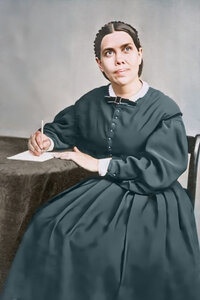
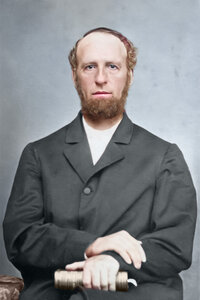
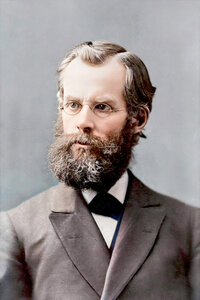
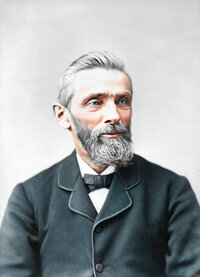
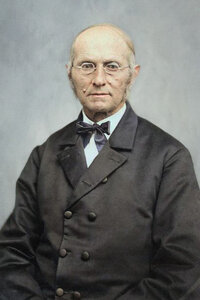
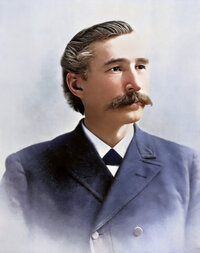
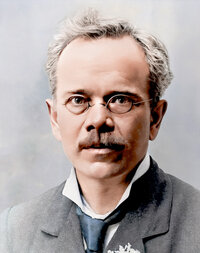
A pioneer writer and scholar-evangelist, John Nevins Andrews exercised wide influence in the early Seventh-day Adventist Church, serving alongside James and Ellen White and Joseph Bates as one of the inner circle of leaders involved in founding the movement. Called “the ablest man in our ranks” and “the intellectual giant of early Adventism,” he helped shape the church’s theology, defended its doctrines through rigorous scholarship, served as General Conference president, and in 1874 became the first official overseas missionary sent by the church. His nearly forty years of tireless labor left an indelible mark on the Advent movement.
Early Life
John Nevins Andrews was born on July 29, 1829, in a sparsely settled farming community of southeastern Maine known as East Poland, about thirty-five miles northwest of the coastal city of Portland. On his father’s side, he could trace his forebears back through seven generations to a Henry Andrews who migrated to the American colonies in 1630 and settled in Boston, Massachusetts. His great-great-grandfather David Andrews served in the War of Independence and then in 1784 moved his family to North Paris. John’s father, Edward Andrews (1797-1865), was born in North Paris but as a boy was sent to live with his maternal grandparents, John and Elizabeth Nevins, to help work their farm. In 1827, Edward married Sarah Pottle, the daughter of a well-to-do family in Minot.
John grew up as an eldest son in a farming community surrounded by a close network of nine uncles and aunts that included farmers, a lawyer, merchants, and a land developer. His only sibling, a crippled younger brother William, was born in 1834. On his mother’s side, he inherited both European and British traditions shaped by a rich New England culture that valued individual liberty, family, religious faith, loyalty, and above all, duty.
John’s spiritual training began early. At the age of five, he was deeply impressed when a Methodist circuit preacher solemnly read Revelation 20:11 about the “Great White Throne” of judgment. He later recalled, “I have rarely read the passage without remembering that discourse.” When he learned to read, the Bible became one of his favorite books.
In 1843, at the age of fourteen, Andrews attended a secondary school in Dixfield for six months while staying with his Aunt Persis, a teacher, and Uncle Charles, an attorney who had served in the Maine legislature. According to his Aunt Persis, John was “a fine, promising boy — a very fine scholar and strictly moral.” He was well versed in Latin, algebra, and English grammar, but “better than all” he had “first rate common sense.” His Uncle Charles was willing to sponsor him through law school, but when John understood the three angels’ messages, he felt the Lord’s call to make known the true Sabbath and the soon coming of the Lord. Ellen White later wrote that he “was a self-educated man. I do not think he was in school a day after he was eleven years old…. His thirst for education was great, yet he could not spare the time nor the means to take a regular course.”
Conversion and the Great Disappointment
In January 1843, at age thirteen, Andrews became a Christian and accepted the Advent message under the conviction of the Millerite message about the soon coming of Christ. The Millerite movement “spread like wildfire” around John’s home, winning large numbers in “every part of town.” Andrews and his family committed to the movement and formed a small Millerite congregation in North Paris.
The Great Disappointment of October 22, 1844, proved to be a severe upheaval for Andrews’s family. Shortly before October 22, the barely fourteen-year-old Andrews demonstrated remarkable courage at a bridge in Paris, Maine. When a man from an angry mob attacked a fellow Adventist, Brother Davis, with a horsewhip, Andrews threw his arms about Davis and declared, “We are commanded to bear one another’s burdens. If you whip Brother Davis, you must whip me also.” Confounded and not wishing to whip a boy, the man drew back with the mob and let them pass.
After the Disappointment, the community struggled to understand their experience. Unusual practices were adopted as they worked through their crisis of faith. In mid-1845, Andrews encountered Seventh Day Baptist teaching concerning the continuing sacredness of the seventh-day Sabbath and made the decision to become a Sabbath keeper — a decision that shaped the rest of his life.
In September 1849, Ellen and James White, together with Joseph Bates, visited North Paris and succeeded in reviving the Sabbatarian Adventist group. Andrews, after some struggle, enthusiastically accepted the new understanding. He was moved to exclaim, “I would exchange a thousand errors for one truth.” Ellen White later commented: “The Lord was bringing out Brother Andrews to fit him for future usefulness, and was giving him an experience that would be of great value to him in his future labors.”
Early Ministry and Scholarly Contributions
Shortly after the 1849 conference, Andrews moved with his parents to Paris Hill. In October 1850, James and Ellen White moved to board with the poverty-stricken Andrews family. Here, writing copy on the kitchen table, John joined James and Ellen in preparing the first issues of the Review and Herald, destined to become the flagship publication of the Seventh-day Adventist Church. He was a member of the initial “publishing committee” and would be associated with the magazine for the next thirty-two years until his death.
In December 1850, Andrews began his itinerant ministry traveling through Vermont, New Hampshire, and Maine with older former Millerite preacher Samuel Rhodes, focusing on persuading former Millerites of the Sabbath and sanctuary truth. In the Review of May 1851, he published a five-page commentary on Revelation 13, identifying for the first time the United States of America as the two-horned beast — a landmark contribution to Adventist prophetic interpretation.
During his first three years of labor, Andrews “conducted evangelistic meetings in 20 different localities in Maine, New Hampshire, Vermont, New York, Ohio, Michigan, and Eastern Canada, and published 35 articles, totaling some 170,000 words.” In late October 1853, at age twenty-four, Andrews was among the first small group of Sabbatarian Adventist ministers to be ordained to the gospel ministry at a conference in Newhaven, Vermont.
Andrews’s systematic expositions were based on the conviction that “truth” rested on facts and that when facts were clearly established, truth could be seen as “self-evident.” James White regarded Andrews, who was ten years his junior, as a Melanchthon-type colleague and supported his fearless approach to defending their doctrine.
By 1854, the pressure of writing and editing while engaged in itinerant evangelism began to wear away at Andrews’s health. He returned penniless and with broken health to his parents’ home in late April 1855.
Marriage and Family
In November 1855, Andrews migrated with his parents 1,400 miles west to the prairies of Waukon, in northeast Iowa, seeking a more healthful climate. Eleven months later, on October 29, 1856, he married Angeline Stevens (1824-1872), a childhood friend from Paris Hill. They had four children: Charles Melville (1857), Mary Frances (1861), an unnamed baby girl who lived only four days (1863), and Carrie Matilda (1864), who died of dysentery at thirteen months. In his wife’s eulogy, Andrews wrote with tender devotion: “No unkind word ever passed between us, and no vexed feeling ever existed in our hearts.”
Angeline died from a stroke on March 19, 1872, at forty-eight years of age. The family was devastated. Andrews placed his house on the market and moved with his two children to South Lancaster, Massachusetts, trying to assuage his grief in study.
Key Leadership Roles
Andrews’s contributions to the Adventist cause were vast:
Editor of the Review and Herald: He served as the third editor after James White and Uriah Smith, taking over in 1869 during a period of crisis when Smith was temporarily relieved of his editorship. Under Andrews, the paper took on a more intense exhortatory and revivalist focus.
President of the General Conference: At the 1867 session, Andrews was elected president when James White was too ill to carry executive responsibility. He served two terms (1867-1869), navigating the difficult period of White’s slow health recovery while the church expanded its horizons.
Sabbath observance: His research established the biblical basis for sunset-to-sunset observance of the Sabbath, proving exceptionally helpful in preserving unity in the young church.
Systematic Benevolence: In February 1859, Andrews led out in a Bible study in the Loughborough home in Battle Creek that developed the plan of tithing annual increase to support itinerant ministers.
History of the Sabbath: His expanded 512-page History of the Sabbath (1874) was celebrated as “the weightiest and most serious scholarly publication the church had yet produced.” A reviewer in the Sabbath Recorder was sure the book would “become a standard work.” A revised edition was issued in 1887, and in 1908 a further expanded edition acknowledged the joint authorship with Louis R. Conradi.
Noncombatant status: In August 1864, Andrews was appointed by the General Conference to present documents to the Provost Marshal in Washington, D.C., making the church’s case for noncombatant status during the Civil War. His successful securing of recognition marked the first formal interaction between the Seventh-day Adventist Church and the United States government.
Health reform: Andrews played a significant formative role in introducing health reform ideas to the Adventist community. In 1864, he sent his six-year-old son Charles to Dr. Jackson’s sanitarium at Dansville with a severely lame leg. Over three months, Charles responded well to hydrotherapy treatments and returned home cured. Andrews himself testified that health reform relieved him of “long-continued digestive distress, and catarrh and other ailments.”
First Missionary to Europe
On September 15, 1874, John Andrews left Boston for Neuchatel, Switzerland, as the first official overseas missionary of the Seventh-day Adventist Church. He was accompanied by his sixteen-year-old son Charles and twelve-year-old daughter Mary, and a Swiss Sabbath-keeper, Ademar Vuilleumier. Ellen White strongly encouraged Andrews to remarry before starting for Europe, but he did not take her advice.
A group of about fifty adult Swiss Sabbath-keepers in several mountain villages had invited the church to send a missionary. Andrews was the designated correspondent, having mentored one of their young trainee ministers, Jakob Erzberger, in his Rochester home in 1870.
The mission coincided with the longest and deepest financial recession of the modern era, and the expectation that the mission would quickly become self-supporting did not work out. Extreme financial pressures, the conservative social circumstances of Europe, and a lack of experience in cross-cultural relations posed immense challenges. Frequently impoverished, Andrews’s family suffered economic hardship that severely threatened their well-being.
To learn French more quickly, the family signed a pact to speak English only between five and six P.M. and for emergencies. Mary became proficient in French within two years and was an invaluable editorial assistant and proofreader. He wrote of Charles in 1876: “He is perfectly steady and quiet and gives me no trouble. He is my companion by day and by night, and seems to prefer my company to that of any young person…. I should not know [how] to live without him.”
Birthed in July 1876 with Andrews as editor, Les Signes des Temps was intended to develop a readership supported by village-based evangelistic preaching programs. By the year of his death, its circulation had expanded to 5,000 copies per month. Andrews also established Adventism’s first German church through pioneering evangelistic meetings.
Final Years and Death
Poor diet, poor sanitation, and overwork took their toll. Mary developed tuberculosis and passed away on November 27, 1878, at the Battle Creek Sanitarium. Andrews was shattered by the loss. He stayed in the United States for five months trying to regain his health before returning to Europe.
During his last four years, Andrews assisted in the British Mission, introduced innovations in Les Signes des Temps, and worked to expand its circulation. The onset of consumption, contracted from Mary in 1878 and formally diagnosed in September 1880, increasingly diminished his energies, confining him to home and sometimes to bed. With exceptional determination, he continued his editorship. He said near the end, “I seem to be having hold upon God with a numb hand.”
Andrews died of tuberculosis on October 16, 1883, and was buried in Basel, Switzerland. His son Charles married Maria Anne Dietschy and returned to Battle Creek, working at the Review and Herald Publishing House. Charles and Maria had three children, including John Nevins II, who became a doctor and missionary to China.
Legacy
John Nevins Andrews has been called “the foremost Adventist intellectual of the 19th Century.” Uriah Smith, in the obituary he wrote for his brother-in-law, credited Andrews with being “especially instrumental in bringing out light upon the subjects of the Sanctuary, the United States in Prophecy and the Messages of Revelation 14.” A tribute at his death declared: “Few men have left behind them a record of greater purity of life, or of more earnest effort for Christ and humanity. His indefatigable labors did more, perhaps, than any other man, to develop the Bible evidence of the views advocated by this people.”
In 1960, the trustees of the Seventh-day Adventist flagship university in Berrien Springs, Michigan, renamed the institution Andrews University in tribute to his scholarly legacy and pioneering spirit. A bronze statue of Andrews and his children, “Legacy of Leadership,” created by English-born artist Allan Collins in 1998, occupies a central place on the campus and commemorates the commitment Andrews and his family made to Adventist mission.
As Annie R. Smith wrote in her hymn: “And there was one who left behind / The cherished friends of early years. / And honor, pleasure, wealth resigned, / To tread the path bedewed with tears. / Through trials deep and conflicts sore, / Yet still a smile of joy he wore; / I asked what buoyed his spirits up, / ‘O this!’ said he — ‘the blessed hope.'”