1798–1887
Summary
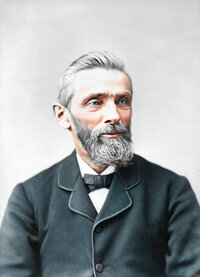
John Byington was a Methodist circuit-riding preacher in upstate New York who became, after his fifty-fourth year, a Sabbatarian Adventist; eleven years later, when James White declined the office for personal reasons, Byington was elected the first president of the General Conference of Seventh-day Adventists at its founding session in May 1863. He was an active abolitionist and Underground Railroad agent in the Methodist years, built the first Sabbath-keeping Adventist meetinghouse in New York, moved his family to Michigan to work alongside the Whites, and spent the next thirty years on the Michigan and northern Indiana preaching circuit until his death in his eighty-ninth year.
Early Life and Methodist Ministry (1798–1843)
The Adventist Pioneer Library compilation Lest We Forget records Byington’s beginning in detail. Of his birthplace and parents: “He was born on October 8, 1798, The sixth of ten children of Mr. and Mrs. Justus Byington of Hinesburg, Vermont” (Lest We Forget, ch. 26, p. 56, ¶ 3). LWF adds in the same paragraph that “Much of his commitment and moral courage is seen reproduced in the life work of his son” (Lest We Forget, ch. 26, p. 56, ¶ 3). The same chapter records the next stage: “John was baptized into the Methodist church shortly after his seventeenth birthday. Not long after he became one of the church leaders, and was given license to preach as a lay preacher, then called “an Exhorter”. As a circuit riding pastor, he worked to support himself, rode, and preached, visiting homes of the needy in his district” (Lest We Forget, ch. 26, p. 56, ¶ 4). A health collapse at age twenty-one took him to New Haven, Connecticut, for three years before he returned to Vermont and the circuit; “the soil, the plow, and preaching on the circuit are for me and mine” (Lest We Forget, ch. 26, p. 56, ¶ 5).
He married twice. Lest We Forget records: “He married Mary Ferris in Vermont, and their first child, Caroline, was born in 1828. After Mary’s death, John moved to Buck’s Bridge, New York. There he married Catharine Newton from Vermont in 1830” (Lest We Forget, ch. 24, p. 53, ¶ 2). Of the move to upstate New York and his role in the local Methodist congregation: “After his move to Buck’s Bridge, near the St. Lawrence River in northwest New York, he helped build a house of worship for the Methodist Church around 1837. Slavery became a major issue in the Methodist churches, and a greater issue to John Byington” (Lest We Forget, ch. 26, p. 56, ¶ 6).
Anti-Slavery Activist
Douglass’s Advent Pioneers sums Byington’s anti-slavery decade: “John Byington was a Methodist circuit rider before he became a Seventh-day Adventist preacher. He was also a vigorous opponent of slavery and his home was said to have been a station on the old underground railroad that offered shelter for slaves who escaped from the South and sought their freedom” (Advent Pioneers Biographical Sketches and Pictures, p. 8, par. 2; refcode APBP 8.2). LWF records his pulpit position in his own words: “Slavery is an outrage. It is a sin. Let us pledge ourselves to use all legal means in our power by preaching, praying, and voting against this unchristian institution” (Lest We Forget, ch. 26, p. 56, ¶ 6).
Embracing the Sabbath (1844–1852)
Byington had heard the Millerite preaching of 1844 but accepted neither the date nor, at that time, the Advent message. Lest We Forget records: “In 1844, Byington heard sermons on the soon coming of Christ. The lectures of William Miller had stirred his entire community. He himself had made a thorough study of the prophecies, but he did not understand some points. Being a cautious man, he was slow to accept new theories” (Lest We Forget, ch. 26, p. 57, ¶ 7). The decision came eight years later, on the day of a daughter’s funeral: “Eight years later, in 1852, H. W. Lawrence gave him a copy of the Review and Herald containing articles on the seventh-day Sabbath. On March 20, 1852, the day of the funeral of his fifteen year-old daughter, Teresa, he made his decision to observe the seventh-day. On July 3, G. W. Holt baptized John and Catharine and two of the older children in the Grasse River near Buck’s Bridge, New York” (Lest We Forget, ch. 26, p. 57, ¶ 7). Douglass adds the broader frame: “He did not accept the Seventh-day Adventist message until he was past fifty. Then he became a vigorous preacher of the truth. He helped organize one of the first Seventh-day Adventist churches, in Buck’s Bridge, New York” (Advent Pioneers Biographical Sketches and Pictures, p. 8, par. 2; refcode APBP 8.2).
The Buck’s Bridge home soon became a hub for Vermont and New York Sabbatarian Adventists. Lest We Forget records a detail of his wife’s labor: “Vermont and New York Adventists often convened at Buck’s Bridge. One year Catharine wove long webs of cloth on her loom, and then sewed the strips together for a tent in which to meet” (Lest We Forget, ch. 24, p. 53, ¶ 3).
Building the Sabbatarian Cause (1855–1858)
In 1855 Byington built the first Sabbath-keeping Adventist meetinghouse in New York, adjacent to the Methodist church he had built earlier. Lest We Forget records the sequence and the move that followed: “In 1855, John helped build the first SDA church to be constructed, adjacent to the Methodist church he had built. After demonstrating leadership ability at Buck’s Bridge, James and Ellen White invited the Byingtons to come to Battle Creek in 1858 to help in the work there. He bought a farm at Newton, near Battle Creek, Michigan, and then brought his family there. Between his trips of ministering to the scattered flocks, he would return to care for the farm” (Lest We Forget, ch. 26, p. 57, ¶ 8). Douglass marks the year of the move and a saying that followed: “In 1857 John Byington moved from New York to Michigan. He did evangelistic work, criss-crossing the country with horse and buggy. People would say, “No one knows Michigan like John Byington”” (Advent Pioneers Biographical Sketches and Pictures, p. 8, par. 8; refcode APBP 8.8).
First General Conference President (1863–1865)
The question of formal church organization had divided Sabbatarian Adventists for years. Lest We Forget records both the resistance to organization and the reason James White stepped aside: “There was a strong belief in many believers that the church should not be organized, that it would make them like the churches out of which they had come. A leader in the drive to organize, James White felt that there had been sufficient resistance to his work to make his being the president difficult and very likely ineffective. John Byington, often called Father Byington, accepted the presidency of the first General Conference, May 20-23, 1863, after James refused it” (Lest We Forget, ch. 26, p. 57, ¶ 9).
The full opening sentences of LWF chapter 26 set out why Byington was the right choice for the founding presidency: “The story of John Byington is remarkable, not because any doctrine had its origin with him, or because of any role in the great disappointment. His story is remarkable, solely due to the multitude of ways he provided for the spiritual and physical needs of the church, both as an organization and to its members individually” (Lest We Forget, ch. 26, p. 56, ¶ 2).
Michigan Itinerant (1857–1886)
Byington’s two one-year terms as General Conference president (1863–1865) ended without his stepping back from itinerant preaching. Lest We Forget records: “In Michigan he ministered for the next twenty-two years. Frequently his Catharine would accompany him. These trips took him to Port Huron and Saginaw on the east and as far north as Muskegon on the west. These ministering tours were not just Sabbath meetings, but they were daily intercourse with the people. He ate with them and prayed with them, sleeping in their homes when invited” (Lest We Forget, ch. 26, p. 58, ¶ 10).
After Catharine’s death in 1885, the elderly preacher continued his rounds. Lest We Forget records his recorded resolutions and his last diary entries: “After his wife’s death, he continued visiting and he never lost his love for the young people. “I must feed the lambs of the flock,” he wrote. At one time, when he was unable to attend prayer meeting, he sent a message to them on a little slip of blue paper, “Tell, O tell them, to leave the world, and come to their Saviour!” On Friday, December 3, 1886, he wrote, “This is a day of comfort and peace. I have felt my sins were very many; have asked and found mercy of the Saviour, and would declare His loving-kindness to all.”” (Lest We Forget, ch. 26, p. 58, ¶ 11).
Death
Douglass’s Advent Pioneers records the dates that bracket Byington’s life in a single line: “FIRST GENERAL CONFERENCE PRESIDENT October 8, 1798 — January 7, 1887” (Advent Pioneers Biographical Sketches and Pictures, p. 8, par. 1; refcode APBP 8.1).
He outlived Joseph Bates and most of the Millerite generation that had gathered around the Whites in the 1840s, and saw the small Battle Creek work of the 1850s grow, in his lifetime, into an organized denomination with congregations across Michigan and beyond.