1821–1881
Summary
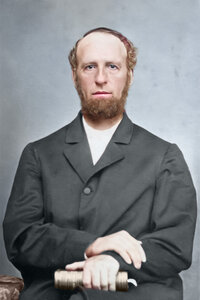
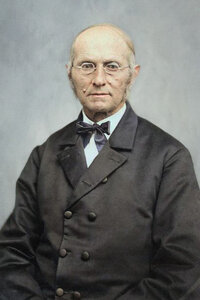
James Springer White was, with Joseph Bates and his wife Ellen G. White, one of the three founders of the Seventh-day Adventist Church. Born in Palmyra, Maine, on August 4, 1821, he was converted in the Christian Connexion, embraced William Miller’s advent message in 1842, and became one of the most successful Millerite preachers of 1842–1844, reportedly leading about a thousand persons to Christ on a single circuit. After the Great Disappointment of October 22, 1844, he met Ellen Harmon, married her August 30, 1846, and threw his life into building up the publishing, organizational, and educational structures of the Sabbatarian Adventist movement. He founded the Present Truth (1849), the Advent Review and Sabbath Herald (1850), the Youth’s Instructor (1852), and the Signs of the Times (1874); he served three separate terms as president of the General Conference (1865–1867, 1869–1871, 1874–1880); and he led the church into health reform, into the West, and toward foreign mission. He died after a bout with malarial fever on August 6, 1881, at the Battle Creek Sanitarium.
Early Life and Conversion (1821–1842)
James White’s Life Incidents opens with his father, John, a Maine farmer and Christian Connexion deacon: “My father possessed from his youth great physical strength, and activity of body and mind. With his own hands he cleared the heavy timber from his land. This revealed stones in the soil, which his own hands removed and placed into stone fence, to prepare the way for the plow. He toiled on for more than half a century, till the rock-bound soil was literally worn out, and much of the old farm lost its power to produce crops. At the age of seventy-four he left it and sought rest in the more congenial climate of the West” (Life Incidents, p. 10, par. 1; refcode LIFIN 10.1).
Of his father’s religious experience: “His religious experience, of more than sixty years, has been marked with firmness and zeal, and yet with freedom from that bigotry which prevents investigation and advancement, and shuts out love for all who seek to worship God in spirit and in truth” (Life Incidents, p. 10, par. 2; refcode LIFIN 10.2).
James White was the fifth of nine children: “In my father’s family I stood in the center of nine children, four above me and four below me. But this family chain is now much worn, and nearly half its links are broken. The four above me in years, all live. All below me sleep. Time, toil and care have made their unmistakable impress on the remaining five” (Life Incidents, p. 12, par. 1; refcode LIFIN 12.1).
He took up school-teaching by the age of nineteen, after a single twelve-week term of Academy training: “At the close of the term of twelve weeks, I received from the preceptor, C.F. Allen, a certificate of my qualifications to teach the common branches, and the winter following taught school. This required close study eighteen hours of each twenty-four. A victory was gained” (Life Incidents, p. 13, par. 1; refcode LIFIN 13.1).
He sustained himself through the next term at Reedfield Academy on the meanest of provisions: “At Reedfield I wore old clothes, while my class-mates wore new, and lived three months on corn-meal pudding prepared by myself, and a few raw apples, while they enjoyed the conveniences and luxuries of the boarding house” (Life Incidents, p. 14, par. 1; refcode LIFIN 14.1).
His mother eventually persuaded him of the Millerite advent doctrine. He records his initial resistance: “But, Mother, this preacher Oakes, of whom you speak, professes to know more than the Lord and his angels, in teaching the time of the second advent. Christ himself has said, ‘But of that day and that hour knoweth no man, no, not the angels which are in Heaven; neither the Son, but the Father.’ This man Oakes is certainly wise above that which is written.” (Life Incidents, p. 16, par. 1; refcode LIFIN 16.1). And his eventual yielding to the message: “My good mother was ready to meet, calmly and pleasantly, all my objections, and I was now disposed to view the subject as worthy of my attention. And when in the house of God I heard my schoolmates speak of the love of Christ, and the glory of his appearing, I was deeply impressed that the hand of God was in the Advent doctrine” (Life Incidents, p. 17, par. 1; refcode LIFIN 17.1).
The struggle with the call to preach is preserved in his own words: “My mind turned to the young people of the school I had just left. In that school of fifty scholars, twenty were near my own age, several were older. My school was a happy one. I loved my scholars, and this love was mutual.” (Life Incidents, p. 18, par. 1; refcode LIFIN 18.1). And the moment of his open rebellion: “I went to the grove to pray for relief. None came. But the impression, Visit your scholars, was still more distinct. My spirit rose in rebellion against God, and I recklessly said, I will not go. These words were accompanied with a firm stamp of the foot upon the ground, and in five minutes I was at the house, packing my books and clothes for Newport Academy.” (Life Incidents, p. 19, par. 1; refcode LIFIN 19.1).
Itinerant Ministry as a Millerite (1842–1844)
Steinweg’s Lest We Forget records the speed and force of James White’s first ministry: “His dedicated, Christian parents, four older, and four younger siblings must have marveled to see how God worked in his life. A weak, sickly child, with an eye disability that prevented formal studies until age 19, he completed basic studies after only 6 weeks, taught his first school the following term, was converted completely to the Millerite message by age 21, and became a preacher by age 22” (Lest We Forget, ch. 121, p. 223, ¶ 4).
Steinweg records the nature of his first preaching tour: “A poor, itinerant preacher, James embarked upon his ministry with his Bible, some Millerite literature, a prophetic chart, three personally prepared lectures, and his youthful zest and strong faith. Though he met with opposition, suffered hard times, and braved discouraging weather, he undauntedly moved forward. The 1000 souls converted on his first six-week tour, were clear evidence of this youthful preacher’s Power Source.” (Lest We Forget, ch. 121, p. 224, ¶ 5).
The Seventh-Month Movement and the Disappointment (1844)
Steinweg records his place at the Exeter, New Hampshire, camp meeting where Samuel S. Snow proclaimed the October 22 date: “The prophetic date Miller had set passed with no appearance of Christ. When, at the famous Exeter, New Hampshire, camp meeting, James heard S. S. Snow’s clear presentation that Jesus would appear on the 10th day of the 7th Jewish month he immediately joined other inspired Advent preachers proclaiming” (Lest We Forget, ch. 121, p. 224, ¶ 6).
Loughborough preserves James White’s own first-person record of the disappointment, prefaced as “from Elder James White, who labored very successfully in 1843 and 1844” (The Great Second Advent Movement, p. 188, par. 1; refcode GSAM 188.1).
The First Vision, Marriage, and Sabbath Acceptance (1845–1846)
Steinweg records James White’s reception of Ellen Harmon’s first vision in February 1845: “In February, 1845, James heard Ellen Harmon tell her visions and was convinced God had given her messages to instruct and comfort the advent band. When he offered to accompany her in her travels to encourage the believers, she accepted his offer. After traveling and working by her side for eighteen months, James, 25, and Ellen, 18, were married August 30, 1846. Mere youths, James and Ellen dedicated their lives to learning and preaching Present Truth as God would reveal it, and with other pioneers, they eventually founded the Seventh-day Adventist church” (Lest We Forget, ch. 121, p. 225, ¶ 8).
Loughborough preserves the marriage date and the early shared labors: “August 30, 1846, Miss E. G. Harmon and Elder James White were united in marriage, and together they labored for the advancement of the message. During the year 1847 their labors were mostly confined to Maine and Massachusetts” (The Great Second Advent Movement, p. 244, par. 1; refcode GSAM 244.1).
In early 1845 James White received and embraced Crosier’s article on the heavenly sanctuary: “When Jesus failed to return on October 22, 1844, God sustained his belief in the prophetic interpretation. He then searched for understanding regarding the prophecy. Early in 1845, he accepted the message written by O. R. L. Crosier and printed in the Day Dawn, which revealed the truth about the heavenly sanctuary.” (Lest We Forget, ch. 121, p. 224, ¶ 7).
The Publishing Work (1849–1862)
Steinweg’s interview with James White preserves his own account of his early Christian-Connexion baptism and his prior love of education over Christ: “At fifteen, I was baptized in the Christian church. By twenty, I had buried myself in study and school-teaching. I loved this world more than I loved Christ, and was worshiping education instead of God. Ibid., p. 15.” (Lest We Forget, ch. 110, p. 200, ¶ 12).
Loughborough records the early labor in Oswego, New York: “In 1849 Elder James White and his wife labored in Oswego, N.Y. In those meetings Hiram Patch and a Miss Benson, who were engaged to be married, were converted to God and the present truth” (The Great Second Advent Movement, p. 225, par. 2; refcode GSAM 225.2).
Steinweg summarizes the doctrinal contributions to the Sabbatarian Adventist movement that he led or shared with the central pioneers: “James White was instrumental in the development and understanding of the following basic S.D.A. Bible doctrines: 1) the prophetic reaffirmation of Jesus’ imminent second advent; 2) conditional immortality; 3) definition of the three angels’ messages, especially the third as including Sabbath-keeping as a test, Sunday-keeping as a mark of the beast, and the importance of God’s people to keep all the commandments; 4) the pre-millennial second advent flanked by two resurrections—of the just dead at Jesus’ advent and of the unjust dead after one thousand years; 5) the Sanctuary doctrine, including the definition of the scape goat as Satan; 6) baptism by immersion only; and 7) restoration of the prophetic gift” (Lest We Forget, ch. 121, p. 225, ¶ 9).
The General Conference Years (1862–1881)
In 1862, after the publishing work had been formally organized in 1860 and the New York Conference and several state conferences had been formed, the General Conference of Seventh-day Adventists was constituted on May 21, 1863. James White was its leading minister, served three separate terms as president (1865–1867, 1869–1871, 1874–1880), and superintended the publishing, health, and educational institutions through years of repeated illness.
Steinweg records the toll of his lifelong overwork: “Elder White was plagued with poor health throughout the years. He suffered from a bum ankle, indigestion, and strokes. He was overworked, overstressed, and truthfully intemperate in his great zeal to place Present Truth before the people. His life was snuffed out prematurely, in a matter of days, when he contracted malaria in 1881” (Lest We Forget, ch. 121, p. 226, ¶ 12).
Steinweg records the breadth of his administrative legacy: “Of what other man could it be reported that he was a key theologian in framing the basic platform of Seventh-day Adventist belief and practice; that, though attacked for his position on the matter, he gave form and solidity to the growing movement by encouraging and leading out in church organization; that he gave his life to establish world-wide publishing, health, and education ministries and was instrumental in expanding the mission outreach of the three angels’ messages to the West Coast and around the world?” (Lest We Forget, ch. 121, p. 226, ¶ 13).
Death (1881)
Arthur White’s Ellen G. White: The Lonely Years sets the stage for James White’s death: “This volume picks up the Ellen White story at a high point in her ministry—a time when she was writing on the life of Christ and also engaged, with her husband, James, president of the General Conference, in a grueling camp meeting labor that had become a recurring summertime activity. The last years of James White’s life were marked by notable achievements in building the church and its institutions in spite of periods impaired by illness.” (Ellen G. White: The Lonely Years 1876-1891, vol. 3, p. 10, par. 1; refcode 3BIO 10.1).
Arthur White records the August 6, 1881 vigil at the Sanitarium: “On the balmy afternoon of the Sabbath, August 6, quite a large number of solemn-faced Adventists residing in Battle Creek drifted to the grounds of the Sanitarium and milled around the lobby of the main building. They had come to keep vigil for James White. These were his friends, those with whom he had worked, and members of the church he had pastored. They had come knowing that James White, critically ill at the Sanitarium, had just taken a serious turn for the worse.” (Ellen G. White: The Lonely Years 1876-1891, vol. 3, p. 168, par. 1; refcode 3BIO 168.1).
Arthur White records the funeral the following Sabbath: “The funeral was set for Sabbath afternoon, just a week after James’s death. Through the week Ellen White’s health and strength dipped to an all-time low.” (Ellen G. White: The Lonely Years 1876-1891, vol. 3, p. 173, par. 2; refcode 3BIO 173.2).
Spalding marks the loss for the early Adventist movement: “In 1883 John N. Andrews, laboring valiantly in the burgeoning cause in Europe, laid down his life. Joseph H. Waggoner, who took his place, fell six years later. Younger men were taking the places of the fallen veterans. Two of the three founders, and several of their earliest helpers, were gone.” (The Story of Adventist Light, p. 79, par. 1; refcode TSAL 79.1).