1806–1882
Summary
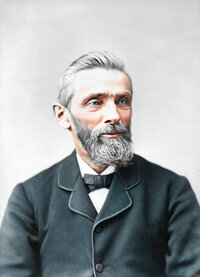
Hiram Edson was a Methodist farmer in upstate New York who, on the morning after the Great Disappointment of October 22, 1844, received the conviction that the “sanctuary to be cleansed” of Daniel 8:14 was not the earth but the heavenly sanctuary in which Christ ministers as High Priest. His subsequent study with O. R. L. Crosier and Dr. F. B. Hahn produced the doctrine of the heavenly sanctuary that became one of the distinguishing teachings of the Seventh-day Adventist Church. Edson preached, traveled, and gave away most of what he owned to fund early Adventist publishing until his death in 1882.
Early Life and Family (1806–1843)
The compilation Lest We Forget records what little is preserved of Edson’s beginnings: “Little is known of Hiram Edson, his family, or life before he became a follower of the Millerite advent message. He descended from an English clergyman named Elijah Edson, who had immigrated to Boston in order to escape religious persecution. Hiram was born December 30, 1806, in Jefferson County, New York” (Lest We Forget, ch. 50 (“HIRAM EDSON (1806–1882) Chosen Instrument”), p. 99, ¶ 2).
LWF continues with the marriages: “Edson was a Methodist farmer when he married Miss Effa Chrisler on December 2, 1830. After five years, in 1835, they bought a 56-acre farm near Port Gibson, New York. Effa died in May of 1839, leaving Edson with three children—George, 8, Susan, 6, and Belinda, 4. He so greatly felt the need of a mother for his small children that he remarried in about six months. Youthful, 23-year-old Esther Persons became his second wife in October of 1839.” (Lest We Forget, ch. 50, p. 99, ¶ 3).
Acceptance of the Millerite Message (1843)
LWF places Edson’s conversion to Adventism among the great-tent meetings of the summer of 1843: “By 1843, Millerism was spreading rapidly, but little had been done in central New York before the summer of 1843. A camp meeting using the “great tent” was scheduled to begin June 23, 1843, in Rochester, New York, about 30 miles from Port Gibson” (Lest We Forget, ch. 50, p. 99, ¶ 5). Edson’s daughter recalled later: “she was born about the time her parents accepted the advent doctrine as preached by Miller. It is safe to conclude that they attended some of those meetings held in the great tent that summer of 1843 and that, during the latter part of November, when Miller spent ten days in Rochester, they heard him preach his convincing message” (Lest We Forget, ch. 50, p. 99, ¶ 6).
The Cornfield Conviction (October 23, 1844)
Edson’s small group of believers had gathered at his Port Gibson home through the night of October 22, 1844, expecting Christ. After the disappointment of the dawn, Edson left the house with O. R. L. Crosier to walk through the fields. Loughborough preserves Edson’s own account in The Great Second Advent Movement:
Hiram Edson, of Port Gibson, N.Y., told me that the day after the passing of the time in 1844, as he was praying behind the shocks of corn in a field, the Spirit of God came upon him in such a powerful manner that he was almost smitten to the earth, and with it came an impression, “The sanctuary to be cleansed is in heaven.” He communicated this thought to O. R. L. Crosier, and they together carefully investigated the subject. In the early part of 1846 an elaborate exposition of the sanctuary question from a Bible standpoint, written by Mr. Crosier, was printed in the Day Star, a paper then published in Canandaigua, N.Y.
(The Great Second Advent Movement, p. 193, par. 1; refcode GSAM 193.1)
Loughborough preserves the moment of decision in human terms as well. As the two men chose their walking route after the sleepless night, Edson reportedly told Crosier, “I cannot go home through town. I do not know what to say to the people. Let us go home across the cornfield” (The Great Second Advent Movement, p. 554, par. 1; refcode GSAM 554.1).
Sanctuary Study with Crosier and Hahn (1844–1846)
Froom records the careful Bible study that turned the cornfield insight into a doctrine: “Edson and Crosier then sought out their mutual friend, Dr. Franklin B. Hahn, and the three of them agreed to meet as a study group, to search the Bible intensively along these lines until all should be clear. The book of Hebrews, especially chapters 8, 9-speaking of the earthly sanctuary as a “shadow of the heavenly,” a “figure of the true,” and with its service as an “example of the true service”—enforced the conviction of the cornfield, and of their subsequent discussions as they went from home to home. The entire Mosaic system of types and ceremonies became the central area of study, together with their matching of antitypical Christian realities” (The Prophetic Faith of Our Fathers, vol. 4, p. 886, par. 1; refcode PFF4 886.1).
Conference at Port Gibson and the Sabbath (1846)
LWF records the meeting at which Joseph Bates joined the Edson sanctuary group and shared his own new conviction on the seventh-day Sabbath: “Edson held a conference on the sanctuary at Port Gibson, perhaps in the fall of 1846. Both James White and Joseph Bates planned to attend, but only Bates was able to be there. He was invited to preach at the conference and took advantage of the opportunity to share the news of the Sabbath” (Lest We Forget, ch. 50, p. 100, ¶ 9).
The combined doctrines became one of the foundations of the new movement. As LWF summarizes: “The light on the sanctuary was “a revolutionary idea, the germ of a doctrine so radical as to bear a chief part in differentiating between the old and the new Adventist bodies.”” (Lest We Forget, ch. 50, p. 100, ¶ 10).
Sacrificial Giving for the Press (1850–1855)
Edson’s giving to the early Sabbatarian Adventist press is recorded in LWF: “Over the years Edson generously supplied funds to support the work, often on a sacrificial basis. Some family silverware was sold to raise funds to publish Crosier’s exposition of the Sanctuary doctrine. The Port Gibson farm was sold in 1850 to help the cause of God. His new farm, at Port Byron, was sold next and $700.00 was lent for the purchase of the first SDA press and type” (Lest We Forget, ch. 50, p. 101, ¶ 13).
Closing Years and Health Reform
In the 1860s Edson received treatment at Dr. James Caleb Jackson’s Dansville, New York, water cure. LWF preserves a brief note from his subsequent letter: “I am thankful for the light on health reform received while at Dansville and from the publications, How to Live, etc.” (Lest We Forget, ch. 50, p. 102, ¶ 16).
He continued to encourage discouraged believers in central New York; James White wrote that “A rash, hasty, fitful spirit has had a blighting influence in Central New York; but it has been removed under the judicious labors of Brn. Wheeler and Edson” (Lest We Forget, ch. 50, p. 102, ¶ 15).