Summary
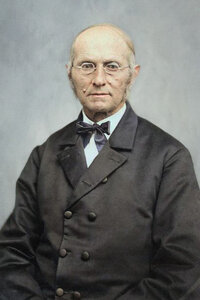
Hiram Edson was an early Adventist prophetic expositor, traveling evangelist, and charismatic farmer whose experience on the morning of October 23, 1844, provided the foundational insight for the Seventh-day Adventist doctrine of the heavenly sanctuary. Walking through a cornfield the day after the Great Disappointment, Edson received an understanding that Christ had not come to the earth but had entered the Most Holy Place of the heavenly sanctuary to begin a new phase of ministry. This insight, developed through intensive Bible study with Owen Crosier and Franklin Hahn, became one of the cardinal pillars of the Seventh-day Adventist faith.
Early Life (1806–1843)
Hiram Edson was born on December 30, 1806, in Jefferson County, New York, to Luther (1780–1837) and Susan E. Taylor Edson (1789–1844). Luther was a descendant of three signers of the Mayflower Compact of 1620. Around 1790, Luther’s parents, James — a Revolutionary War veteran — and Lovina Edson, moved from Massachusetts and purchased land in Farmington (Manchester), in Ontario County, New York. Luther, himself a War of 1812 veteran, purchased two properties in Manchester where he and Susan, staunch Methodist Episcopalians, reared four children: Hiram, Jackson, Belinda, and Luther Jr.
On December 2, 1830, Hiram married Effa Crisler (1810–1839) of Ontario County, New York, in a Methodist ceremony. They would have three children: George Washington, Susan Frances, and Belinda Adelaide. To accommodate his growing family, on March 14, 1832, Hiram purchased a 56-acre farm near Halliday Corners (Port Gibson), within a mile of his parents’ farm in Manchester, for $788.98. Because this property was unsuitable for agriculture but good for pasture, Hiram raised sheep rather than commercial crops.
Tragically, Effa died of unknown causes on May 21, 1839. On October 10, 1839, Hiram married Esther Mariah Persons (1816–1893) of Onondaga County, New York, also in a Methodist ceremony. To this union three children were born: Viah Ophelia (who died at thirteen months), a second daughter also named Viah Ophelia, and Lucy Jane.
Although no information exists regarding Edson’s formal schooling, his mastery of grammar and style in his later articles reveals that he had at least an elementary education. While the date and place of his conversion are unknown, from birth he had been reared in a Christian family. Around 1839, he became a steward in the Port Gibson Methodist Episcopal Church, responsible for the use of funds and literature donated by the congregation. He was widely respected as an earnest, soul-winning layman.
Conversion to Millerite Adventism (1843–1845)
In the summer of 1843, when the Millerite Adventist preachers Joshua Himes, Charles Fitch, and Thomas Barry held tent meetings in Rochester, New York, Edson attended these services and read their paper The Glad Tidings of the Kingdom at Hand. In an unpublished manuscript, he refers to “the new doctrine” (Millerism), which he accepted in 1843.
When the Methodists rejected the Millerite teaching of Christ’s imminent second advent and expelled members who accepted it, Hiram and Esther began holding meetings in their home, and many attendees experienced conversion. Also during 1843–1844, Edson began having “presentments,” which he defined as supernatural experiences that brought him new understandings, often through visual images of events that soon came to pass. These presentments told him about a revival service yet to occur, instructed him to lay hands on a sick friend and heal him, and told him to plead with a neighbor until he converted.
While believers accepted Edson’s presentments as indications of God’s guidance, others who opposed any manifestations of supernatural phenomena — whether Mormon or Millerite — sometimes reacted violently. Forty hostile men broke up one of his cottage meetings and some neighbors issued death threats. For their safety, the Edson family moved to a rented farm near Centerport.
The Great Disappointment and the Cornfield Experience
Following the Great Disappointment of October 22, 1844, Edson was devastated. “Our fondest hopes and expectations were blasted,” he wrote, “and such a spirit of weeping came over us as I never experienced before. It seemed that the loss of all earthly friends could have been no comparison. We wept, and wept, till the day dawn.”
On October 23, after praying with friends in his granary for understanding, Edson and Owen Crosier, a Millerite friend, cut through a cornfield to comfort their disappointed friends. Midway across the field, Edson related, “I was stopped… Heaven seemed open to my view, and I saw distinctly and clearly that instead of our High Priest coming out of the most holy place of the heavenly sanctuary to come to this earth on [October 22, 1844]… He, for the first time, entered on that day into the second apartment of that sanctuary.”
Edson’s words, “I saw distinctly and clearly,” have led to various interpretations as to whether he had a vision, saw a flash of light, or received an impression. Regardless of the nature of the experience, its theological implications were profound and far-reaching.
Development of the Sanctuary Doctrine
After five months of intensive Bible study, Edson, Crosier, and Franklin Hahn shared their discoveries in the March 1845 issue of the Day Dawn, a private paper edited by Hahn and Edson in Canandaigua, New York. To finance the project, Mrs. Edson sold a part of her silverware. A fuller, systematic exposition of the subject appeared in the February 7, 1846, issue of the Millerite paper the Day-Star Extra, in an article entitled “The Law of Moses,” written by Crosier.
These articles stated that a literal sanctuary existed in heaven; that the earthly tabernacle services were modeled on the heavenly; that the heavenly sanctuary contained two chambers, a Holy Place and a Most Holy Place, representing two phases of priestly ministry; that Jesus, the High Priest, had entered into the latter on October 22, 1844, to cleanse it by the blotting out of sins by His blood; and that Christ would return to earth after this second phase of His ministry was completed.
In May 1845, Edson sent a letter to the Jubilee Standard, a Millerite paper published in New York City, in which he argued that while the 2300-day prophecy (Daniel 8:14) ended on October 22, 1844, the 1335-day prophecy (Daniel 12:12) would end in August 1845 with God’s final judgment and Christ’s second coming. When this expectation also failed, Edson set no further dates.
Conversion to Sabbatarian Adventism (1846)
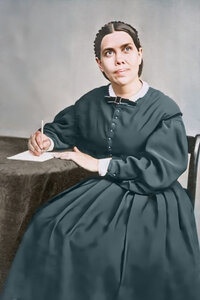
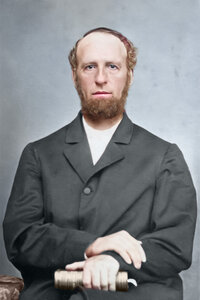
After reading Crosier’s article in the Day-Star Extra, James White and Joseph Bates wrote Edson requesting that he host a conference of believers in the autumn of 1846. James and Ellen White, Bates, Crosier, Hahn and his wife, and possibly others attended this gathering. After Crosier presented the subject of the cleansing of the heavenly sanctuary, Bates read from his pamphlet The Seventh Day Sabbath, a Perpetual Sign. Edson exclaimed, “Brother Bates, that is light and truth. The seventh day is the Sabbath; and I am with you to keep it.”
In a letter to the Day Dawn, Edson recommended Bates’ tract on the Sabbath “to all such as are willing to do the commandments of God.”
Sabbath Conferences and Evangelism (1848–1859)
Between 1848 and 1850 a series of twenty-two weekend gatherings (called “Sabbath Conferences”) convened in Connecticut, New York, Maine, and Massachusetts to clarify Adventist beliefs through prayer, Bible study, and discussion. Edson attended many of these, and he and Esther hosted the third conference at Port Gibson on August 27–28, 1848. Because unanimity prevailed concerning the seventh-day Sabbath, the cleansing of the heavenly sanctuary, and the third angel’s message, this gathering has been called “the theological birthplace of the Seventh-day Adventist Church.”
In 1849, when James White published the songbook Hymns for God’s Peculiar People, Hymn No. 23, “Here Is No Rest,” became Edson’s favorite. Also that year, Edson and Richard Ralph convinced Samuel Rhodes, a disappointed Millerite, to return to active ministry after he heard Ralph speak in tongues and Edson deliver a reassuring message from Ellen White. Rhodes became a successful evangelist in New York and the Midwest.
In 1850, Edson and Esther sold their farm in Port Gibson and rented a farm in Oswego for two years. Between 1850 and 1852, Edson served on the four-man editorial board of the Advent Review (published in Oswego) until it was moved to Rochester, New York. In 1852, the family purchased a farm in Port Byron, selling it a few months later for $3,500 and donating $650 to James White to buy a Washington Hand Press for the Review in Rochester.
Edson also partnered with other preachers for extensive evangelistic tours of New York, Pennsylvania, and Canada. Between 1850 and 1858, Edson teamed up with George Holt, Samuel Rhodes, H. S. Case, John Andrews, Joseph Bates, J. N. Loughborough, Horace Lawrence, Frederick Wheeler, and William Ingraham. They traveled in all kinds of weather and faced frequent opposition, yet converted many to Sabbatarian Adventism.
At the Oswego conference in December 1855, Edson was ordained as a local elder, and Roswell F. Cottrell baptized his daughter Ophelia after breaking the ice on Lake Ontario. One year later, the family moved to Martville, Cayuga County, New York, where Lucy Jane was born. In the fall of 1856, Edson attended a conference hosted by John and Catharine Byington in Bucks Bridge, New York, where he accepted the Laodicean Message as applicable to his spiritual condition. In the spring of 1858 at a conference in Syracuse, New York, Edson, David Arnold, Roswell Cottrell, and A. Robinson were chosen to recruit workers to begin an evangelistic tent ministry in the state.
In 1859 the family made their final move to a small farm in Palermo, Oswego County, New York.
Publications (1849–1867)
Edson also wrote pamphlets and articles for Sabbatarian Adventist papers between 1849 and 1867. Intrigued with prophetic symbolism and type/antitype analogies, he enjoyed speculative theology. His 1849 tract, An Exposition of Scripture Prophecy; Showing the Final Return of the Jews in 1850, argued that the world’s Jews would return to Palestine before Christ’s second coming. His second tract, The Time of the End, predicted the Second Advent on May 19, 1850.
In a subsequent letter to Present Truth, he asserted that Sabbatarian Adventists had been experiencing “the scattering time” from 1844 to 1849, but were now in “the gathering time.” Edson’s “Appeal to the Laodicean Church” appeared in an Advent Review Extra in 1850. A year later, the Review published his article explaining “The 69 Weeks and 2300 Days” prophecies in the Book of Daniel. His three-part series on “The Ten Commandments of God” in 1852 discussed the 144,000, the time of trouble, the Sabbath, and the Little Horn (papacy). Four years later, in a seven-part series entitled “The Times of the Gentiles,” Edson shared his unique interpretation of the 2520-year prophecy (723 B.C.–1798 A.D.) regarding the rise of “mystery Babylon” (paganism), the formation of American republicanism, the destruction of the Papacy, and the resurgence of Protestantism prior to Christ’s second advent. His shortest article, “Daniel Standing in His Lot,” in 1857 briefly focused on the time of judgment, which began on October 22, 1844, when Christ entered the Most Holy Place in the heavenly sanctuary.
Other Accomplishments (1860–1876)
In 1861 Edson helped organize the Roosevelt (New York) SDA Church. But during the 1860s, as Edson’s health declined from physical prostration, colds, typhoid fever, and nervous debility, James White and J. N. Andrews appealed for funds to send him to Dr. James Caleb Jackson’s water cure in Dansville, New York. After months of hydrotherapy treatments, rest, and a vegetarian diet, his health improved and he adopted the health reform diet.
Following his recovery, he attended the fifth session of the New York-Pennsylvania Conference in 1866, at which he received a ministerial license. Edson also attended quarterly meetings (communion services) at Vernon (1867) and Adam’s Center (1868) and conference sessions at Adam’s Center (1868) and Kirkville (1869), New York, where his ministerial license was renewed.
In 1870 at Oneida, New York, Edson received ministerial credentials as an ordained minister of the New York-Pennsylvania Conference. In 1871 he baptized sixteen-year-old Byron Tefft of Allegany County, New York — his only documented baptism.
During the 1870s Edson’s health worsened as he suffered from consumption (tuberculosis) and catarrh (inflammation of the nose and throat). He missed most of the conference sessions after 1873. In 1875 his ministerial credentials were not renewed, largely because of a dispute between Edson and the reading committee at the Review publishing house, who refused to publish his 230-page manuscript on prophecy that they deemed biblically unsound.
Later Life (1877–1882)
Although embittered by this controversy, Edson remained faithful to the Adventist message but did not always attend Sabbath services. In 1878 he converted A. E. Place of Rome at the Kirkville, New York, camp meeting. Place, who later became a minister, remembered Edson as “the mightiest man in prayer I have ever heard pray.” He particularly enjoyed hearing Edson sing his favorite hymn, “Come, O My Soul, to Calvary.”
Despite suffering great pain and being bedridden with tuberculosis, Edson registered his last will at the Oswego courthouse in September 1881. He died on January 8, 1882, at Palermo, New York, at the age of 75. New York-Pennsylvania Conference President Buel L. Whitney, who officiated at his funeral, called him “among the first to receive the third angel’s message and identify himself with the work, giving largely of his time and means for its advancement.” Whitney asserted that Edson’s devotion to the cause of Present Truth “fully entitles him to a place among its pioneers.”
He was buried in a cemetery near the Roosevelt SDA Church he had helped build. His wife Esther died of Bright’s disease (nephritis) on May 1, 1893, at 77 and was buried beside her husband.
Key Quotes
On the Disappointment: “Our fondest hopes and expectations were blasted, and such a spirit of weeping came over us as I never experienced before. It seemed that the loss of all earthly friends could have been no comparison. We wept, and wept, till the day dawn.”
On the Sanctuary Revelation: “I was stopped… Heaven seemed open to my view, and I saw distinctly and clearly that instead of our High Priest coming out of the most holy place of the heavenly sanctuary to come to this earth on [October 22, 1844]… He, for the first time, entered on that day into the second apartment of that sanctuary.”
On accepting the Sabbath: “Brother Bates, that is light and truth. The seventh day is the Sabbath; and I am with you to keep it.”
Legacy
Although Hiram Edson is chiefly remembered for his cornfield experience on October 23, 1844, which provided insights into Christ’s high priestly ministry in the Most Holy Place of the heavenly sanctuary, his contributions to the Adventist movement were far broader. His articles in Millerite and Sabbatarian Adventist publications focused on prophetic symbols, type/antitype analogies, and numerological interpretations. He played a key role in organizing Sabbath Conferences and partnering with other traveling evangelists during the 1850s. He gave sacrificially of his means — selling farms, donating funds for the first Adventist printing press, and supporting evangelistic work. His faithful devotion to the cause of Present Truth, through decades of personal hardship, ill health, and even controversy, fully entitled him to a place among the pioneers of the Seventh-day Adventist Church.