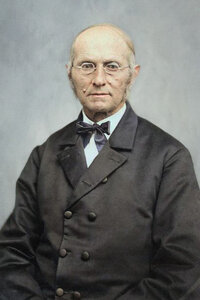
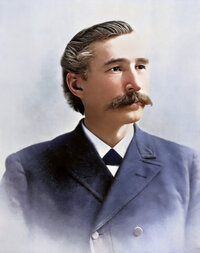
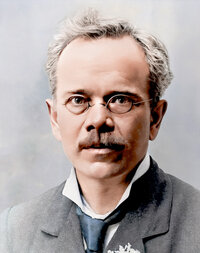
1832–1913
Summary
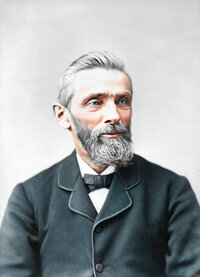
George Washington Amadon was a hoggee on the Erie Canal towpath at fourteen, a typesetter at five dollars a week at the Rochester Review press at twenty-one, and a vice-president of the Seventh-day Adventist Publishing Association before he was forty. Self-taught in eighteen ancient and modern languages so that he could set type for the church’s foreign-language tracts, he edited the Youth’s Instructor from 1858 to 1864, served as elder of the Battle Creek Tabernacle, and gave fifty-eight years of his life — from 1855 until his death in 1913 — to the publishing work at Battle Creek. He married Martha Dorner Byington, daughter of John Byington (the first General Conference president), on November 24, 1860; she outlived him by twenty-four years.
Beginnings (1832–1853)
Amadon was born August 30, 1832, at Sand Lake, New York, the eldest of five children of Philanda and Eliza Amadon. He spent part of his boyhood with his grandfather near Boston and the rest in upstate New York, where in his early teens he drove mules along the Erie Canal towpath. In the late 1840s he studied briefly at Oberlin College in Ohio.
In 1853, James and Ellen White and J. N. Loughborough led the twenty-one-year-old Amadon to the Sabbath-keeping Adventist faith, and he was hired at the Review press in Rochester, New York. When the publishing work moved to Battle Creek, Michigan, in 1855, Amadon moved with it; he would never leave.
A Prolific Hand at the Press (1855–1880s)
Amadon was, in his own admission, “self-taught” — and he taught himself well. He learned Hebrew, Greek, German, Danish, Swedish, French, and a dozen other languages so that he could compose the foreign-language tracts that began streaming from the Battle Creek press in the late 1850s and 1860s. According to his own diaries he could set ten thousand pieces of type in a day, and he frequently worked twelve- to sixteen-hour days, including Saturday nights and Sundays. In October 1863 the General Conference, on motion of Elder J. B. Frisbie, “unanimously chose” him editor of the Youth’s Instructor (Advent Review and Sabbath Herald, October 6, 1863, page 149.48; refcode ARSH October 6, 1863, page 149.48).
His own pen — frequently, in short editorials in the Review — kept the church’s eye fixed on the prophetic times. In one of those columns he wrote of a generation grown crooked and perverse, urging that the believers “inseparably unite our dearest interests with God’s cause; seek protection of his Omnipotent arm; then we shall abide the coming day.” (Lest We Forget, ch. 141, p. 276, ¶ 4).
In another, he wrote of the urgency of the hour: “Brethren, let us wake up in the cause of God. Let us not sleep as do others. The times are growing perilous. Systems are being undermined, creeds are exploding, thrones are being shaken, men’s hearts are failing them through fear, and soon every man’s work will be tried of what sort it is. The Christian’s hope is immovable; for it is founded on the Bible. It will stand the fiery ordeal just ahead.” (Lest We Forget, ch. 141, p. 276, ¶ 6).
Husband, Father, and Pastor (1860–1881)
In 1857 Amadon met Martha Dorner Byington, who had recently moved to Battle Creek from Bucks Bridge, New York, to live with the Whites. They were married November 24, 1860, in a ceremony solemnized by Martha’s father, John Byington — three years before he became the first president of the General Conference. The Amadons had two daughters, Kate (1866) and Grace (1872), and adopted a son, Claude, in 1876.
Throughout the 1860s and 1870s Amadon stood by James and Ellen White through repeated personal and institutional crises. In March 1863 he served on the committee that cleared the Whites of charges of profiteering and produced a 39-page Vindication of the Business Career of Elder James White, with seventy-four affidavits from character witnesses. After James’s first stroke in 1865, he and Adelia Van Horn took charge of the publishing work for two months while James recovered. In 1867 and 1868, when James was unable, he travelled with Ellen on her speaking circuits.
Ellen White, writing in 1869, recorded both his service and the strain it cost him: “Brother Amadon has borne that from you that but few men would stand up under. You have a work to do and but little time to do it in. His influence has been destroyed by your influence upon him.” (Manuscript Releases, Letter 9, 1869, par. 8; refcode 2LtMs, Lt 9, 1869, par. 8).
Of his own pastoral spirit Amadon wrote: “My soul trembles when I think how much God’s people fail of coming up to Bible requirements. We live in the time when the prophet says, God shall turn the hearts of the fathers to the children, Mal. 4:6, and what does this mean except home catechizing and Sabbath-school instruction? I never saw the importance of Bible-Class and Sabbath-School instruction as today, and shall labor on” (Lest We Forget, ch. 141, p. 276, ¶ 5).
Death (1913)
George W. Amadon died at Battle Creek on March 20, 1913, in his eighty-first year. His widow Martha lived another twenty-four years, dying February 4, 1937. The Review and Herald obituary appeared the same week as his death.