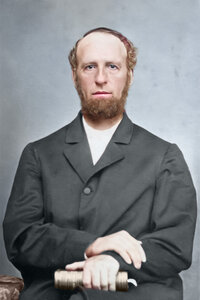
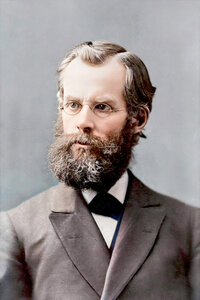
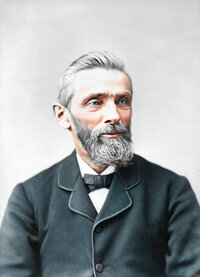
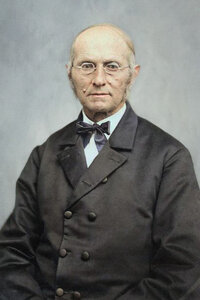
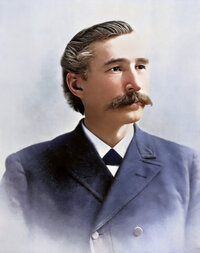
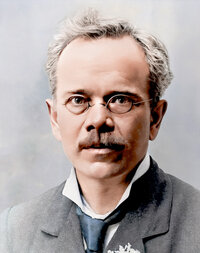
1811–1910
Summary
Frederick Wheeler was the first ordained Millerite minister to embrace the seventh-day Sabbath — and therefore, in Loughborough’s later judgment, “the first Seventh-day Adventist minister.” Born in Acton, Massachusetts, on March 12, 1811, he was ordained in the Methodist Episcopal Church in 1840 and embraced William Miller’s advent message in 1842. In the spring of 1844 — under the witness of Rachel Oakes (later Preston) at the Washington, New Hampshire, communion table — he accepted the seventh-day Sabbath, and by the fall of 1844 he had brought between 150 and 200 New Hampshire Millerites with him. He preached as a Sabbatarian Adventist in New England, New York, and elsewhere for sixty-six years. He died in 1910 at the age of ninety-nine.
Family Background and Early Ministry (1811–1842)
Per the Encyclopedia of Seventh-day Adventists (Samuel Gomide), Wheeler was born March 12, 1811, in Acton, Massachusetts, to Theodore and Hannah Reed Wheeler. His grandfather William Reed had served in the Continental Infantry from 1775 to 1776 in the American Revolution.
The Ellen G. White Estate’s biographical sketch in Letters and Manuscripts records his marriage and early ministry: “Frederick Wheeler was born in Acton, Massachusetts, and married Lydia Proctor in 1832. From about 1838 to 1857 they lived in Washington, New Hampshire, or nearby Hillsborough. About 1840 Frederick Wheeler was ordained as a minister in the Methodist Episcopal Church, and in 1842 he accepted the Second Advent teachings of William Miller” (The Ellen G. White Letters and Manuscripts: Volume 1, p. 902, par. 5; refcode 1EGWLM 902.5).
The First Millerite Minister to Accept the Sabbath (Spring 1844)
The same biographical sketch records Wheeler’s distinctive place in Adventist history: “Although available sources are somewhat contradictory, according to several accounts Frederick Wheeler, a Millerite Adventist preacher from New Hampshire, began to keep the seventh-day Sabbath in the spring of 1844 through his contact with Rachel Oakes, a Seventh Day Baptist. If so, Wheeler was the first Millerite preacher to adopt the Sabbath, earlier than T. M. Preble, another Millerite minister who became a Sabbatarian some months later, in August 1844” (The Ellen G. White Letters and Manuscripts: Volume 1, p. 902, par. 4; refcode 1EGWLM 902.4).
Loughborough’s Heavenly Visions preserves Wheeler’s own first-person account of his Sabbath observance, dictated late in life: “Frederick Wheeler, the first Seventh-day Adventist minister, we may say, though the denominational name was not so early in use, left on record the facts concerning his acceptance of the Sabbath. It was written down for me at the time of the Phelps camp meeting in New York, in 1906.” (Heavenly Visions, p. 103, par. 8; refcode HEVI 103.8).
Loughborough also preserves Wheeler’s recollection of the rapid spread of the Sabbath in his Washington-area circuit through 1844: “Elder Wheeler told me that on the first Sabbath he observed he preached a sermon on the subject of the Sabbath. He told me that before the time passed in the fall of 1844, there were from 150 to 200 keeping the Sabbath in Washington (New Hampshire) Hillsdale, Newbury, and some other towns about there” (Heavenly Visions, p. 105, par. 2; refcode HEVI 105.2).
A Half-Century of Preaching (1851–1906)
The Ellen G. White Estate’s biographical sketch summarizes Wheeler’s half-century of preaching: “From about 1851 Frederick Wheeler preached widely throughout the New England States. In 1857 the family moved to Brookfield, New York, and he continued itinerant preaching in New York State for the next three or four years.” (The Ellen G. White Letters and Manuscripts: Volume 1, p. 903, par. 1; refcode 1EGWLM 903.1).
Ellen White herself, in 1875, recorded a renewed encounter with him at the Syracuse, New York camp meeting: “Here we met Elder Wheeler, with whom we became acquainted in New Hampshire thirty years ago.” (The Retirement Years, p. 16, par. 2; refcode RY 16.2). The same paragraph adds her sense of being among the surviving veterans: “My heart was touched as I looked upon these brethren who had long stood in defense of the faith” (The Retirement Years, p. 16, par. 2; refcode RY 16.2).
A Brief Rough Patch and Recovery (1861–1867)
The Ellen G. White Estate biographical sketch records the only known difficult period in Wheeler’s relationship to the Whites and the wider church: “The only known rough patch in the relationship between the Whites and Wheeler occurred during the early 1860s. In 1861 Wheeler refused for a while to support James White in his drive for church organization.” (The Ellen G. White Letters and Manuscripts: Volume 1, p. 903, par. 2; refcode 1EGWLM 903.2). The same paragraph records his eventual recovery: “He subsequently changed his mind and published a” Confession in the Review, in which he reaffirmed his belief that the visions were from the Lord.
Death (1910)
Per the Encyclopedia of Seventh-day Adventists, Wheeler died in 1910 at the age of ninety-nine. He had outlived nearly all his Millerite contemporaries by half a century or more.