Summary
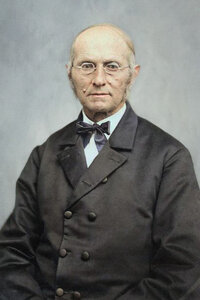
Frederick Wheeler was the first ordained minister in the Second Advent movement of the 1840s known to have also proclaimed observance of the seventh-day Sabbath as Christian duty. A farmer-preacher who served for decades across New England and New York, Wheeler combined a sturdy independence of character with a deep commitment to the Advent hope. His acceptance of the Sabbath, prompted by the forthright witness of Rachel Oaks Preston during a communion service, marked the beginning of Sabbath observance among Adventist believers and helped shape the identity of the movement that would become the Seventh-day Adventist Church. Ellen White, who knew him across the span of decades, counted him among the “old standard-bearers” of the faith. Wheeler lived to the remarkable age of ninety-nine, his life spanning nearly the entire first century of the Adventist movement.
Early Life and Family
Frederick Wheeler was born on March 12, 1811, to Theodore and Hannah Reed Wheeler (1777-1829; 1783-1834) in Acton, Massachusetts. His family roots ran deep in American soil — his grandfather, William Reed, had served in several companies and regiments of the Continental Infantry from 1775 to 1776 during the American War for Independence. This heritage of principled conviction and willingness to stand against prevailing opinion would prove to be a family trait.
On March 25, 1832, just thirteen days after his twenty-first birthday, Frederick married nineteen-year-old Lydia Proctor (1813-1886) of Washington, New Hampshire, who was a cousin on his mother’s side. This marriage connected Wheeler to a wider network of families that would prove significant in Adventist history. Lydia was a cousin of William and Cyrus Farnsworth, who would be prominent among the early Sabbath-observing parishioners in Washington. Their mother, Martha (Proctor) Farnsworth, was the younger sister of Lydia’s father, Israel Proctor.
Frederick and Lydia would have six children: George (1834), Theodore (1836), Lucy (1838), Nathan (1840), Mary (1845), and Lydia (1849). Wheeler also had an adopted son, William Henry Anderson, who would care for him in his final years.
Methodist Ministry and the Millerite Movement
In 1840, eight years after his marriage, Wheeler was ordained as a minister of the Methodist Episcopal Church. He served his congregation in Washington, New Hampshire — a small, close-knit community nestled in the hills of southern New Hampshire that would soon become famous in Adventist history.
Wheeler began reading the writings of William Miller, the Baptist preacher whose calculations from the prophecies of Daniel and Revelation had convinced him that Christ would return around 1843. By the end of 1842, Wheeler was fully convinced about the message of the soon second advent of Christ, and his congregation in Washington, New Hampshire, embraced the message as well. The small church in Washington would become one of the earliest communities to accept both the Advent hope and the seventh-day Sabbath — the two pillars of what would become Seventh-day Adventism.
In August 1844, as excitement about the expected return of Christ intensified, the Wheeler family attended a Millerite camp meeting near Hillsborough, New Hampshire. Joshua Himes, Miller’s leading associate and the movement’s chief promoter, was present among the three hundred to four hundred people attending. Frederick’s son George later recalled the atmosphere with vivid detail: “The singing was delightful.” They had no organ, but a “few song leaders . . . sat near the speakers’ stand, and a man from near Washington would stand on a seat and beat the time for the singing. Then the congregation would sing to beat everything.”
The Sabbath Encounter
The pivotal moment in Wheeler’s spiritual journey — and one of the most significant moments in Adventist history — came during a communion service, though the exact date remains debated. Wheeler was confronted with the Sabbath question in either 1844 or 1845 following a communion service in which he had emphasized that genuine communion with Christ meant a readiness to keep all of God’s commandments.
Present in the congregation that day was Rachel Oaks (later Preston), a Seventh Day Baptist who was worshipping with Wheeler’s congregation while on an extended stay with her daughter Delight, who had married a local man. Oaks was a woman of firm convictions, and she recognized the inconsistency between Wheeler’s sermon and his practice. She pointed out to Wheeler that he was not following God’s commandment to observe the Sabbath on the seventh day.
The encounter struck deep. Wheeler became deeply convicted that Oaks’ witness was true to Scripture, and he began keeping Saturday as the Sabbath shortly afterward. This made Frederick Wheeler the first ordained minister known to have combined the preaching of the Second Advent with observance of the seventh-day Sabbath — two truths that would become the defining pillars of Seventh-day Adventist faith.
The congregation at Washington, New Hampshire, followed their pastor’s lead. A small group of believers there began observing the Sabbath, making the Washington church the first Sabbatarian Adventist congregation. The Farnsworth brothers — Lydia Wheeler’s cousins, William and Cyrus — were among this pioneering group.
The Great Disappointment and Its Aftermath
When October 22, 1844, came and went without the return of Christ, Wheeler, like thousands of other Millerites, faced the crushing weight of the Great Disappointment. But unlike many who abandoned the Advent faith entirely, Wheeler persevered.
His son George described an early example of the family’s continued ministry, which took place soon after the Disappointment: “In the summer of 1845 my father took four of his children and a cow over to his wife’s sister’s husband, Reuben Spalding, and left them six or eight weeks, while he and mother labored among the people in Vermont.” This detail — the practical arrangement of leaving children and livestock with relatives so that both Frederick and Lydia could devote themselves to ministry — reveals both the urgency they felt and the sacrificial nature of their calling.
Traveling Ministry
Frederick Wheeler was a farmer-preacher, a pattern common among early Adventist ministers who supported themselves through agricultural work while preaching without regular salary. But his responsibilities on the farm did not prevent him from extensive traveling ministry.
During the 1850s, Wheeler ministered throughout New England and in New York, many times alongside other pioneers. “I have during the past Winter, visited most of the brethren in western Massachusetts and Connecticut,” he wrote in May 1855, adding that he “also spent some time among the Seventh-day Baptists in Rhode Island; and found some among them quite interested to hear on the subject of the Lord’s near coming. I have also visited most of the brethren in Maine and some other places.”
His ministry earned the trust and respect of the movement’s leaders. After meetings in Washington, New Hampshire, in 1853 at which Wheeler officiated in the baptism of five individuals, James White wrote that he would “heartily recommend Bro. Wheeler to the brethren in Maine, Massachusetts, or wherever he may travel.”
In 1857, at a conference in Roosevelt, New York, the growing church formally recognized Wheeler’s ministry and the need for it elsewhere: “It was decided that the labors of Bro. F. Wheeler of New Hampshire are needed in Central N. Y., and that it is the duty of the church to defray the expenses of removing his family to his field of labor, and support him in the field.” Accordingly, the Wheeler family made the significant move from their New Hampshire roots to Brookfield, New York, where Frederick could serve the scattered Sabbatarian Adventist believers of central New York.
Struggles with Organization
Wheeler’s independent spirit, which had served him well in embracing unpopular truths, also led him into conflict with the emerging denominational structure. In 1861, as Sabbatarian Adventists debated whether to formally organize as a denomination, Wheeler found himself on the wrong side of a dispute with a fellow church member and resistant to the idea of church organization.
Frederick and Lydia Wheeler received a testimony from Ellen White rebuking them for their treatment of the Ira Abbey family. The Wheelers had, in Ellen White’s words, “watched Brother Abbey’s family for evil, watched for their haltings, and they have been made offenders for a word, and condemned them for things unworthy of notice or remark.” The rebuke was pointed and specific. Ellen White also admonished Frederick for his opposition to denominational organization.
James White reported that at a meeting in Roosevelt, “after near two hours . . . and the removal of objections,” a call was made for all who were in favor of organizing to stand up. Frederick Wheeler “kept his seat.” His resistance to organization was rooted in the same independent temperament that had led him to embrace unpopular truths, but in this case, it put him at odds with the direction the movement was taking.
To his credit, Wheeler recognized his error. In the same issue of the Review and Herald, he published a letter asking for forgiveness for being against organization. About three months later he published a “Confession” in the Review acknowledging his “wrong course toward Bro. Abbey and family.” He also confessed that he had “murmured against Bro. and Sr. White” and doubted the visions of Ellen White during the past few months, although he had, for many years, had complete confidence in them.
This episode of honest self-examination and public confession demonstrated a quality that the early Adventist community valued deeply: the willingness to acknowledge error. Writing almost six years later, Wheeler stated in the Review that he could “now sympathize with” James and Ellen White “in their toils and trials and appreciate their labors and the gift of prophecy more fully than ever before.”
In 1861, the Wheelers left Brookfield, probably because of the strained relationships with the Abbey family, and moved to a farm in West Monroe, New York, where Frederick would spend the remainder of his life.
Later Life
The Wheelers spent their remaining years in New York State. On March 14, 1886, Lydia Wheeler died at age seventy-three, just two days after Frederick’s seventy-fifth birthday. It was a loss felt after more than fifty-three years of marriage and shared ministry. Frederick would continue for the next twenty-four years, cared for by his adopted son, William Henry Anderson.
In 1890, Ellen White had occasion to see Wheeler again and wrote with evident warmth:
“We were gratified to meet the aged servants of God on this occasion. We have been acquainted from the rise of the third angel’s message with Elder [Frederick] Wheeler, who is now nearing 80 years. We have been acquainted with Elders [H. H.] Wilcox and [Charles O.] Taylor for the last 40 years. Age is telling on these old standard-bearers, as well as upon me.”
The phrase “old standard-bearers” captures the respect that Ellen White and the broader Adventist community held for the pioneers who had carried the movement’s truths from the earliest days.
Death and Legacy
Frederick Wheeler died at his home in West Monroe, New York, on October 11, 1910, at the age of ninety-nine — just five months short of his hundredth birthday. Five of his children were still living at the time of his death. In all, Wheeler’s progeny, counting Anderson’s children, included “twenty-five grandchildren . . . thirty-nine great-grandchildren, and at least four great great-grandchildren.”
Wheeler’s place in Adventist history is secured by that singular moment during a communion service when a Seventh Day Baptist woman pointed out the inconsistency between his preaching and his practice. His willingness to follow conviction, even when it led him away from his Methodist ordination and into an unpopular minority, demonstrated the same principled courage his grandfather had shown on the battlefields of the American Revolution. As the first ordained minister to combine the preaching of the Second Advent with observance of the seventh-day Sabbath, Frederick Wheeler helped forge the distinctive identity of what would become the Seventh-day Adventist Church.
The small church in Washington, New Hampshire, where Wheeler first preached the Sabbath, still stands today as a memorial to the beginnings of Sabbath observance among Adventist believers — and to the farmer-preacher from Acton, Massachusetts, who followed the truth wherever it led.