1867–1952
Summary
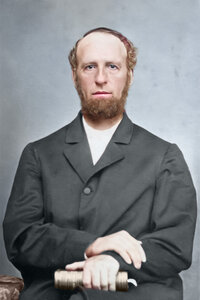
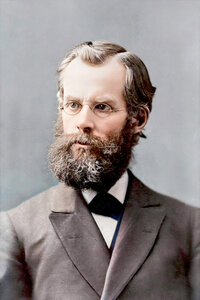
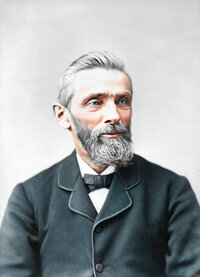
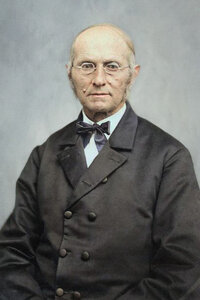
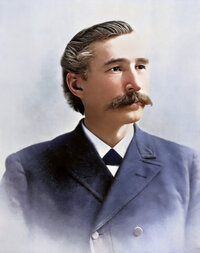
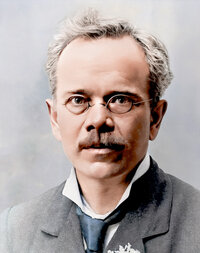
Frederick Griggs was the principal architect of the worldwide Seventh-day Adventist educational system in the early twentieth century. Born at St. Charles, Saginaw County, Michigan, on March 23, 1867, the son of Adventist evangelist Ezra S. Griggs (a personal friend of James and Ellen White), he served successively as principal of the Battle Creek College Preparatory School (1890–1899), principal of South Lancaster Academy (1899–1907), Secretary of the General Conference Educational Department (1904–1910 and 1914–1918), president of Union College (1910–1914), president of Emmanuel Missionary College (1918–1925), president of the Far Eastern Division (1930–1936), and president of the China Division (1936–1942). He founded the Fireside Correspondence School in 1909 — later renamed Home Study Institute and ultimately Griggs University in his honor. He died at Loma Linda, California, on July 26, 1952.
From St. Charles to Battle Creek College Prep (1867–1890)
Per Dennis Pettibone’s article in the Encyclopedia of Seventh-day Adventists, Frederick Griggs was born March 23, 1867, in St. Charles, Saginaw County, Michigan, to Ezra S. Griggs (1834–1896) and Diantha Mansfield Griggs (1840–1899). His father was an Adventist pastor and evangelist who worked alongside James and Ellen White; the Whites were on at least one occasion guests at the Griggs home. Frederick attended Battle Creek College, the Chicago Normal School, the University of Buffalo School of Pedagogy, and Washington Missionary College, eventually earning bachelor’s and master’s degrees. He was musically inclined — he played guitar as a boy, sang the solo “How Can I Keep from Singing?” at the 1909 General Conference Session, and on July 24, 1915, sang “Rest for the Toiling Hand” at Ellen White’s Battle Creek funeral. He married Blanche Eggleston (1871–1939) on August 16, 1892; after her death he married Mabel Rebecca Shaffer (1881–1974) in 1940.
Battle Creek College Preparatory School and the Birth of Adventist Church Schools (1890–1899)
Per ESDA, Griggs served from 1890 to 1899 as principal of the Battle Creek College Preparatory School — the model institution that helped to launch the Adventist church-school movement under the broader vision of E. A. Sutherland. By 1895 the preparatory school had ten grades, four hundred enrolled, and ten classroom teachers (alongside specialists in gymnasium, art, music, and Sloyd manual training). Griggs and Sutherland launched a normal department (teacher-training school) in 1896 with Bessie DeGraw as its third leader; from this normal training were sent church-school teachers into villages and hamlets across the church. Loughborough’s Great Second Advent Movement recorded the institution as it stood in 1899: “This institution, after twenty-one years of efficient service, is still prospering, and has sent out earnest laborers in the Master’s cause to various parts of the world. The principal of the academy now is Frederick Griggs, who also serves as secretary for the Educational Department of the General Conference” (The Great Second Advent Movement, p. 395, par. 2; refcode GSAM 395.2).
Ellen White’s 1898 Counsel and Griggs’s Acceptance
Per ESDA, in 1898 some of Griggs’s articles in The Christian Educator prompted Ellen White’s concern that he was at risk of “espousing humanistic philosophy”; her letter to Griggs and editor Frank W. Howe rebuked them and warned that they had been mingling “the common with the sacred.” When Griggs replied with a conciliatory letter, Ellen White’s response — preserved in Manuscript Releases, vol. 7, as Letter 117, 1898, par. 4 — focused on the question of family-based Christian education: “The Lord has a controversy with parents, because they have permitted their children to follow their own pernicious ways, by which the way of truth is evil spoken of. Education should be commenced in the home at the dawn of reason, and is to be carried forward in the fear and love of God” (Manuscript Releases, vol. 7, p. 6, par. 1; refcode 7MR 6.1).
Per ESDA, Griggs would be “a supporter of Ellen White throughout the remainder of her life.” In 1911 he wrote to her: “I cannot tell you how thankful I am every day that God has given to us the gift of the Spirit of Prophecy and that we have the wonderful expositions of truth which have come to us through your writings.”
South Lancaster, GC Educational Secretary, the Fireside School (1899–1910)
Per ESDA, in 1899 Griggs left Michigan for Massachusetts to become the sixth principal of South Lancaster Academy, which he led through a deep financial crisis using Ellen White’s Christ’s Object Lessons book-sale relief plan. In 1904 he was elected secretary of the General Conference Educational Department, and in 1907 he moved permanently to Takoma Park to lead that department full-time. In 1909 he founded the Fireside Correspondence School to give the benefits of an Adventist education to those unable to attend traditional schools — a forerunner of Home Study Institute (renamed 1931), Home Study International (1982), and Griggs University (1990).
The 1909 General Conference Bulletin records his hopes for substantive scholarship at the new school: “If we can get our young people down to good hard study, their work is going to be substantial. I see in this a great advantage for our educational work, since the reading courses will help the youth to form ideals, and give them a desire for a part in this work” (General Conference Bulletin, May 24, 1909, p. 124, par. 25; refcode GCB May 24, 1909, page 124.25).
Union College, Emmanuel Missionary College, and Two Decades of Educational Leadership (1910–1925)
Per ESDA, Griggs served as president of Union College, Nebraska, from 1910 to 1914, where he taught philosophy alongside his administrative duties and led the college through transformative weeks of prayer. He returned to the General Conference Educational Department from 1914 to 1918, then in 1918 took over the presidency of Emmanuel Missionary College (forerunner of Andrews University), where his eight-year tenure was remembered as a “golden age”: new buildings, a campus radio station, dual accreditation by the State of Michigan and the North Central Association, and an enrollment that for the first time passed five hundred.
The 1913 General Conference Bulletin records his closing summation of the role of the schools in the third angel’s message: “The third angel’s message is the greatest message, the greatest proclamation, the greatest work that has ever been put before the world. As Professor Lewis has said, in it are embodied all the great upward movements of all times. Our schools are the heart of this message. In these schools there should be a deeper study, on the part of students and teachers, into the things of God, of heaven, and of our relation to mankind” (General Conference Bulletin, June 2, 1913, p. 237, par. 1; refcode GCB June 2, 1913, page 237.1).
The Bulletin’s record of the same conference’s Religious Instruction Day: “Monday was Religious Instruction Day for the Educational Department, and the Seminary chapel was full to overflowing when the chairman called the meeting to order. The hour was very profitably occupied by three addresses, dealing with the following subjects” (General Conference Bulletin, May 22, 1913, p. 101, par. 15; refcode GCB May 22, 1913, page 101.15).
Far Eastern and China Divisions (1925–1942)
Per ESDA, in 1925 Griggs moved to Shanghai, China, where he served on the executive board of the Far Eastern Division. In 1930 he was elected president of the Far Eastern Division (which by then had been split off from China and was administered from Manila and later Bagnio). In 1936 he was elected president of the China Division and returned to Shanghai. As mainland China was torn by war, in 1938 the China Division and all its employees relocated to Hong Kong; by 1939 the headquarters returned to Shanghai for a brief period. Griggs continued in administrative service for the church in the Far East through 1942, when wartime conditions forced his retirement to Loma Linda, California.
Death (1952) and Legacy
Per ESDA, Frederick Griggs died at Loma Linda on July 26, 1952, in his eighty-sixth year. He had been the dominant figure in Seventh-day Adventist education for over half a century — a builder of institutions, a defender of the Adventist church-school philosophy, a faithful supporter of Ellen White’s prophetic gift, and the founder of the worldwide distance-education program that today carries his name. The Fireside Correspondence School he founded in 1909 had, by 2010 (when integrated into Andrews University), reached more than 240,000 students worldwide.