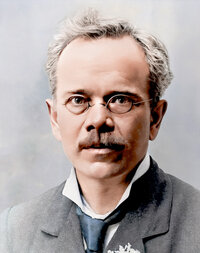
1865–1951
Summary
Francis McLellan Wilcox was the editor of the Review and Herald (later renamed the Adventist Review) for thirty-three years, from 1911 to 1944 — the longest tenure of any editor of the church’s flagship periodical. Born to farming parents in Theresa, New York, on February 28, 1865, he became a Seventh-day Adventist at the age of twelve under the labors of H. H. Wilcox (no relation), entered the ministry in his early twenties, and rose through educational and administrative positions until he was called to the editor’s chair in 1911 at the age of forty-six. He was author of the major 1933 statement of fundamental beliefs (A Conference on Christian Fundamentals). Per the Encyclopedia of Seventh-day Adventists (Douglas Morgan), Wilcox “became one of the most influential Seventh-day Adventist leaders of the first half of the 20th century.”
Early Life and Conversion (1865–1877)
Per the Encyclopedia of Seventh-day Adventists, Wilcox was born February 28, 1865, in Rossie, New York, the fourth-born of six children of Allen David and Julia Ann Lawton Wilcox, who farmed in Theresa, Jefferson County, in northern New York. He attended public school in Theresa and worked the family farm as a teenager.
Per ESDA, in 1877, when Frank was twelve and his older brother Milton was twenty-four, the two boys became Seventh-day Adventists through the labors of Henry H. Wilcox (no relation), joining a small new congregation at Rossie organized by Dudley M. Canright. Milton C. Wilcox would precede his brother in entering the ministry, and would later edit the California-based Signs of the Times from 1891 to 1913.
Ellen White’s 1911 Testimony to Wilcox
When Ellen White wrote on October 23, 1911, to F. M. Wilcox at Sanitarium, California, the document she sent — later published as Selected Messages, vol. 1, pp. 54–57, under the title “The Work and the Helpers” — became one of her most important late-life statements about her own work and her literary helpers. She wrote of an experience some years earlier: “About a year after the death of my husband, I was very feeble, and it was feared that I might live but a short time. At the Healdsburg camp meeting, I was taken into the tent where there was a large gathering of our people. I asked to be raised up from the lounged on which I was lying, and assisted to the speaker’s platform, that I might say a few words of farewell to the people. As I tried to speak, the power of God came upon me, and thrilled me through and through” (Selected Messages, vol. 1, p. 54, par. 2; refcode 1SM 54.2).
She continued, recording the assurance she received about her work and her son W. C. White’s role: “After this experience, light was given me that the Lord had raised me up to bear testimony for Him in many countries, and that He would give me grace and strength for the work. It was also shown me that my son, W. C. White, should be my helper and counselor, and that the Lord would place on him the spirit of wisdom and of a sound mind” (Selected Messages, vol. 1, p. 54, par. 3; refcode 1SM 54.3).
In the same paragraph she gave the deeper assurance: “You are not alone in the work the Lord has chosen you to do. You will be taught of God how to bring the truth in its simplicity before the people. The God of truth will sustain you, and convincing proof will be given that He is leading you” (Selected Messages, vol. 1, p. 54, par. 4; refcode 1SM 54.4).
A second extended testimony of Ellen White’s writing in Selected Messages, vol. 3 (a 3SM compiled volume), preserves a salutation that addressed Wilcox directly: “Dear Brother [F. M.] Wilcox” (Selected Messages, vol. 3 — opening, page reference per 3SM).
The Editor’s Chair (1911–1944)
In 1911 Wilcox was elected editor of the Review and Herald. He served continuously in that role until 1944 — thirty-three years, the longest tenure in the paper’s history. Per ESDA, he authored the 1933 statement of fundamental beliefs that, as A Conference on Christian Fundamentals, served as a foundational doctrinal document for the church through the mid-twentieth century.
Dr. Merlin Burt’s Understanding Ellen White (2015) records Wilcox’s editorial vision: “When Jesus informed His disciples of their future mission of teaching all nations (Matt. 28:19, 20), He indirectly legitimized the translation of the gospel message into the languages of the respective” peoples.
Arthur White’s brother Milton’s role at the Signs of the Times parallel to Frank’s at the Review meant that the Wilcox family had stewarded the church’s two flagship periodicals for the better part of half a century. Per ESDA, the Wilcox brothers’ combined editorial service to the church spanned from 1891 to 1944.
Death (1951)
Per the Encyclopedia of Seventh-day Adventists, Wilcox died in 1951 at the age of eighty-six. The exact date of death is recorded in his Review and Herald obituary.