1827–1915
Summary
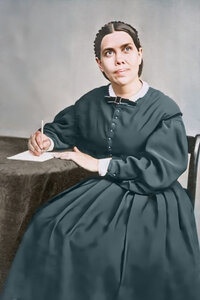
Ellen Gould Harmon White was the messenger of the Lord to the Seventh-day Adventist Church, the wife of co-founder James White, and the prophetic voice through whom God guided the early Sabbatarian Adventist movement from a scattered handful of disappointed Millerites in 1844 into a worldwide church. Born Ellen Gould Harmon in Gorham, Maine, on November 26, 1827, she received her first vision in December 1844 in Portland, Maine, at the age of seventeen. She received over two thousand visions in the seventy years that followed, was the author of nearly forty books and thousands of articles, and led — together with her husband and Joseph Bates — the formation of the publishing, health, educational, and mission infrastructures of the Adventist movement. She died at Elmshaven, near St. Helena, California, on July 16, 1915, at the age of 87.
Early Life and the Accident (1827–1840)
Ellen White’s own Life Sketches Manuscript opens with the basic biographical record: “Ellen Gould Harmon was born in Gorham, Cumberland County, Maine, November 26, 1827. A few years after her birth the family moved to Portland, where most of her early life was spent. Her father, Robert Harmon, was a man of acknowledged integrity, and an earnest, devoted Christian.” (Life Sketches Manuscript, p. 1, par. 1; refcode LSMS 1.1).
The same opening continues with the Harmon family’s industrious New England piety: “They were in humble circumstances, but they were industrious, self-reliant, and pious. The characteristic virtues which have rendered famous the earlier homes of New England,—such as reverence for God and respect for parental authority,—were early and firmly inculcated; and the children were faithfully taught, by both precept and example, those lessons of integrity and diligence” (Life Sketches Manuscript, p. 1, par. 2; refcode LSMS 1.2).
Ellen’s early childhood is described in the same biographical sketch: “In Ellen, both mental and physical development was rapid and vigorous. While but a child, she displayed a love of study, a quick perception, and a retentive memory. She was of a buoyant, hopeful disposition, fond of society, courageous, resolute, and persevering. It was but natural that her parents should regard her with peculiar interest, and entertain high hopes for her future. But by a painful accident, the circumstances of which are related in her own language in the first chapter following, these hopes appeared to be utterly blighted” (Life Sketches Manuscript, p. 2, par. 1; refcode LSMS 2.1).
The accident at age nine — a stone thrown by an angry classmate as Ellen was crossing a Portland common — left her near death and permanently altered the course of her life. Her own account of it, preserved in Life Sketches of James White and Ellen G. White (1880), records the moment: “At the age of nine years an accident happened to me which was to affect my whole life. In company with my twin sister and one of our school-mates, I was crossing a common in the city of Portland, Maine, when a girl about thirteen years of age, also a member of our school, becoming angry at some trifle, followed us, threatening to strike us. Our parents had taught us never to contend with any one” (Life Sketches of James White and Ellen G. White (1880 ed.), p. 131, par. 1; refcode LS80 131.1).
Of her early conviction in the days that followed: “At this time I began to pray the Lord to prepare me for death. When Christian friends visited the family, they would ask my mother if she had talked to me about dying. I overheard this and it roused me. I desired to become a Christian and prayed earnestly for the forgiveness of my sins. I felt a peace of mind resulting, and loved every one, feeling desirous that all should have their sins forgiven” (Life Sketches of James White and Ellen G. White (1880 ed.), p. 132, par. 4; refcode LS80 132.4).
The lasting effect of the accident is described in her own words: “My health seemed to be completely shattered. For two years I could not breathe through my nose, and was able to attend school but little. It seemed impossible for me to study and retain what I learned.” (Life Sketches of James White and Ellen G. White (1880 ed.), p. 134, par. 2; refcode LS80 134.2).
The Life Sketches Manuscript records the eventual end of her formal schooling: “My teachers advised me to leave school, and not pursue my studies further until my health should improve” (Life Sketches Manuscript, p. 10, par. 1; refcode LSMS 10.1). And the final attempt: “Three years later I made another effort to obtain an education, by entering a seminary for young ladies in Portland. But on attempting to resume my studies, my health again failed, and it became apparent that if I remained in school, it would be at the expense of my life. It was the hardest struggle of my young days to yield to my feebleness” (Life Sketches Manuscript, p. 10, par. 2; refcode LSMS 10.2).
Embracing the Advent Message (1840–1844)
Ellen’s Life Sketches records the impact of William Miller’s first visit to Portland: “In March, 1840, William Miller visited Portland, Me., and gave his first course of lectures on the second coming of Christ. These lectures produced a great sensation, and the Christian church, on Casco street, that Mr. Miller occupied, was crowded day and night. No wild excitement attended these meetings, but a deep solemnity pervaded the minds of those who heard his discourses.” (Life Sketches of James White and Ellen G. White (1880 ed.), p. 136, par. 3; refcode LS80 136.3).
Steinweg’s Lest We Forget records the salvation Ellen experienced at the Buxton Methodist camp meeting: “Ellen heard William Miller preach in Portland, Maine. That summer, she attended the Methodist camp meeting at Buxton, Maine, where she accepted salvation in Christ and joined the Methodist church on probation. She soon was earning money to buy Christian books and tracts to share her new-found faith” (Lest We Forget, ch. 126, p. 239, ¶ 9).
Steinweg also records the religious struggle that followed: “Ellen’s heart was so weak she had to sit propped up in bed to work. She was troubled by the doctrine of an eternally burning hell. Her religious experience progressed from perplexity over the Methodist doctrine of justification and sanctification, to hunger and thirst for full salvation, to rejoicing over a renewed understanding of the plan of salvation, and testifying to other youth of her joy in Christ and hope for His soon coming” (Lest We Forget, ch. 126, p. 239, ¶ 11).
The First Vision (December 1844) and the Beginning of Her Ministry
Steinweg’s Lest We Forget records the moment of Ellen’s first vision: “Fall, October 22—The Great Disappointment: Ellen, was sick with tuberculosis and hemorrhaging from the mouth, and nearly died. But in December, at Portland, Maine, she had her first vision regarding the travels of the advent people to the City of God. She was only seventeen” (Lest We Forget, ch. 126, p. 240, ¶ 33).
Ellen White’s own Early Writings preserves the substance of that first vision. Arthur White’s Volume 1 biography preserves her words about the moment: “While I was praying, the power of God came upon me as I had never felt it before. I was wrapped in a vision of God’s glory, and seemed to be rising higher and higher from the earth, and was shown something of the travels of the Advent people to the Holy City.” (Ellen G. White: The Early Years 1827-1862, vol. 1, p. 56, par. 1; refcode 1BIO 56.1).
Arthur White records, also from her own letter to Enoch Jacobs published in the Day-Star: “As God has shown me the travels of the Advent people to the Holy City, and the rich reward to be given those who wait the return of their Lord from the wedding, it may be my duty to give you a short sketch of what God has revealed to me. The dear saints have got many trials to pass through. But our light afflictions, which are but for a moment, worketh for us a far more exceeding and eternal weight” (Ellen G. White: The Early Years 1827-1862, vol. 1, p. 56, par. 3; refcode 1BIO 56.3).
The shape of her early reluctance and obedience is recorded in Arthur White’s biography: “For several days and far into the night Ellen prayed that God would remove the burden from her and place it upon someone more capable of bearing it. But constantly the words of the angel sounded in her ears” (Ellen G. White: The Early Years 1827-1862, vol. 1, p. 63, par. 4; refcode 1BIO 63.4).
Her own account of the first public meeting where she shared the vision is preserved in Arthur White: “When my message was ended my voice was gone until I stood before the people again, when the same singular restoration was repeated. I felt a constant assurance that I was doing the will of God, and saw marked results attending my efforts.” (Ellen G. White: The Early Years 1827-1862, vol. 1, p. 65, par. 6; refcode 1BIO 65.6).
The first eastern Maine itinerancy followed soon after, with William and Sarah Jordan as her travelling companions: “The Jordans were driving by sleigh the one hundred miles to Orrington, on the Penobscot River.” (Ellen G. White: The Early Years 1827-1862, vol. 1, p. 69, par. 5; refcode 1BIO 69.5).
It was at Orrington, on that journey, that Ellen Harmon first met James White. Arthur White records: “She began her work of encouraging the believers and meeting fanaticism, a work that was to continue through the next year or two. Reporting her experience of this period, she wrote” (Ellen G. White: The Early Years 1827-1862, vol. 1, p. 71, par. 1; refcode 1BIO 71.1).
Marriage to James White (1846)
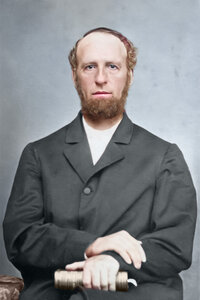
Loughborough records the marriage of August 30, 1846: “August 30, 1846, Miss E. G. Harmon and Elder James White were united in marriage, and together they labored for the advancement of the message. During the year 1847 their labors were mostly confined to Maine and Massachusetts” (The Great Second Advent Movement, p. 244, par. 1; refcode GSAM 244.1).
Steinweg records the matter: “After traveling and working by her side for eighteen months, James, 25, and Ellen, 18, were married August 30, 1846. Mere youths, James and Ellen dedicated their lives to learning and preaching Present Truth as God would reveal it, and with other pioneers, they eventually founded the Seventh-day Adventist church” (Lest We Forget, ch. 121, p. 225, ¶ 8).
The Long Ministry (1846–1881)
Throughout the next thirty-five years Ellen White ministered through visions, testimonies, books, and travel — first across the Northeast, then the Midwest, then the Pacific Coast — at the side of her husband. The Life Sketches Manuscript records one of many incidents of healing in those early years, the case of Brother W. H. Hyde: “At this time Brother W. H. Hyde was very sick with dysentery. His symptoms were alarming, and the physician pronounced his case almost hopeless. We visited him and prayed with him, but he had come under the influence of certain fanatical persons, who were bringing dishonor upon our cause. We wished to remove him from among them, and petitioned the Lord to give him strength to leave that place.” (Life Sketches Manuscript, p. 100, par. 1; refcode LSMS 100.1).
Of the outcome: “Brother Hyde immediately dressed and walked out of the room, praising God, and with the light of heaven shining upon his countenance. His recovery was complete and permanent.” (Life Sketches Manuscript, p. 100, par. 4; refcode LSMS 100.4).
Arthur White’s Ellen G. White: The Lonely Years sets the stage for the long widowhood that began in 1881: “This volume picks up the Ellen White story at a high point in her ministry—a time when she was writing on the life of Christ and also engaged, with her husband, James, president of the General Conference, in a grueling camp meeting labor that had become a recurring summertime activity.” (Ellen G. White: The Lonely Years 1876-1891, vol. 3, p. 10, par. 1; refcode 3BIO 10.1).
Final Years and Death (1881–1915)
After her husband’s death in 1881, Ellen White continued her ministry for another thirty-four years, including a nine-year period of mission service in Australia (1891–1900). Her final years were spent at Elmshaven, near St. Helena, California.
Arthur White records the closing weeks. On June 27, 1915, Elder and Mrs. Starr came to say goodbye, and she replied to their greetings with the assurance that her trust was in the Lord: “the Lord has arranged and led in all these things for me, and I am trusting in Him. He knows when it will all end.” (Ellen G. White: The Later Elmshaven Years, vol. 6, p. 430, par. 7; refcode 6BIO 430.7).
To the Starrs’ confidence that they would meet her in the kingdom of God, she replied: “Oh, yes” (Ellen G. White: The Later Elmshaven Years, vol. 6, p. 430, par. 9; refcode 6BIO 430.9). And she added: “It seems almost too good to be true, but it is true!” (Ellen G. White: The Later Elmshaven Years, vol. 6, p. 430, par. 9; refcode 6BIO 430.9).
Her last recorded words came on the morning of Friday, July 9, when she rallied enough to speak to her son W. C. White and her companion Sara McEnterfer: “I know in whom I have believed.” (Ellen G. White: The Later Elmshaven Years, vol. 6, p. 431, par. 2; refcode 6BIO 431.2).
Arthur White records the moment of her death seven days later: “The next day, Friday, July 16, at about two o’clock the nurses saw that the end was very near and sent for W. C. White and his wife, May. They hastened to the home and her room. As her breathing slowed, others were notified and made their way one or two at a time to the second-floor room.” (Ellen G. White: The Later Elmshaven Years, vol. 6, p. 431, par. 4; refcode 6BIO 431.4).
The progression of her last hour is preserved exactly: “In the morning Ellen White’s respiration had been clocked at fifty per minute, but at three o’clock it was thirty-eight; at three-twenty it was eighteen, and a little later only ten. Then her breathing became slower and more irregular, until without a tremor the breathing stopped. It was three-forty. No one in the room stirred for several minutes, thinking she might take yet another breath. But she did not” (Ellen G. White: The Later Elmshaven Years, vol. 6, p. 431, par. 5; refcode 6BIO 431.5).
The news of her death travelled rapidly: “Late Friday afternoon, July 16, 1915, the telegraph wires carried the word across the land that Ellen G. White, the messenger of the Lord, was at rest. Through telephone and telegraph the message reached many of the churches in time for Sabbath-morning announcement. To the public press the news called for the release of stories and pictures so that the world might know. News stories had been prepared in advance to be held until the release of word of her death” (Ellen G. White: The Later Elmshaven Years, vol. 6, p. 432, par. 1; refcode 6BIO 432.1).
She was buried beside her husband James White in Oak Hill Cemetery in Battle Creek, Michigan.