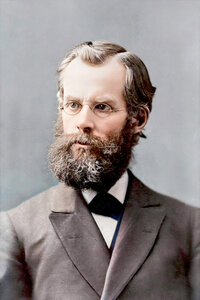
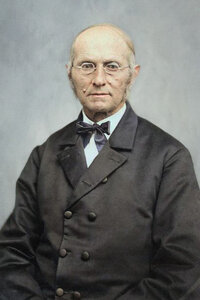
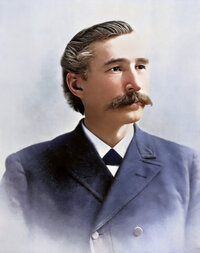
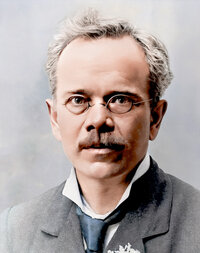
1840–1919
A Cautionary Biography
Dudley M. Canright served the Seventh-day Adventist Church as a minister for twenty-eight years (1859–1887) before publicly leaving in February 1887 and devoting the rest of his life to attacking the church, its doctrines, and Ellen G. White personally. His 1889 book Seventh-day Adventism Renounced and his 1919 Life of Mrs. E. G. White became the standard sources for every later opposition writer against Adventism. His example is not to be followed. The biographical record below is drawn from Butler and Smith’s Replies to Elder Canright’s Attacks on Seventh-day Adventists and other primary sources that addressed his apostasy at the time.
Summary
Born in Kinderhook, Branch County, Michigan, on September 22, 1840, Canright became a Sabbath-keeping Adventist in 1859 at the age of nineteen, was ordained in 1865, and served as president of the Ohio Conference (1865–1873) and the Michigan Conference (1880–1882). Through his twenty-eight years of Adventist ministry he was a vigorous evangelist and debater. After repeated wrestlings with doubt and the testimonies, he publicly resigned at Otsego, Michigan, on February 17, 1887. From that date until his death in 1919 his pen was turned against the church.
Twenty-Eight Years in the Adventist Cause (1859–1887)
Butler and Smith’s Replies to Elder Canright’s Attacks on Seventh-day Adventists records the long arc of Canright’s Adventist ministry: “Some twenty-eight years ago, D.M. Canright embraced the views of S.D.Adventists. For several years he labored to acquire some necessary education, and soon after commenced to preach their doctrines. He was blessed with a good degree of earnestness, with fair ability, and with ambition to succeed, and he had excellent success in his labors, and was considered for many years a growing man in the denomination” (Replies to Elder Canright’s Attacks on Seventh-day Adventists, p. 15, par. 2; refcode RCASDA 15.2).
The same paragraph records the early signs of the personal weakness that would prove his undoing: “He had a strong taste for debates and controversy, and applied himself especially to them, and had good success in them. These qualities always attract attention, and they gave him quite a prominence. For a dozen years his labors were valuable to this cause, and he traveled extensively in different States and Conferences. He then had quite fully the confidence of our people. But from that point their confidence began to lessen” (Replies to Elder Canright’s Attacks on Seventh-day Adventists, p. 15, par. 2; refcode RCASDA 15.2).
The February 17, 1887 Withdrawal
Butler and Smith’s Replies records the public moment of Canright’s resignation at Otsego, Michigan: “In the month of January last, Eld D.M. Canright, who had been connected with our people for about twenty-eight years, took the position that he could be an S.D. Adventists no longer. Feb. 17, he gave his reasons in public before the Otsego church, of which he was a member. The writer was present” (Replies to Elder Canright’s Attacks on Seventh-day Adventists, p. 4, par. 3; refcode RCASDA 4.3).
Canright’s testimony at the moment of withdrawal was strikingly conciliatory. The same paragraph records: “In his remarks concerning our people and the treatment he had received among us, he was very kind and conciliatory. He stated that he thought there was a larger percentage of true Christians among our people than among any other denomination with which he was acquainted. He expressed a high appreciation of, and confidence in, some of our leading men, believing them to be honest, devoted servants of Christ. He said he was perfectly satisfied with the treatment he had received among Seventh-day Adventists. He had no fault to find with them on that score, and felt that they had used him in all respects as well as Christians should” (Replies to Elder Canright’s Attacks on Seventh-day Adventists, p. 4, par. 3; refcode RCASDA 4.3).
Butler and Smith’s Replies preserves Canright’s own published words from the Review and Herald of March 1, 1887, including his frank acknowledgment that he had been treated justly, liberally, and tenderly by the Adventist body — words preserved in the same paragraph cited below at refcode RCASDA 20.1.
From Conciliation to Attack (1887–1919)
The same paragraph records the trajectory that followed: “Yet now, like the ungrateful youth who strikes his own mother, he can turn upon his old friends and the cause which fostered him, ridicule us through the papers and in the pulpit, make the utmost of our unpopularity, join with our bitterest enemies in opposition to our work, and class us among Mohammedans, Mormons, and other fanatics, and do his best to make it appear that we are a narrow, bigoted set of dupes” (Replies to Elder Canright’s Attacks on Seventh-day Adventists, p. 20, par. 1; refcode RCASDA 20.1).
Butler’s introduction to Replies records the church’s long forbearance with Canright before answering: “In undertaking the unpleasant work of replying to the attacks of Eld. D.M. Canright upon Seventh-day Adventists and their doctrines, we feel almost like offering an apology to the reading public. For months past his attacks have continued in various papers and upon many different points of our faith. He has held us up to ridicule, and tried to make it appear that our people are ignorant, narrow-minded, bigoted, and doing much harm in the Christian world, and that our doctrines are utterly unworthy of confidence” (Replies to Elder Canright’s Attacks on Seventh-day Adventists, p. 3, par. 1; refcode RCASDA 3.1).
The Pattern Butler and Smith Named
The book’s most arresting sentence, in the same paragraph that records Canright’s published acknowledgment of just treatment: “We could never have believed our old friend D.M. Canright would pursue such a course had we not well known his weakness and the nature of that spirit which often takes possession of those who give up this truth” (Replies to Elder Canright’s Attacks on Seventh-day Adventists, p. 20, par. 1; refcode RCASDA 20.1). And, also in the same paragraph: “We have never known a man in all our lives who could change his mind so suddenly and so radically as Eld. C.” (Replies to Elder Canright’s Attacks on Seventh-day Adventists, p. 20, par. 1; refcode RCASDA 20.1).
Death (1919)
Per the Encyclopedia of Seventh-day Adventists, Canright died on May 12, 1919, at the age of seventy-eight. He was a Baptist minister at the end of his life. Several Adventist leaders attempted to communicate with him in his final years, including W. A. Spicer, but his pen continued in opposition to the very last.
Legacy
Canright’s own admission at the moment of his withdrawal — that the church had treated him “justly, liberally, and tenderly” — stands as the truest measure of the personal-grievance fiction later built around his name. His writings became the standard sources for every later opposition writer; the testimony of those who labored beside him for twenty-eight years — and his own words at the moment he left them — is the more reliable witness. Several Adventist leaders, including W. A. Spicer, attempted to communicate with him in his final years; his pen continued in opposition to the very last.