Summary
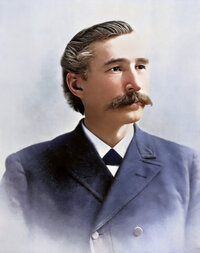
Charles M. Kinny was the first African American ordained minister in the history of the Seventh-day Adventist Church subsequent to organization of the General Conference in 1863. Born in Richmond, Virginia, and raised during the era of slavery and Reconstruction, Kinny became a trailblazing evangelist who labored tirelessly to bring the Adventist message to African Americans across the United States. Though often spelled “Kinney” in denominational sources, Kinny himself always spelled his name “Kinny” in correspondence and other documents in his own hand. Historian Ronald Graybill called Kinny the “Founder of Black Adventism,” and his far-sighted 1889 proposal for separate black conferences — made when only one black Adventist church with barely double-digit membership existed — would be vindicated decades later when those conferences were finally established and facilitated remarkable growth.
Early Life and Conversion
Charles M. Kinny was born on April 1, 1855, to Andrew and Lucy Ann Kinny in Richmond, Virginia. He lived his first ten years in a slave state, in what became the capital city of the Confederacy during the Civil War (1861—1865). However, no evidence has surfaced to indicate whether Charles was enslaved or a free person of color. Charles’s mother apparently passed away sometime before 1880.
After 1870, Andrew Kinny and three children — Philip, Charles, and Ida — left Virginia in search of a better life in the West, ending up in Reno, Nevada. Charles earned his living in Reno as a barber, a skill he learned from his father.
In the summer of 1878, Charles attended a series of evangelistic lectures that J. N. Loughborough presented in Reno. Ellen White visited while the series was in progress and spoke on Tuesday evening, June 30, to about 400 listeners on the “Love of God.” Kinny accepted the Adventist message and never forgot Ellen White’s sermon. He kept his first Sabbath on the last Saturday of September 1878 at the age of 23. He was one of the seven charter members and the only black member of the Reno Seventh-day Adventist church.
Tract Society Work in Nevada
Kinny became active in the church tract society and by 1882 was state secretary for the Nevada Tract and Missionary Society. Though the Nevada membership was not large, this was a position of high responsibility in an era when “T and M” or tract societies, not conference departments, were the primary agencies for organizing members for personal evangelism and outreach.
His reports, published in the Review, revealed a conscientious and meticulous secretary, zealous of his new faith. They also reveal that Kinny sent literature to and corresponded with interests from all across the nation. He seems especially to have focused on friends and acquaintances from Virginia. In May 1881 he reported, “A colored teacher in Richmond, Va., has accepted the truth as the result of receiving Signs from our society with correspondence and others are interested.” Later that year a young Baptist minister in Richmond wrote, promising that “if I can aid in the proclamation of the Third Angel’s Message, I shall be glad to do so.” In that same brief report, Kinny cited favorable responses from another minister in Hampton, Virginia, a Baptist deacon in Richmond, and a friend in Columbus, Ohio.
Mission to Kansas
Favorably impressed with Kinny’s work, the Reno church and the California Conference (which included Nevada at that time) helped support him for two years of study at Healdsburg, the Adventist college located in northern California, from 1883 to 1885. In the summer of 1885, sponsored by the California Conference, Kinny began evangelistic labor in Kansas, a popular destination for black migrants from the South after the Civil War, and especially after the hopeful advances toward equal rights in the Reconstruction era began to give way in the late 1870s to the rise of legal segregation and the rule of white supremacists.
He began work in Topeka, the state capital, in June and by mid-October had canvassed a third of the city and given Bible studies to interested individuals, resulting in three converts. He also succeeded in stirring opposition, especially from black Baptist ministers. Although he hoped to avoid public debate, he ended up before a crowd of 300 at a city park, responding to arguments against the seventh-day Sabbath from the most vocal opponent. He succeeded in answering many of the objections, judging from the response of some of the witnesses who were present.
Kinny showed remarkable determination in pressing on with the mission despite the obstacles of ignorance, superstition, and poverty. Because those he sought to reach had “drank deep of the wine of Babylon,” he did not think “large conversions” should be expected in the short-term. He thus focused more on personal evangelism than public evangelism, going from house to house giving Bible studies, selling, loaning, and giving away Adventist literature.
After Topeka, Kinny worked in Emporia, leaving a group of “twelve colored Sabbath-keepers” there when his labors concluded in November 1887.
Racial Conflict in St. Louis
Focusing even more on canvassing, Kinny also extended his labors into a new state: Missouri. He spent the first half of 1889 canvassing in St. Louis where a number of new believers from the black community were joining the predominantly white church. It was here, apparently, that Kinny for the first time encountered serious conflict over racial prejudice within the church. He did not report any details for publication, but must have described difficult experiences in letters to Dan T. Jones, General Conference secretary, because Jones’s replies acknowledged the reality of “race prejudice in the church” while encouraging Kinny to persist nonetheless.
Less than a year after Kinny left the city, Ellen White encountered the serious difficulties in St. Louis first hand, and later wrote of having “experiences at St. Louis that I can never think of without a feeling of dread.” She addressed the issue head-on in her talk to church leaders in 1891 entitled “Our Duty to the Colored People”:
“While at St. Louis a year ago, as I knelt in prayer, these words were presented to me as if written with a pen of fire: ‘All ye are brethren.’ The spirit of God rested upon me in a wonderful manner, and matters were opened to me in regard to the church at St. Louis and in other places. The spirit and words of some in regard to members of the church were an offense to God. They were closing the door of their hearts to Jesus. Among those in St. Louis who believe the truth there are colored people who are true and faithful, precious in the sight of the God of heaven, and they should have just as much respect as any of God’s children.”
Ordination and Foundations of the Black Work
Under assignment from the General Conference Committee, Kinny arrived in Louisville, Kentucky, in June 1889 to shepherd and build up the small company of black believers there. While serving in Louisville, Kinny attended the Tennessee camp meeting and Nashville Institute in late September 1889. This gathering drew Adventist workers from throughout the South, and was followed by a council convened by R. A. Kilgore, superintendent of General Conference District No. 2 which covered the South.
At the council, Kinny became the first African American since General Conference organization to be ordained as a Seventh-day Adventist minister of the gospel, with Kilgore and J. O. Corliss leading the service.
Along with that milestone, the Nashville council would set a precedent for the Adventist church’s grappling with the color line at a time when white supremacism was consolidating control over the southern states and the nation as a whole was entering “the nadir” in its racial history. Kilgore and others believed that the presence of Black people at the Nashville camp meeting was one reason why attendance from the surrounding community was so low at preaching services open to the public. In his report on the council in the Review, Kilgore asserted that those experienced in Adventist work in the South realized that any effort “to break down the distinction between the races, thus ignoring the popular prejudice, is simply fanatical and unwise.”
The Twelve Propositions
Kinny addressed the council on October 2, 1889, setting forth “twelve propositions” for resolving the dilemma of racial segregation in the church. He began by pointing out that separating the races at “general meetings” such as the one just conducted tended to destroy the unity of the Third Angel’s message and caused “great embarrassment and humiliation and not only to me, but to my people also.” He did not want “the colored people” to be “driven from the truth by our position on this question.” At the same time he affirmed that “the Third Angel’s message is to go to all nations of the people” and recognized the reality that “the very presence of the colored people in church relations and in our general meetings” hindered the message from reaching many white people.
While Kinny believed in the power of the gospel to change lives, he accepted the sociological reality of living in a racist society and saw his propositions as the best way to adjust to this reality without hurting the church’s mission for both races. While he did not believe in segregation, he was willing to work within its narrow confines for the ultimate good of the church. Thus, he wrote, “Where the two races cannot meet together without limitation in the church, it is better to separate” (4) and that missions be undertaken for the purpose of “raising up separate churches” (5).
Kinny’s next propositions revealed a long-term vision for black Adventist self-governance within the unified Adventist body. He proposed that blacks should continue to fellowship in the same church as white members until their numbers became sufficient for organization as a separate church (7). Similarly, “colored churches, companies or individuals” should be part of the “state conference” until their growth warranted formation of a “conference for colored people” (8). Such conferences should “bear the same relation to the General Conference that white conferences do” (11).
The separate conference proposal was truly far-sighted at a time when only one black Adventist church, with a membership barely in double digits, had been organized. In the meantime, he urged that the General Conference invest in “educating worthy colored laborers” (9).
Church Planting in the South
Kinny returned from the Nashville council to Louisville, where his proposal for organizing separate black churches was implemented with a company of 10 believers on February 16, 1890. The Louisville group thus became the second formally organized black Seventh-day Adventist church. In August 1890, Kinny began a series of public meetings seeking to build up the first such church, organized in 1883 in Edgefield Junction, Tennessee.
He continued to advocate for the denomination to devote greater resources to advancing the work among African Americans, but found it difficult to make headway. His request in December 1890 that the church’s main periodical, the Review and Herald, publish an appeal for donations to be used for construction of church buildings for the black congregations in Edgefield Junction and Louisville was rebuffed on the grounds that the Review never published appeals on behalf of local churches.
In March 1891 Kinny went to Battle Creek, Michigan, as a delegate to the General Conference session, where he had opportunity to present his case on behalf of the black work. The outlook, he frankly stated, was “extremely embarrassing.” He believed he had done some good “building up and encouraging” scattered small groups as he went from place to place in Kentucky and Tennessee. That work, accomplished mainly through personal visitation, Bible studies, and circulation of literature, needed to be quickly followed up by a “living preacher” to spiritually nurture the churches and hold public evangelistic meetings. Because no corps of black Adventist ministers and gospel workers yet existed to do this, Kinny appealed for “at least one white laborer of experience to devote his entire time to the work among this people.”
Kinny’s appeal did not fall on deaf ears. Ellen G. White, who attended the same meeting, supported his call by making her own historic appeal, “Our Duty to the Colored People,” delivered on March 21 to a group of church leaders gathered at the same General Conference session. In 1895 her eldest son, J. Edson White, took the lead in responding to the appeal in his renowned mission to the South utilizing the Morning Star steamboat.
Meanwhile, Charles Kinny continued his work of establishing small black Adventist congregations in the South: Bowling Green, Kentucky, June 13, 1891, 8 members; New Orleans, Louisiana, June 4, 1892, 10 members; Nashville, Tennessee, September 15—16, 1894, 10 members. Organization of the 15-member Birmingham, Alabama, church on June 19, 1896, brought the number of black Adventist congregations to six.
Extended Ministry Amidst Health Challenges
In March 1898, after paying Kinny’s salary for nearly nine years, the General Conference Committee voted that he “engage in self-supporting missionary work,” with no clear reason recorded. The change must have been discouraging at some level, but there is no indication that Kinny protested it. For the next nine years, he traveled widely, canvassing intermittently in Nebraska, Missouri, Texas, Tennessee, and Alabama.
Kinny married Viola E. Kinny (1877—1939) in Nashville on October 19, 1902, with Franklin Warnick performing the ceremony. Viola taught church school in Nashville for a time. Charles Kinny returned to the salaried denominational work force in 1907 as a minister in the Tennessee River Conference. However, Viola experienced serious health problems, and by 1911, Kinny concluded that the necessity of caring for her made it impossible for him to continue in ministry full-time.
Receiving some support from the denominational sustentation fund, Kinny engaged in part-time ministry until his wife’s death in 1939, based in Nashville except for three years in Virginia (1912—1915). Soon after Viola’s death, Kinny became a resident at Riverside Sanitarium and Hospital where he received care until his death on August 2, 1951, at the age of 96.
Legacy
“Black ministers in better times made many more converts than C. M. Kinny, but no one faced the lonely task he faced,” wrote historian Ronald Graybill, who called Kinny the “Founder of Black Adventism.” Refusing to be defeated by forbidding circumstances, Kinny was a thoughtful evangelistic strategist who adjusted his approach to fit the time and place.
In his history of African American Adventism, Louis B. Reynolds described Kinny’s legacy as “a carefully chiseled and meticulously laid foundation” upon which others would build. In 1896, the combined membership of the five churches he founded along with that of Edgefield Junction could not have totaled much more than 100. By the time of his death in 1951, the black Adventist membership in America had reached 26,500. Though long-deferred, the black conferences that he envisioned in 1889 had by then just been established, and would facilitate even greater flourishing for the cause he championed in the decades ahead.