1805–1844
Summary
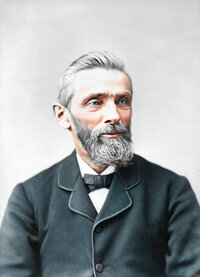
Charles Fitch was a Congregational and Presbyterian minister who became one of the most effective preachers of the Millerite movement, the co-author of the famous “1843 Chart,” and the author of the 1843 sermon “Come Out of Her, My People.” He died of pneumonia on October 14, 1844 — eight days before the date for which he had given his life and his fortune in expectation of Christ’s return — and Ellen White afterward wrote of meeting him in vision at the tree of life.
Education and Early Ministry (1805–1836)
Froom records the bare facts of Fitch’s life and ordained ministry: “Next was CHARLES FITCH (1805-October 14, 1844), who came from Hampton, Connecticut. He was trained at Brown University, and after ordination to the Congregational ministry served successively at Abington, Connecticut; Warren, Massachusetts; and Hartford, Connecticut” (The Prophetic Faith of Our Fathers, vol. 4, p. 533, par. 2; refcode PFF4 533.2). Of the New York Broadway Tabernacle dedication, Froom adds: “Fitch, then of Hartford, was secured to preach the sermon” (The Prophetic Faith of Our Fathers, vol. 4, p. 533, par. 2; refcode PFF4 533.2).
The compilation Lest We Forget sketches the same arc and adds the headline that Adventist memory came to attach to him: “Scholar, theologian, poet, prophetic chart maker, popular preacher and evangelist, proponent of sanctification by faith, abolitionist, tender husband and father, Charles Fitch was there at the precise time where God meant him to be” (Lest We Forget, ch. 38 (“Charles Fitch 1805-1844”), p. 79, ¶ 2). LWF continues: “After studying at Brown University in Rhode Island, Fitch began his ministry in the Congregational Church at Abington, Connecticut. Other cities where he ministered were Warren and Boston, Massachusetts, Hartford, Connecticut, and Newark, New Jersey. By 1832 he was an honorary member of the American Board of Commissioners for Foreign Missions and had been ordained” (Lest We Forget, ch. 38, p. 79, ¶ 3).
Encounter with Miller, Hesitation, and Conversion (1838–1841)
Fitch’s first reading of William Miller’s lectures came in 1838. Lest We Forget records his initial conviction and the long retreat that followed: “In March of 1838 Fitch wrote William Miller stating that he had read Miller’s Lectures and did not doubt the correctness of his views. However, for Charles Fitch, as for many other similarly trained ministers of that remarkable reform time, it took great courage and intense conviction to identify with the advent Millerites” (Lest We Forget, ch. 38, p. 79, ¶ 4). LWF preserves Fitch’s later confession in his own words: “the reproach which I saw would come upon me if I advocated them led me to lay the matter aside” (Lest We Forget, ch. 38, p. 79, ¶ 5). The same paragraph adds: “The truth is, that the fear of man brought me into a snare; I was unwilling at this time to appear as an advocate of the truth defended by Mr. Miller” (Lest We Forget, ch. 38, p. 79, ¶ 5).
The retreat lasted three and a half years. Josiah Litch’s visit and a parcel of literature reopened the question, and Fitch’s letter to friends describes the prayerful study that followed: “I went to the Lord; I read my Bible, and all the works that I could obtain. I possessed myself of all the evidences in the case that I could; and then with fasting and prayer I laid them and myself with my all before the Lord, desiring only that the Blessed Spirit might guide me into all truth” (Lest We Forget, ch. 38, p. 79, ¶ 8).
Cleveland Ministry and the “1843 Chart” (1842–1843)
Fitch threw himself into the Adventist cause without reserve. Lest We Forget records his pace: “Thereafter, Fitch traveled tirelessly, throwing himself unreservedly into proclaiming the need of preparation for the Second Coming of Christ. He moved his family to Cleveland, Ohio and held meetings and baptisms all over Ohio. His words testify to his dedication to both doctrines, “Wherever I have been I have preached holiness. My usual practice has been to preach on Holiness in the afternoon and”” (Lest We Forget, ch. 38, p. 79, ¶ 9).
The single most enduring contribution he made to the Millerite cause was a chart. Loughborough records: “First to head the list is Charles Fitch, of Cleveland, Ohio, who in 1842 suggested the idea of having charts to illustrate the visions of Daniel and the Revelation. The origin of the thought was based upon Habakkuk 2:2, 3” (The Great Second Advent Movement, p. 124, par. 2; refcode GSAM 124.2). LWF records the partner and the role of the chart in the movement: “In 1842, feeling the need of an accurate chart, Fitch and Apollos Hale prepared the famous chart illustrating the fulfillment of the last-time prophecies of Daniel. This was used extensively by the Millerites” (Lest We Forget, ch. 38, p. 80, ¶ 10).
“Come Out of Her, My People” (1843)
Fitch’s polemical tract of July 1843 became one of the defining moments of the Millerite movement. Lest We Forget records its three guiding questions: “Fitch also preached the message of the second angel of Revelation 14. “Come out of her my people.” Therefore he is considered an inseparable link of the advent movement. In one sermon he addressed the following questions: What is Babylon? What is the fall of Babylon? What is it for God’s People to come out of Babylon?” (Lest We Forget, ch. 38, p. 80, ¶ 11). Fitch’s own assessment of the prospects of reform without the second advent appears in a letter from Cleveland published in the Signs of the Times: “To bring about an extensive and permanent reformation in this crazy world is a hopeless thing” (Lest We Forget, ch. 38, p. 80, ¶ 12).
The Loss of Two Sons (December 1843 – January 1844)
Within a month, two of Fitch’s young sons died. Lest We Forget records the death of seven-year-old Willie buried December 5, 1843, then of his twenty-month-old brother. The Midnight Cry of January 24, 1844 noted the second loss: “Bro. Charles Fitch is now at Cleveland. He has buried another child” (Lest We Forget, ch. 38, p. 80, ¶ 14). Fitch’s reflection on his children’s resurrection-side restoration opens: “Those parents therefore who are themselves prepared for the Kingdom of God, have God’s word to assure them that they shall there find their infants, returned from the land of the enemy and there shall their work be rewarded” (Lest We Forget, ch. 38, p. 81, ¶ 15). The same paragraph closes: “They have not labored in vain for their little ones” (Lest We Forget, ch. 38, p. 81, ¶ 15).
Death (October 14, 1844)
Fitch was reported to have caught a chill while baptizing converts. Lest We Forget records: “Charles Fitch became seriously ill, probably with pneumonia, in the month of October, 1844. He had chilled while baptizing converts” (Lest We Forget, ch. 38, p. 81, ¶ 16). The Midnight Cry of October 19, 1844, carried news of his last hours: “he found Br. Fitch at Buffalo barely alive. His soul, however, was full of hope and glory. He said that it was indelibly written on his soul, that the Lord would come on the 10th day of the 7th month and if he went into the grave, he would only have to take a short sleep, before he should be waked in the resurrection morn” (Lest We Forget, ch. 38, p. 81, ¶ 18). The Midnight Cry of October 31, 1844 carried his obituary: “This dear brother has fallen asleep in Jesus. Those lips from which the words of God have been poured forth with power upon so many thousands of listening ears, are now sealed. That heart, which beat with a father’s tenderness, and a brother’s love for the children of God, has ceased beating” (Lest We Forget, ch. 38, p. 81, ¶ 20).
Froom’s section header for that closing chapter of Fitch’s life is itself the briefest summary: “DEATH FROM PNEUMONIA ON OCTOBER 14, 1844” (The Prophetic Faith of Our Fathers, vol. 4, p. 545; refcode PFF4 545).
Ellen White’s Vision (Tree of Life)
Years later, Ellen White recalled a vision in which she had met Fitch and another deceased Adventist preacher, Levi Stockman, at the tree of life:
We all went under the tree and sat down to look at the glory of the place, when Brethren Fitch and Stockman, [ See Appendix. ] who had preached the gospel of the kingdom, and whom God had laid in the grave to save them, came up to us and asked us what we had passed through while they were sleeping. We tried to call up our greatest trials, but they looked so small compared with the far more exceeding and eternal weight of glory that surrounded us that we could not speak them out, and we all cried out, “Alleluia, heaven is cheap enough!”
(Early Writings, p. 17, par. 2; refcode EW 17.2)
The same scene was recorded earlier in Spiritual Gifts, vol. 2, p. 34, par. 1 (refcode 2SG 34.1) and in Testimonies for the Church, vol. 1, p. 61, par. 2 (refcode 1T 61.2). To the Adventists who survived the Great Disappointment of October 22, 1844, the consolation that their preacher had been “laid in the grave to save him” — at rest, awaiting the resurrection — became one of the most repeated of Ellen White’s testimonies.