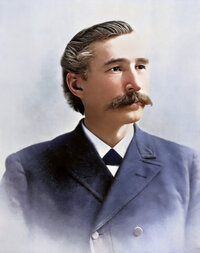
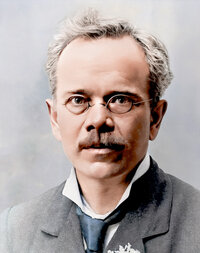
1858–1935
Summary
Arthur Grosvenor Daniells served twenty-one years (1901–1922) as president (and after the 1901 reorganization, chair of the General Conference Committee) of the Seventh-day Adventist Church — the longest tenure in that office in denominational history. He led the church through the watershed reorganization of 1901, the move from Battle Creek to Takoma Park (1903), the painful struggle with John Harvey Kellogg (1902–1907), the founding of Loma Linda (1905) and the Washington Foreign Mission Seminary, and the great expansion of Adventist mission work in the early twentieth century. Born at West Union, Iowa, on September 28, 1858, he was baptized at age ten by George I. Butler, married Mary Hoyt at eighteen, served as tent master to R. M. Kilgore in Texas in 1878 (where he and Mary worked alongside the aging James and Ellen White), pioneered Adventist work in New Zealand and Australia from 1886, returned to America in 1900, and was elected to lead the General Conference at the 1901 session in Battle Creek. He died at Takoma Park, Maryland, on March 22, 1935. Throughout his administration he was the steady defender of Ellen White’s prophetic gift and the author of the apologetic The Abiding Gift of Prophecy (1936).
From Iowa Orphanage to Battle Creek College (1858–1875)
Per Benjamin McArthur’s article in the Encyclopedia of Seventh-day Adventists, A. G. Daniells was born September 28, 1858, in West Union, Iowa, to Thomas Grosvenor Daniells and Mary McQuillan Daniells. His father, a Vermont-born stonemason and frontier physician, served in the Civil War as a member of the Iowa “Graybeards” regiment for men over forty-five years of age, and died in camp of one of the wasting diseases. His widow Mary placed Arthur and his younger twin siblings Jesse and Charles in an orphanage; her 1867 marriage to Rememberence Lippincott returned the children to a home setting. Mary embraced Adventism through the labors of lay evangelist Dan Shireman, and Arthur was baptized at age ten by Iowa Conference president George I. Butler. After one year at Battle Creek College — the only formal college year of his life — illness ended his education.
Texas, the Whites, and the Mules (1876–1881)
In 1876 Arthur married Mary Ellen Hoyt at the unusual age of eighteen. In 1878, after a “Damascus Road” experience walking to school, he turned from the schoolroom to the ministry, going to Texas as tent master for evangelist R. M. Kilgore. There the Daniellses were tasked with assisting the aging and ailing James and Ellen White: Mary served as cook, Arthur aided James in whatever he needed.
Ellen White’s letter of 1878 records the famous incident in which the young Daniells rounded up the Whites’ escaped mules: “Soon as you left, word came to us that the mules were found. Brother Daniells brought them to us” (Letters and Manuscripts, vol. 3, Letter 64, 1878, par. 1; refcode 3LtMs, Lt 64, 1878, par. 1).
New Zealand and Australia (1886–1900)
In 1886 the Daniellses accepted a call to New Zealand. James R. Nix’s Passion, Purpose & Power records, in Daniells’s own later words: “Our work began in Australia in 1885, when Pastors [Stephen N.] Haskell, [John O.] Corliss, and [M. C.] Israel, also Brethren Henry Scott and William Arnold, came to this field” (Passion, Purpose & Power, p. 186, par. 1; refcode PPP 186.1).
Per ESDA, the Daniellses spent four and a half years pioneering New Zealand (chiefly the North Island — Auckland, Napier, Kaeo, Wellington), and in 1891 transferred to Australia, where Arthur was elected conference president at the urging of Ellen White. With her, W. C. White, and W. W. Prescott he was a principal architect of the Avondale School, opened in April 1897.
Ellen White’s Ellen G. White in Australia records the McCullagh-Hawkins crisis of 1894 in Adelaide and Daniells’s part in resolving it: “Brethren Daniells and Colcord went immediately to Adelaide, where they found a determined rebellion. When they arrived, Brn. McCullagh and Hawkins refused to converse with them. They had given out an appointment for a meeting on Sunday evening, and asked Brother Daniells to speak in the tent that same evening. This he refused to do, going instead to hear them” (Ellen G. White in Australia, p. 311, par. 5; refcode EA 311.5).
The 1901 General Conference Reorganization
Per ESDA, Daniells returned to America in 1900 via South Africa and Europe and arrived in New York that fall. At the April 1901 General Conference Session in Battle Creek, with Ellen White’s strong endorsement, he was elected chair of the new General Conference Committee — effectively the church’s chief officer — and presided over the reorganization that introduced the union conference layer between the General Conference and local conferences. John Harvey Kellogg moved his name; A. T. Jones seconded.
A. T. Jones’s Review and Herald report of May 14, 1901, recorded the spirit of the Indianapolis general meeting Daniells presided over a few weeks later: “The meeting began Friday evening, with a sermon by Elder Daniells from the expressive words of Joshua 3:5; 4:24” (Review and Herald, May 14, 1901, p. 316, par. 4; refcode ARSH May 14, 1901, page 316.4).
The Move from Battle Creek to Washington (1902–1903)
The Battle Creek Sanitarium burned February 18, 1902; the Review and Herald printing house followed ten months later. Ellen White’s Testimonies for the Church, vol. 8, records her counsel to Daniells against rebuilding at Battle Creek, written before the fires: “I have received a letter from Elder Daniells regarding the addition of another building to the Review and Herald office. The answer I make to this is: No, no, no. Instead of making any additions to the buildings already erected, cleanse the office of the trash of satanic origin, and you will gain room in every way” (Testimonies for the Church, vol. 8, p. 90, par. 3; refcode 8T 90.3).
Her response after the Review fire: “Today I received a letter from Elder Daniells regarding the destruction of the Review office by fire. I feel very sad as I consider the great loss to the cause. I know that this must be a very trying time for the brethren in charge of the work and for the employees of the office. I am afflicted with all who are afflicted. But I was not surprised by the sad news, for in the visions of the night I have seen an angel standing with a sword as of fire stretched over Battle Creek” (Testimonies for the Church, vol. 8, p. 97, par. 1; refcode 8T 97.1).
Per ESDA, Daniells led the church to a new headquarters at Takoma Park, Maryland, with the actual move occurring in August 1903. Ellen White’s 1904 letter to W. W. Prescott confirms the divine commission: “You are where the Lord would have you. Elder [A. G.] Daniells and yourself must not be loaded down with a great many burdens. Washington has been neglected long enough. A decided work must now be done there. The Lord will give strength and grace” (Ministry to the Cities, p. 161, par. 4; refcode MTC 161.4).
The Daniells–Kellogg Conflict and the Defense of The Living Temple (1902–1907)
Per ESDA, the Battle Creek fires intersected with John Harvey Kellogg’s plans for ambitious Sanitarium rebuilding and the publication of The Living Temple. W. W. Prescott persuaded Daniells that Kellogg’s manuscript needed revision; the resulting confrontation between Daniells and Kellogg ran from the fall of 1902 through 1907 and ended with Kellogg’s separation from the denomination. Through it Ellen White’s testimonies (which Kellogg had at first sought to use against Daniells) ultimately confirmed Daniells’s “no debt” position and the rejection of The Living Temple‘s pantheistic theology.
Ellen White’s letter to Daniells and Prescott during the conflict: “I send you this, my brethren [A. G. Daniells and W. W. Prescott], that you may give it to others. Those who go forth to proclaim the truth shall be blessed by Him who has given them the burden of proclaiming this truth” (Ministry to the Cities, p. 109, par. 2; refcode MTC 109.2).
Defender of the Spirit of Prophecy
Ellen White’s letter of February 19, 1908, to W. C. White (preserved in Selected Messages, vol. 3) records her own awareness of Daniells’s hesitation to commit to a sustained book on the prophetic gift: “Since sending away a letter to you yesterday I have found yours of December 22. In it you tell me that for two full years you have been encouraging Elder Daniells to prepare a book on the Spirit of Prophecy, but you failed to tell me what response he gives to these requests” (Selected Messages, vol. 3, p. 453, par. 4; refcode 3SM 453.4).
The book Ellen White had urged him to write took twenty-eight more years; Daniells finally wrote it as The Abiding Gift of Prophecy and saw it through the press in 1936, the year after his death. The Ellen G. White Estate’s Judged by the Gospel preserves Daniells’s mature position on the prophetic gift — that he would teach others to “begin with the beginning of this movement. At that time here was a gift to that individual, at the same time came this movement of the three-fold message. They came right together in the same year. That gift was exercised steadily and powerfully in the development of this movement. The two were inseparably connected, and there was instruction given regarding this movement in all its phases through this gift, clear through for seventy years” (Judged by the Gospel, p. 403, par. 1; refcode JTLD 403.1).
Later Years and Death (1922–1935)
Per ESDA, Daniells stepped down from the General Conference presidency in 1922 after twenty-one years, declined to serve a sixth term, and was elected one of the first General Field Secretaries. Through the 1920s and 1930s he focused on ministerial professional development, helped found the Seventh-day Adventist Theological Seminary at Takoma Park, and devoted his last years to The Abiding Gift of Prophecy. He died at Takoma Park on March 22, 1935, in his seventy-seventh year, and is buried in Battle Creek’s Oak Hill Cemetery beside the founders. Mary survived him by nine years, dying in 1944.