1858 — 1936
Summary
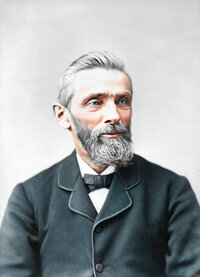
Arthur Grosvenor Daniells was the longest-serving president of the General Conference of Seventh-day Adventists, leading the church for twenty-one years (1901–1922) during one of the most transformative periods in its history. He orchestrated the momentous 1901 reorganization that created the union conference system, confronted John Harvey Kellogg, relocated church headquarters from Battle Creek to Washington, D.C., championed worldwide missions, founded a new medical school at Loma Linda, and convened the landmark 1919 Bible Conference.
Early Life
A. G. Daniells was born September 28, 1858, in West Union, Iowa, to Thomas Grosvenor Daniells (1805–1863) and Mary McQuillan Daniells (1835–1921). Thomas served in a unique Union Army regiment — the Graybeards, composed of men over forty-five — but fell victim to disease in camp. His death threw the family into straitened circumstances, and Mary had to place Arthur and his younger twin siblings, Jesse and Charles, in an orphanage. Mary’s marriage to farmer Rememberence Lippincott in 1867 returned the children to a home setting.
Mary came to Adventism through lay evangelist Dan Shireman. Arthur was baptized at age ten by Iowa Conference president George I. Butler. At age sixteen, he attended a normal school, then traveled to Battle Creek College. Illness ended his formal education after just one year.
Marriage and Early Ministry
Mary Ellen Hoyt (1854–1944), Canadian born, cut short her education to attend to Arthur. They married in 1876; Arthur was eighteen and Mary twenty-two. His persistent stammer caused church leaders to doubt his fitness for ministry. But Daniells got a chance to prove himself in Texas in 1878 as tent master for evangelist R. M. Kilgore. Both Mary and Kilgore tutored him, and Daniells would ultimately become a serviceable if not outstanding preacher.
During their time in Texas, the Daniellses assisted James and Ellen White. The friendship forged here would prove essential to Arthur’s later career. The Daniellses entered evangelistic ministry in Iowa, and in 1886 they received a call to cross the Pacific to New Zealand.
Years Abroad
Adventism had been brought to New Zealand by Stephen Haskell in 1885. When the Daniellses arrived in mid-fall 1886, Arthur wasted no time mounting evangelistic meetings under a tent in Auckland, Napier, Kaeo, and Wellington. The Daniellses spent four and a half years in New Zealand, leaving behind a well-established Adventist church.
In Australia from 1891, Daniells found the Adventist church numbered only about five hundred. He quickly learned Australians didn’t take to tent meetings — “The people are too English,” he later concluded. But Ellen White’s arrival later in 1891 boosted the church, and at her urging Daniells was elected conference president. The capstone of his organizational adeptness in Australia was the founding of the Avondale School for Christian Workers, which opened in April 1897.
General Conference Leader
Daniells returned to America in 1900 after fourteen years abroad. When the fateful 1901 General Conference session convened on April 2 in Battle Creek, Ellen White addressed leaders the night before, telling them the time for change was long overdue. The 216 delegates accepted Daniells’s motion to suspend normal rules and appoint an ad hoc committee to draft a new church organization. John Harvey Kellogg moved Daniells’s name for leadership, seconded by Alonzo T. Jones.
Reform took two primary forms. First, union conferences would be formed between the General Conference and local conferences. Second, most independent associations would be abolished and made departments of the General Conference. The General Conference of 1901 established an organizational structure that, with modifications, has endured for more than a century.
Key Contributions
Confrontation with Kellogg: Daniells stood firm against John Harvey Kellogg’s plans for unchecked institutional expansion. W. W. Prescott persuaded Daniells that Kellogg’s manuscript The Living Temple needed revision due to its pantheistic tendencies. “The time has come for members of the General Conference Committee to take a definite stand,” Daniells wrote. The bitter dispute ended with the dissolution of the International Medical Missionary and Benevolent Association and Kellogg’s eventual departure from Adventism.
Relocation to Washington, D.C.: After the Battle Creek Sanitarium fire of February 18, 1902, and the Review and Herald fire of December 30, 1902, Daniells led the move of church headquarters to Takoma Park, Maryland, in August 1903.
Missions Emphasis: The average number of missionaries leaving the United States for posts abroad increased fivefold between 1901 and 1920. “I have a great horror of having the work in America occupy the whole attention and resources of the church,” Daniells wrote.
Loma Linda Medical School: With Ellen White’s endorsement, Daniells championed the founding of the College of Medical Evangelists. When accreditation was threatened, Daniells delivered an impassioned address: “If I do not say my mind I will be a coward and unworthy of your confidence. … We can build up this school. We can do anything God wants us to do.”
The 1919 Bible Conference: Daniells convened a three-week conference of educators to examine Adventism’s historical position on prophecy and the nature of inspiration. However, the decision was made not to publish the transcripts, and they were filed away, not to be rediscovered for decades. Historians have debated whether wider dissemination of the discussions might have benefited the church.
End of Presidency and Later Years
As 1922 approached, many church leaders felt the time for change had come. William A. Spicer emerged as the favorite. Daniells did the honorable thing: he removed his name from consideration. He was elected to Spicer’s position of General Conference Secretary. After 1922, Daniells became what would later be styled a general field secretary, created the Ministerial Association (with its journal Ministry in 1928), and authored two classics: Christ Our Righteousness (1926) and The Abiding Gift of Prophecy (1935). He also chaired the College of Medical Evangelists Board of Trustees during the Great Depression.
Legacy
Arthur G. Daniells served as General Conference president for twenty-one years, longer than any other person in that office. The streamlined organizational form signified a shift in the Adventist Church from the culture of its founders — and ultimately from reliance on the charismatic presence of Ellen White. His administrative skill, forged during years of practical experience abroad, proved equal to the enormous challenges of leading a rapidly growing worldwide movement.
Source: Encyclopedia of Seventh-day Adventists, encyclopedia.adventist.org. Article by Benjamin McArthur.