1807–1898
Summary
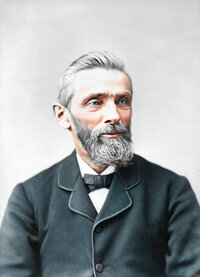
Apollos Hale was a Massachusetts-born Methodist minister who, after embracing the Millerite advent message in 1842, became one of the movement’s chief organizers, the co-author of the famous “1843 Chart,” and an associate editor of the Millerite journal Advent Herald. He chaired Millerite general conferences and survived the Great Disappointment of 1844, eventually withdrawing from regular preaching and earning his living as a shoe merchant in Charlestown, Massachusetts. He died in 1898 in his early nineties.
The “1843 Chart” (1842)
The most enduring contribution of Hale’s Millerite ministry was a hand-painted chart he created with Charles Fitch. Froom records: “In 1842 Fitch was still at Haverhill, Massachusetts, as pastor of the Winter Street Church, which Apollos Hale usually attended. At this time Fitch, assisted by Hale, designed the famous “1843” prophetic chart, painted on cloth, which he presented to the Boston General Conference of May, 1842, of which Joseph Bates was chairman” (The Prophetic Faith of Our Fathers, vol. 4, p. 538, par. 6; refcode PFF4 538.6).
Froom adds the conference’s response: “After the presentation of the chart, with its graphic symbols and time periods, to the conference, three hundred lithographed copies were authorized for use by the Adventist preachers” (The Prophetic Faith of Our Fathers, vol. 4, p. 538, par. 6; refcode PFF4 538.6).
Froom restates the importance of the chart later in his volume: “At the very opening of the twelfth General Conference, back again at Boston-where the first conference had convened eighteen months prior-Charles Fitch and Apollos Hale presented their prophetic chart, soon to become famous as the “1843 Chart.” It was painted on cloth, and was designed to simplify and unify the public presentations of the Adventist speakers. The conference voted to lithograph three hundred copies, of large size, this quickly becoming the standard chart. It was thenceforth uniformly used by the Millerite preachers and lecturers, superseding the various personal charts of prior” (The Prophetic Faith of Our Fathers, vol. 4, p. 615, par. 2; refcode PFF4 615.2).
Joseph Bates’s own first-person record of the chart’s presentation appears in Froom: “At the opening of this meeting Br. Chs. Fitch and A. Hale of Haverhill, presented us the Visions of Daniel and John which they had painted on cloth, with the prophetic numbers and ending of the vision, which they called a chart. Br. F., in explaining the subject said in substance as follows: he had been turning it over in his mind, and felt that if something of this kind could be done, it would simplify the subject, and make it much easier for him to present it to the people. Here new light seemed to spring up. These brethren had fulfilled a prophecy given by Hab.[akkuk] 2468 years before” (The Prophetic Faith of Our Fathers, vol. 4, p. 615, par. 3; refcode PFF4 615.3).
The Bates-chaired May 1842 conference also became one of the founding moments of the Millerite movement. Froom notes that Bates “by May, 1842, was chosen chairman of one of the most important of the conferences—the one that authorized the lithographing of Fitch’s famous “1843 Chart,” and approved the conducting of camp meetings, which were destined to be such a noteworthy success” (The Prophetic Faith of Our Fathers, vol. 4, p. 547, par. 2; refcode PFF4 547.2).
Boston Conference Chairman (May 1843)
Hale’s prominence in the movement’s leadership reached its peak the following year, when he chaired the last of the great Millerite general conferences. Froom records: “The last of the General Conferences to be held was again in Boston, during the Anniversary Week of May 1, 1843. Most of the sessions were held in the Millerite Tabernacle, seating nearly four thousand, with certain smaller meetings in Himes’s old Chardon Street Chapel. Apollos Hale was chairman, with Nathaniel Southard as secretary. It had an imposing list of speakers-Whiting, Fitch, Litch, Hawley, Hale, Barry, Himes, Brown, and Skinner. Meetings were held morning, afternoon, and evening” (The Prophetic Faith of Our Fathers, vol. 4, p. 619, par. 1; refcode PFF4 619.1).
Death (1898)
After the disappointment of October 22, 1844, Hale was briefly associated with Joseph Turner’s “shut-door” interpretation but withdrew to the majority Adventist position at the 1845 Albany Conference. His preaching activity diminished by 1846 and he supported himself as a shoe merchant in Charlestown, Massachusetts. Per the Encyclopedia of Seventh-day Adventists, he died on February 13, 1898, at the home of his widowed daughter in Washington, D.C., in his ninety-first year.