Summary
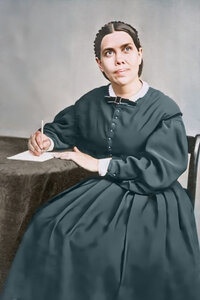
Annie Rebekah Smith was a gifted writer, editor, poet, and artist who devoted her considerable abilities to the early publishing work of what would become the Seventh-day Adventist Church. In a brief ministry that lasted barely four years before tuberculosis claimed her life at age twenty-seven, Annie served as copy editor of the Review and Herald, contributed more than forty articles and poems to the church’s nascent periodicals, and wrote hymns that continue to be sung in Adventist congregations today. She was the older sister of Uriah Smith, who would become one of the most influential editors in Adventist history. Annie’s life, marked by sacrifice, literary talent, and quiet devotion, left an enduring legacy far beyond what its brief span might suggest.
Early Life and Education
Annie Rebekah Smith was born on March 16, 1828, in West Wilton, New Hampshire. She was the only daughter among the four children of Samuel Keyes Smith and Rebekah Spaulding Smith who survived infancy. Her youngest brother, Uriah, born in 1832, would follow her into the service of the Advent movement and become one of its most prominent figures.
Annie grew up in a devout New England household and joined the Baptist Church at the age of ten. In 1844, when she was sixteen, she withdrew from the Baptist Church along with her mother and brother Uriah when they identified with the Second Advent movement. Like thousands of others across New England, the Smith family was caught up in the fervent expectation of Christ’s imminent return.
When those expectations went unfulfilled in 1844, Annie turned to secular pursuits, channeling her intellectual gifts into education. She enrolled at the Charlestown Female Seminary (CFS) in Massachusetts, an institution that offered studies in English, art, music, and languages. Annie was an excellent student who planned to become a teacher of French and painting — pursuits that reflected both her artistic sensibility and her facility with language.
However, during her sixth and final term at the seminary in 1850, an eye problem developed that threatened her plans. The affliction was serious enough that she declined an offer to teach at a seminary in Hancock. Rather than returning home in defeat, she briefly became an agent for and contributor to a monthly magazine called The Ladies’ Wreath in New York City. Her pieces published in that periodical were among her first efforts in public writing, hinting at the literary career that lay ahead — though in a direction she had not yet anticipated.
Conversion and Call to Service
In 1851, Annie’s life took a decisive turn. With the encouragement of her mother Rebekah, she attended meetings being held by Joseph Bates in Boston. Bates, the retired sea captain who had become the foremost advocate of the seventh-day Sabbath among Adventist believers, made a compelling case. Annie was convinced and accepted the Sabbath, joining the small but growing body of Sabbatarian Adventists that would later formally become the Seventh-day Adventist Church.
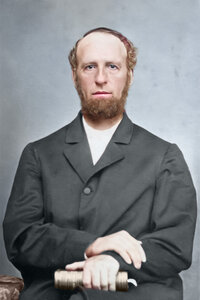
At that time, moved by her newfound convictions, Annie sent a poem titled “Fear Not, Little Flock” to the Review and Herald, the fledgling periodical that served as the movement’s primary organ of communication. The poem caught the attention of editor James White, who immediately invited Annie to assist him as copy editor.
Annie initially declined because of her continuing eye problems. But James White, who recognized talent when he saw it, told her to come anyway to Saratoga Springs, New York, where the Whites’ home served as publishing office and residence for staff members. Upon her arrival, Annie received an anointing with prayers offered on her behalf, and her vision problem cleared up, enabling her to do the work without hindrance. She stayed on at the office, which soon moved to Rochester, New York.
Editorial Work at the Review and Herald
Annie quickly proved indispensable. James White was known for demanding a high standard of quality from his workers, and Annie met that standard. So great was his confidence in her abilities that he sometimes entrusted Annie with full responsibility for editing the Review while he was away on his extensive travels. For a young woman in the early 1850s to be given sole editorial charge of a religious periodical — even a small one — was a remarkable testament to her competence and reliability.
In addition to her editorial work, Annie contributed prolifically. She wrote more than forty articles and poems for the Review and Herald and for the Youth’s Instructor, which began publication in 1852. Her writing combined theological reflection with poetic sensibility, and her contributions helped shape the literary voice of the early Adventist press.
Annie worked without salary, a sacrifice shared by many of the early Adventist workers who labored out of conviction rather than compensation. The conditions were modest at best. In Rochester, eighteen people lived and worked together in close quarters at the publishing office — a situation that would have fateful consequences.
A Costly Choice
In November 1852, Annie returned home to West Wilton to be with her father, Samuel Keyes Smith, who had become seriously ill. He died in December 1852. The loss was deeply felt, but it also brought an opportunity.
In January 1853, Annie and her brother Uriah were invited to take charge of an academy in Mount Vernon, New Hampshire, at a substantial salary. It was a tempting offer — financial security, professional recognition, and a chance to use her educational training. Annie declined, preferring to return to the Review office, without salary, where she felt her efforts could more directly spread the Advent message.
This was perhaps the defining decision of Annie’s short life. She chose mission over security, believing that the work of preparing people for Christ’s return was more important than personal advancement. Her brother Uriah would make a similar choice, joining her at the Review office and beginning a career that would span more than half a century as the paper’s editor.
The Shadow of Tuberculosis
Tuberculosis struck the crowded Rochester publishing office in 1852. By the time Annie returned following her father’s death, James White’s brother Nathaniel and sister Anna were already showing symptoms of the disease. Within less than two years, tuberculosis had claimed the lives of both Nathaniel and Anna White, as well as another office worker, Luman V. Masten. The close quarters in which they all lived and worked — eighteen people sharing a single building — created conditions in which the disease spread with devastating efficiency.
Annie’s own symptoms began in the fall of 1854. The toll was severe, and by the time she arrived back at her family home in West Wilton, New Hampshire, on November 7, 1854, she was seriously ill. Treatments at a hydropathic institute brought temporary relief but no lasting improvement.
During her illness, Annie received a cheering four-day visit from Joseph Bates — the same veteran preacher whose meetings had first drawn her into the Advent faith. Bates’s visit brought a partial improvement in her physical condition and a deeper renewal of her spirit. She spoke with a new joy and eagerness about preparation for the Lord’s return, and did so with a fervency that led others to faith. Even in her weakening state, Annie’s witness was powerful.
Final Poem and Death
In January 1855, Annie began work on what would be her final poem, “Home Here and Home in Heaven.” As her strength continued to fade, she prayed for the ability to complete it. On May 28, 1855, her prayer was answered — she finished the poem. The following day, her brother Uriah arranged for it to be printed along with others she had previously written. In a tender gesture, Uriah sketched a peony — Annie’s favorite flower — and engraved it for the title page.
The small volume of poems, titled Home Here and Home in Heaven, was published shortly after Annie’s death, which came on July 26, 1855, in West Wilton, New Hampshire. She was twenty-seven years old.
Poetry and Hymns
Annie Smith’s poetic legacy has endured far beyond the small circle of believers she served during her lifetime. Her mother, Rebekah Smith, prepared a book entitled Poems: With a Life Sketch of the Life and Experience of Annie R. Smith, published in 1871. The volume included seventy-seven of Rebekah’s own poems, sixteen of Annie’s, and fifteen of Uriah’s, along with “A Brief Sketch of the Life, Sickness, and Death of Annie R. Smith.”
Ten hymns using Annie Smith’s poetry were published in the 1941 Church Hymnal. Adventist tradition holds that the first stanza of one of these hymns, “The Blessed Hope” (renamed “I Saw One Weary” in the 1985 Seventh-day Adventist Hymnal), refers to Joseph Bates, the second stanza to James White, and the third to Annie herself. If this tradition is correct, it means that Annie wove her own spiritual journey into the fabric of a hymn that would be sung for generations.
Three hymns using her poetry were retained in the 1985 Seventh-day Adventist Hymnal:
These hymns continue to be sung in Adventist congregations around the world, carrying Annie’s voice across nearly two centuries.
A Personal Dimension
Ellen White’s correspondence reveals a poignant personal dimension to Annie’s story. In a letter to John N. Andrews on August 26, 1855 — just one month after Annie’s death — Ellen White discussed Andrews’s relationship with Angeline Stevens. Though she had earlier thought the match ill-advised, she now told Andrews “that after you had gone thus far it would be wronging Angeline to have it stop here.” She then stated: “Annie’s disappointment cost her her life.”
This striking comment has been interpreted as evidence that Annie may have been attracted to Andrews, who, as a prominent young preacher and author, had been connected with the publishing office in Rochester where Annie worked. If so, it adds a deeply human dimension to Annie’s story — a gifted young woman who gave up financial security for the sake of the Advent cause, labored without salary in crowded conditions that destroyed her health, and carried in her heart a personal sorrow that, in Ellen White’s assessment, contributed to her early death.
Legacy
Annie Rebekah Smith’s brief life of service to the Advent movement — cut short at just twenty-seven years of age — left a lasting mark through her editorial work, her poetry, and the hymns that continue to resonate with believers today. She helped establish the literary standards of the early Adventist press during a critical period when the movement was finding its voice. Her brother Uriah, who followed her to the Review office and eventually served as its editor for decades, built upon the foundation she helped lay.
In the broader narrative of Adventist history, Annie Smith represents the countless unnamed and under-recognized workers — many of them women — who gave their best years and abilities to a cause they believed in, often at great personal cost. Her choice to return to the unpaid work at the Review office rather than accept a comfortable teaching position speaks to a quality of dedication that helped sustain the early Adventist movement through its most precarious years.
The hymns she left behind are perhaps the most fitting memorial. Every time an Adventist congregation sings “How Far From Home?” or “I Saw One Weary,” they are joining their voices with that of a young woman from New Hampshire who gave everything she had to the message she believed in.