Summary
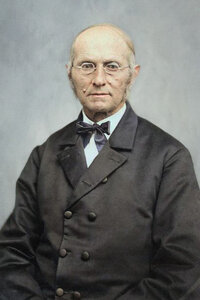
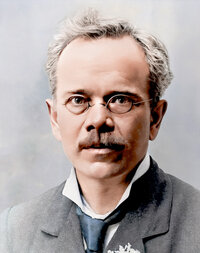
Alonzo Trevier Jones was an evangelist, church administrator, prolific author and editor, and religious liberty advocate. Together with E. J. Waggoner, he played an instrumental role in re-focusing the Adventist experience of the late nineteenth and early twentieth century back to the centrality of the everlasting gospel. Ellen White declared that through “Elders Waggoner and Jones” God had sent “a most precious message to His people.” Jones was also the denomination’s most active advocate for religious liberty, testifying before the United States Congress on multiple occasions against Sunday legislation and other threats to the separation of church and state.
Early Life and Military Service (1850-1874)
Alonzo Trevier Jones was born in Rockhill, Ohio on April 26, 1850. Few details are known of his childhood. On November 2, 1870, at the age of 20, Jones enlisted as a private in the United States Army and left Ohio to serve in the Southwest. After about two years, he was stationed in the Northwest at Fort Vancouver with the 21st Infantry. Then in January 1873, Jones’s company was transferred to Tule Lake, California as a reinforcement unit to assist in putting down a resistance group of 50 Modoc Indians who refused to comply with the government’s policy of forcing Indian tribes into reservations. Jones’s company then marched across eastern Oregon to their new station at Fort Walla Walla, Washington.
As Jones settled in on his military post at Fort Walla Walla, the Seventh-day Adventist Church was sending its first minister to work in the Pacific Northwest, and the first assignment was to conduct tent meetings in the town of Walla Walla. The missionaries chosen for the work were Isaac Van Horn and his wife, Adelia. Van Horn was himself a convert of Adventist pioneer Joseph Bates (1792-1872), and he pitched his 60-foot tent in Walla Walla in the spring of 1874.
In those days, Adventists in the Washington Territory were few in number and miles apart, making denominational growth difficult and slow. Adelia soon wrote to Ellen and James White to describe the bleak situation and the overall lack of believers who could throw themselves into the ministry and build up the work. She expressed an earnest desire to find someone in that area who could “make a stir.” She did not yet know that in that very area was a young soldier, A. T. Jones, who was spending his free time in the garrison feeding his voracious appetite for reading and studying and would soon display a remarkable gift for “making a stir.”
Conversion
Jones ventured out from the garrison and attended Van Horn’s lectures. After devouring all the Adventist literature he had access to, Jones enthusiastically embraced the teachings and committed himself to a new life. On August 8, 1874, while still enlisted in the United States Army, Jones was baptized. A report in the Advent Review and Sabbath Herald described the events of that day. After the Sabbath service, a group “went to the water side; a hymn was sung and a prayer offered.” After several baptisms, “a young man, a soldier from the garrison,” stepped forward. “For weeks he has been earnestly seeking the Lord, and a few days since received bright evidence of sins forgiven. After being buried with Christ he arose exclaiming with upraised hands, ‘Dead to the world, and alive to thee, O my God!'”
Career and Ministry (1875-1885)
Following his baptism, Jones continued his studies and became increasingly interested in history and the prophecies of the Bible. By July 1875, members of the growing Seventh-day Adventist Church in Walla Walla petitioned the General Conference to recognize Jones officially as an Adventist preacher. A month later, on August 26, the Review and Herald acknowledged the young man’s evident talent and his promising future as one who “came out clear and decided on the truth about one year ago. Having but little duty to do as a soldier, he has employed the greater portion of his time in study, with the idea that as soon as he was released from the army he would immediately enter into the service of the Lord by preaching the truth.”
Jones was finally discharged from the United States Army in November 1875, five years after enlisting. With his military responsibilities behind him, he threw himself into full-time ministry at age 25. His responsibilities throughout the following two years were primarily in assisting Van Horn’s evangelistic work and in conducting his own meetings throughout the Pacific Northwest. In September 1876, Jones ventured out solo and held his first evangelistic meetings in Eola, Oregon, which resulted in a newly founded church of eight members. He continued on to Oak Grove, then concluded a series of fifty lectures in Jefferson, Oregon on February 12, 1877, which resulted in fifteen new believers.
Just a year before his ordination, at the age of 27, Jones married Adelia Van Horn’s sister, Frances E. Patten, on April 15, 1877. Frances gave birth to their first daughter, Laneta, in 1883, and their second daughter, Desi, in 1887. Laneta was born with a mental disability, and the pressure of constant care would eventually wear heavy on the couple. Jones’s constant travel schedule kept him away from home for extended periods of time and caused tension in their marriage. It took years, and some prodding from Ellen White and other colleagues, before Jones came to terms with his struggling home life, he finally acted on it and made things right with his wife.
Van Horn and Jones saw the fruit of their labors when the General Conference, in October 1877, organized five churches and 200 members within their territory into the North Pacific Conference. From 1877 through 1879, Jones continued holding evangelistic meetings throughout Oregon, baptizing new members and organizing new churches in places like Beaverton, Damascus, and Eugene City. With evident fruit from his ministry, the denomination ordained Jones in 1878.
Soon more leaders in the Adventist movement were beginning to notice Jones’s impressive potential. Ellen White’s initial encounter with Jones prompted her to write to James White in June and July of 1878 expressing that, in her estimation, if Jones were granted the right opportunities, “he would make a promising young man.” She recognized his earnestness and dedication, already establishing himself as a preacher who “calls great congregations and is an acceptable speaker.” When Stephen N. Haskell met Jones in 1879, he wrote to James White, “Bro. Jones is a splendid man. Think he will make a stir. Give him a country and he will cut his own fodder.”
On May 25, 1880, at a meeting in Milton, Oregon, delegates voted to divide the North Pacific Conference into two conferences, using the Cascade Mountains as the dividing line to create the Upper Columbia Conference. The newly established conference began with 119 members in four churches. Jones was elected secretary, with George Colcord as president.
Editor and Teacher in California (1885-1888)
By 1884, after a decade of committed service in the Northwest, Jones once again pressed his desire to be relocated in pursuit of new challenges and opportunities in the work. At a camp meeting in Portland on June 30, 1884, delegates recommended that Jones be transferred to “labor in California under the direction of that Conference.” Now Jones was off to California to begin a new phase in his ministry.
Having already contributed several articles to the Review and Herald on the subjects of prophecy and religious liberty, Jones caught the eye of Joseph H. Waggoner, editor of Signs of the Times and The American Sentinel. Before long, Jones began working at the Pacific Press Publishing Association in Oakland, California as associate editor, along with his new friend, E. J. Waggoner (son of J. H. Waggoner). On May 6, 1886, the Signs of the Times announced that Jones and Waggoner were elected editors, with Joseph H. Waggoner taking a lesser role and allowing the young men to rise as leaders.
Along with his new responsibilities as co-editor with E. J. Waggoner, Jones had also continued to delve deeper into his research in history and prophecy, especially with the added role of teacher, beginning in the fall of 1885, at nearby Healdsburg College.
The Ten Horns Controversy
Since the early days leading up to his conversion, Jones had exemplified a voracious appetite for reading and studying — a passion he nurtured throughout his entire ministry. When asked about his approach to historical research and writing, he insisted on the necessity of students checking the evidence for themselves. “You are not proper students until you have done all that yourself. . . . You must know that for yourself, or you will not know the philosophy of it for yourself, and you can not make it plain to other people.”
By 1884, his reputation as a student of history and prophecy had persuaded the delegates of the 1884 General Conference to commission him to produce “a series of articles,” based on historical research, that would substantiate the fulfillment of Bible prophecies. Barely a year into his research project, Jones’s historical studies of the ten horns of Daniel 7 led him to a different conclusion from that held by Uriah Smith (1832-1903), the church’s senior authority on prophetic interpretation and author of the book Daniel and Revelation. From what Jones could gather from his sources, Smith’s inclusion of the Huns as one of the ten kingdoms was incorrect. Instead, the Alemanni were a better fit with the prophecy.
Jones wrote to Smith in May 1885 to initiate dialogue and to share his difficulties with the conclusions in Smith’s book. He assured Smith, “I have tried my best to bring about an agreement, but with no authorities that I have, can I make it fit. . . . I don’t want to disagree with you on them if it can be prevented. . . . If you have evidence on this to which I have no access, please let me have the benefit of it.” When Smith failed to respond, Jones printed his research in the Signs of the Times journal, igniting a debate between the two men that would contribute to further controversy in the lead-up to the 1888 General Conference.
Righteousness by Faith
Around the same time that Jones was challenging the traditional position on the ten horns of Daniel 7, a far more significant theological subject would soon add to the tensions between Jones and the General Conference leaders. Along with his colleague, E. J. Waggoner, Jones had embarked on an in-depth study of righteousness by faith at a time when, as Ellen White put it, “many had lost sight of Jesus” and had settled for a lifeless religious experience. Ellen White lamented: “The commandments of God have been proclaimed, but the faith of Jesus Christ has not been proclaimed by Seventh-day Adventists as of equal importance, the law and the gospel going hand in hand. . . . ‘The faith of Jesus.’ It is talked of, but not understood.”
It is in this context that Jones and Waggoner immersed themselves in the message of the gospel and brought new life into Adventism. As editors of Signs of the Times, they used their position to emphasize to their readers the importance of accepting Christ and His righteousness as the central focus of the Adventist message.
Minneapolis, 1888
Jones and Waggoner could not have imagined the resistance that awaited them at the Minneapolis General Conference in October of 1888. Prior to the official commencement, a week-long meeting, called the Ministerial Institute, began on October 10 to discuss church-related issues and urgent theological questions, including the issue of the ten horns of Daniel 7 and the law in Galatians. Jones was facing stern opposition from Uriah Smith and also from G. I. Butler, who made it clear that Jones was violating “the long established faith of our people taken forty years ago.” Frustrated at Jones’s interpretation, Butler concluded that “this thing needs to be publicly rebuked.”
After the week-long Ministerial Institute had concluded, the General Conference session began on Wednesday, October 17, at 9:00 a.m. There were roughly 500 attendees, 96 of those being delegates representing 27,000 members of a growing global movement. Throughout the conference, both Jones and Waggoner gave presentations on righteousness by faith, which became the focus of attention. Emphasizing the “faith of Jesus,” they presented the love of God and the righteousness of Jesus as the central theme of the Word of God and the Adventist message.
Ellen White later described her overall impression: “The Lord in His great mercy sent a most precious message to His people through Elders Waggoner and Jones. . . . Many had lost sight of Jesus. They needed to have their eyes directed to His divine person, His merits, and His changeless love for the human family. . . . This is the message that God commanded to be given to the world. It is the third angel’s message, which is to be proclaimed with a loud voice, and attended with the outpouring of His Spirit in a large measure.”
The General Conference in Minneapolis concluded on November 4, 1888. There was a mixed reaction to the conference, but, generally speaking, the leadership of the denomination resisted the message that was proclaimed by Jones and Waggoner. A. G. Daniells, who would become the longest serving president of the General Conference, maintained that “the message has never been received, nor proclaimed, nor given free course as it should have been. . . . The division and conflict which arose among the leaders because of the opposition to the message of righteousness in Christ, produced a very unfavorable reaction.” Ellen White would add that it was “one of the saddest chapters in the history” of the movement. Jones internalized much of the opposition he faced at that conference, and the experience remained a sour memory well into his final years with the denomination.
Religious Liberty
From the late 1880s to the early 1900s, Jones distinguished himself as the most active Seventh-day Adventist in the advocacy of religious liberty. His denominational service in this field included his role as co-editor of the church’s religious liberty journal American Sentinel (1887-1897), president of the National Religious Liberty Association (1889), and head of the church’s religious liberty department (1901). He was a force to be reckoned with for those who were attempting to Christianize America by merging religion and government.
In early 1888, Senator Henry W. Blair, Republican from New Hampshire and chairman of the Senate Committee on Education and Labor, proposed a bill to “secure to the people the enjoyment of the first day of the week, commonly known as the Lord’s day, as a day of rest, and to promote its observance as a day of religious worship.” Jones was elected as a representative of the church to appear before the Fiftieth United States Congress to testify against the Blair Sunday law bill. On December 13, along with a few other dissenting voices, Jones made his case before the committee.
Continuing his zealous efforts, Jones embarked on a speaking tour through major cities to lecture on religious liberty. In addition to his visit to Congress for the Blair Sunday law bill of 1888, Jones also spoke before the Senate Committee on Education and Labor to testify against a proposal to amend the Constitution to Christianize the public school system (1889); and before the House Committee for the District of Columbia to testify against the Breckenridge Sunday Bill (1890), which proposed a Sunday law in Washington, D.C.
In 1892, the issue further intensified when Associate Justice of the Supreme Court David J. Brewer, in the verdict for the case Church of the Holy Trinity v. United States, declared that Americans are “a religious people” and that America “is a Christian nation.” To argue against this declaration, Jones wrote Appeal from the U.S. Supreme Court Decision Making this “A Christian Nation” (1893). He pressed, “What, then, is this, but the legal establishment of the very likeness of the papacy, and that by the supreme judicial authority of the national government?”
Later in 1905, Jones was selected by the General Conference as one of forty delegates to visit the White House and present President Roosevelt with a statement of the church’s position regarding “the American idea of civil government,” emphasizing the Adventist belief in “religious liberty and in the total separation of church and state.”
Later Ministry and Falling Out (1889-1909)
For three years following the 1888 General Conference, Jones, along with Waggoner, travelled with Ellen White on preaching tours throughout the nation to present the message of righteousness by faith. In Massachusetts, Jones’s preaching, as Ellen White put it, was delivering “soul-nourishing food,” so much so that even ministers saw the gospel in a light they had not known. In Illinois the people received “an education in faith as they had never had before” as they learned “that it was true religion to depend entirely upon Christ’s righteousness, and not upon works of merit.” Ellen White was so impressed with Jones’s ministry that she declared that to deny him access to the people would amount to “robbing the churches” of the beautiful message he was sharing.
On October 5, 1897, the Review announced that Jones was voted in as the new editor (with Smith as associate editor). Readers were assured that “now, instead of speaking to comparatively few of our people in annual gatherings, he will address all of them every week.” Jones was so successful in bringing new life to the paper that by January of 1898, General Conference president George A. Irwin was celebrating the bolstered subscription list with more than two thousand new readers since Jones had taken over the paper.
Ellen White, while affirming his message, counseled Jones about his manner of presentation: “The influence of your teaching would be tenfold greater if you were careful of your words. . . . Be careful that you do not make the words of the Lord offensive.” By 1901, Jones was replaced as editor, and Smith became editor once again.
From 1901 to 1903, Jones served as president of the California Conference, where he directed his efforts to reform the educational and medical institutions. During this time Ellen White encouraged him to be patient and tender in his leadership and counseled him regarding what she called a “dictatorial spirit.”
Jones held strong convictions about individual conscience and church organization, which led to growing differences with denominational leaders. At the General Conference session of 1903, Jones opposed resolutions that would favor denominational ownership of institutions. He developed sympathy for J. H. Kellogg during the institutional crisis, and in August of 1903, against the counsel of Ellen White, Jones united with Kellogg and became president of Battle Creek College.
On May 22, 1907, after careful deliberation, the General Conference Committee revoked Jones’s credentials as an ordained minister of the Seventh-day Adventist Church. For two years he carried on in his own autonomous work. At the 1909 General Conference session, A. G. Daniells made an emotional appeal to him, saying, “Come, brother Jones, come.” But Jones would not open up.
Even then, Ellen White had not given up on him. It is remarkable that as late as July 25, 1908 — more than a year after his ministerial credentials had been revoked, and well after he had aligned himself with Kellogg — she was still laboring personally to bring him back. She wrote him a letter in which she affirmed the divine origin of the very message he had preached and urged him to return to the role God had given him:
“I have been instructed to use those discourses of yours printed in the General Conference Bulletins of 1893 and 1897, which contain strong arguments regarding the validity of the testimonies, and which substantiate the gift of prophecy among us. I was shown that many would be helped by these articles, and especially those newly come to the faith who have not been made acquainted with our history as a people. It will be a blessing to you to read again these arguments, which were of the Holy Spirit’s framing.” (Ellen G. White to A. T. Jones, Letter 230, 1908, par. 2)
In the same letter, she appealed directly to his conscience: “Be assured, Elder Jones, that if you see your mistake in pursuing the course you have for some time been following, and take your position on the side of truth in regard to this question, the spell that is upon you will be broken. We call upon you to take your stand on the Lord’s side and act your part as a loyal subject of the kingdom.” She reminded him of the gift of prophecy placed in the church and of the approaching latter rain, pleading: “Repent ye therefore, and be converted, that your sins may be blotted out when the times of refreshing shall come from the presence of the Lord.” (Letter 230, 1908)
In another letter written that same month, Ellen White went even further — offering a conditional promise that God still had a place for Jones at the very kind of gatherings where he had once been most effective:
“But now if you will be converted and live the prayer you made in Fresno that morning, as you promised to do, the Lord will work with you in the large gatherings of our people.” (Ellen G. White to A. T. Jones, Letter 239, 1908)
These letters are remarkable because they reveal that even at this late stage — more than a year after his credentials had been revoked — Ellen White still recognized Jones’s discourses as having been “of the Holy Spirit’s framing,” still believed God had a place for him at the large gatherings of the Adventist people, and was still personally laboring to bring him back. The message was still valid, and the messenger still had a role to fulfill if he would humble his heart. But despite these heartfelt appeals, Jones did not respond. He was finally disfellowshipped by the Berkeley Adventist Church on August 21, 1909.
Later Life (1909-1923)
Having lost his membership in the Seventh-day Adventist Church, Jones would continue his work in publishing material critical of the church’s organizational structure. He also founded, in 1915, a journal called the American Sentinel of Religious Liberty, through which he kept alive his insatiable passion for religious liberty advocacy and the subject of righteousness by faith.
In January of 1923, Jones became seriously ill and would spend the remaining months of his life under medical care. Shortly before his death he confessed to a former student and colleague, “I have never given up the faith of Seventh-day Adventists.” He passed away at his residence on May 12, at 6:30 in the morning.
Legacy
A. T. Jones has cemented a formidable legacy, despite his later departure from the organized structure of the Adventist Church. He was a tireless evangelist of the message of righteousness by faith and played an instrumental role — along with E. J. Waggoner and Ellen G. White — in re-focusing the Adventist experience of the late nineteenth and early twentieth century back to the centrality of the everlasting gospel. This was at a time when the church desperately needed it. As a prolific author and editor, his publications, though too numerous to list, include Review and Herald articles (1879-1904); American Sentinel articles (1886-1900); Signs of the Times articles (1877-1905); The National Sunday Law (1889); Religion and the Public Schools (1889); Arguments on the Breckenridge Sunday Bill (1890); The Two Republics (1891); The Great Empires of Prophecy (1898); Christian Patriotism (1900); and Ecclesiastical Empire (1901).
From the early days of his conversion and baptism, Jones was a voracious student of history and prophecy and left an excellent example of dedication to painstaking research. This characteristic not only made him an eminent expositor of biblical prophecy, but it also found practical application in his commitment to religious liberty advocacy.
Yet Jones’s story also carries a solemn warning. The very man through whom God sent “a most precious message” eventually separated from the people to whom that message was given. Ellen White herself had foreseen this possibility: “It is quite possible that Elder Jones or Waggoner may be overthrown by the temptations of the enemy; but if they should be, this would not prove that they had had no message from God, or that the work that they had done was all a mistake.” The message was from God; the messenger proved to be fallible.
Jones’s deathbed confession — “I have never given up the faith of Seventh-day Adventists” — is both poignant and instructive. It suggests that one can hold the right beliefs while standing outside the body of believers with whom God is working. His life reminds us that faithfulness to the message must be accompanied by submission to God’s leading through His church, and that even the most gifted and sincere workers are not immune to the dangers of self-reliance and independence from the counsel God provides through His appointed channels.
Source: Encyclopedia of Seventh-day Adventists, encyclopedia.adventist.org. Article by Jeffrey Rosario.