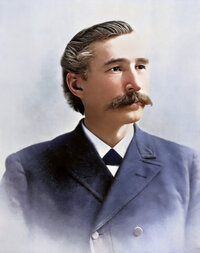
1822–1903
Summary
Abram La Rue was a former seaman, gold prospector, mountain shepherd, and tireless self-supporting colporteur who, at sixty-one, persuaded the church to send him as the first Adventist missionary to East Asia. Born in West Windsor, New Jersey, on November 25, 1822, La Rue was converted in middle age, accepted the Sabbath in the early 1870s through tracts handed him by a Dunkard preacher’s wife, and after eight years of mountain ministry in California enrolled at Healdsburg College at age sixty for a course in Bible study. The Foreign Mission Board, judging him too old for China, sent him instead to Hawaii in 1884; from there he sailed to Hong Kong on March 21, 1888, arriving May 3, 1888, and labored fifteen years as a ship missionary in the harbor, distributing literature to vessels bound for every port in the Orient. He prepared the first Chinese-language Adventist tracts and the first Adventist publications translated into Japanese, and at his death on April 26, 1903, the seven Chinese converts he had prepared for baptism became the foundation of the Adventist work in China.
From New Jersey Farm to California Mountains (1822–1873)
Per Michael W. Campbell’s article in the Encyclopedia of Seventh-day Adventists, Abram La Rue was born on November 25, 1822, in West Windsor, Mercer County, New Jersey, the only member of a large family of French Huguenot origin known to survive. His parents, Joseph and Mary La Rue, were farmers. As a young boy of eleven he witnessed the great Leonid meteor shower of November 13, 1833 — a sign which, the Youth’s Instructor obituary of 1914 recorded, he ever afterward referred to as a token of the near coming of the Lord. He spent his youth at sea, traveled the world, mined for gold in Idaho and California, amassed and lost a considerable fortune, and after his conversion at the Hawaiian Islands joined the Dunkard Church and lived as a shepherd and woodcutter in the California mountains. Per the same biographical sketch, the Adventist message reached him through tracts which a Dunkard preacher named Studebaker refused to read but his wife passed on to La Rue. The earliest documented record of his correspondence with the Adventist body is a receipts list in the Review and Herald of May 6, 1873.
Mountain Ministry and Healdsburg College (1873–1884)
After accepting the Sabbath, La Rue sold his farm to his neighbor Ruel Stickney, became the caretaker of Stickney’s land so as to free himself for itinerant literature work, and labored eight years as a mountain colporteur among the Swiss and Carolina settlers. When local men ridiculed his solitary life and asked whether he might take up smoking for company, he is said to have drawn out his Bible and answered, “This is my company.” Through his patient distribution of literature a small church was raised up at Christine, California. About 1883, at the urging of his neighbor W. C. Grainger (then president of Healdsburg College), La Rue enrolled at Healdsburg for a course in Bible study, and there celebrated his sixtieth birthday with a special cake from Mrs. Grainger.
To Hawaii (1884–1888)
Loughborough’s Great Second Advent Movement records the launch of his missionary career: “In the year 1884, Mr. La Rue and Henry Scott, at their own expense, went as missionaries to Hawaii. They began their labor by doing personal missionary work and selling books” (The Great Second Advent Movement, p. 439, par. 3; refcode GSAM 439.3). The same paragraph records the four years that followed: “Mr. La Rue remained in Honolulu till the year 1889, when he set sail for Hong Kong, China” (The Great Second Advent Movement, p. 439, par. 3; refcode GSAM 439.3). (Per ESDA the actual departure was March 21, 1888, with arrival in Hong Kong on May 3, 1888.)
The 1887 General Conference voted formal recognition of his work and authorized its continuation: “21. That we recognize the good services of Brother A. La Rue in the ship missionary work on the Pacific Ocean and its islands, and recommend that he continue the same” (General Conference Daily Bulletin, November 23, 1887, p. 29, par. 7; refcode GCDB November 23, 1887, page 29.7).
To Hong Kong — First Adventist Missionary to China (1888–1903)
Ellen White recorded the watershed of 1887: “the message was carried to Hong Kong that same year by a layman, Brother Abraham La Rue” (Testimonies for the Church, vol. 5, p. 5, par. 2; refcode 5T 5.2).
The General Conference Daily Bulletin of October 22, 1888, recorded his arrival and the conversion of his shipmate during the voyage: “Brother A. La Rue, who was recommended to labor as ship missionary in the islands of the Pacific, after spending about two months in Honolulu, proceeded to Hong Kong, China, where he is selling books and selling tracts and periodicals with the assistance of Brother Olson, who was converted on the passage through Brother La Rue’s labors” (General Conference Daily Bulletin, October 22, 1888, p. 8, par. 14; refcode GCDB October 22, 1888, page 8.14).
The same Bulletin’s tribute to his vigor at age sixty-five: “Brother La Rue is now about 60 years of age, but his zeal, like Moses’ strength, is unabated with age, and his example ought to stimulate many young men” (General Conference Daily Bulletin, October 22, 1888, p. 9, par. 3; refcode GCDB October 22, 1888, page 9.3).
The Signs of the Times of April 1, 1889, carried his report from the field: “Brother La Rue writes from Hongkong, China, that the Lord is opening up the way for the work there in a wonderful manner” (The Signs of the Times, April 1, 1889, p. 201, par. 2; refcode SITI April 1, 1889, page 201.2).
A few weeks later, the same paper’s notice of his expansion into Japan: “Brother La Rue has for several years past been laboring as a ship missionary in Honolulu and Hongkong, and already considerable fruit of his labors has been seen. May the blessing of the Lord of the vineyard still attend his efforts” (The Signs of the Times, May 13, 1889, p. 247, par. 105; refcode SITI May 13, 1889, page 247.105).
In 1900, twelve years into his Hong Kong residence, the General Conference Bulletin still reported him as the lone Adventist worker in the empire: “Brother A. La Rue is our only missionary in the empire of China. He is located at Hongkong, where he devotes his time to ship missionary work. As vessels from every country come into this port, he has opportunity to circulate literature very widely, and in this way is preaching the message to representatives from every nation” (General Conference Bulletin, July 1, 1900, p. 189, par. 1; refcode GCB July 1, 1900, page 189.1).
Per ESDA, La Rue’s Chinese-language work was made possible through a friendship with Mo Wen Chang, a translator at the colonial court who stopped each day at the Adventist mission and translated the first SDA tract — “The Judgment” — into Chinese in 1891 (2,500 copies printed). La Rue then printed two further tracts drawn from Ellen White’s Steps to Christ — “The Love of God” and “The Sinner’s Need of Christ” — the first Adventist publications in Chinese. By 1894 he had also translated “The Sinner’s Need of Christ” into Japanese, the first Adventist publication in that language.
Death (1903) and the Foundation Laid
Per ESDA, in 1901 La Rue wrote that, “worn out,” he must give up the ship work. In response the 1901 General Conference session sent J. N. and Emma Anderson and Ida Thompson, who arrived in Hong Kong on February 2, 1902. On March 1, 1902, they baptized seven Chinese converts whom La Rue had prepared — the first SDA baptisms in China. Abram La Rue died at Hong Kong on April 26, 1903, of pneumonia complicated by malaria and typhoid, in his eighty-first year. He was buried in the Protestant Cemetery in Happy Valley.
The 1913 General Conference recorded the historical significance of his solitary work twenty-five years on: “This work was begun many years ago by Brother A. La Rue settling in Hongkong and working as a self-supporting missionary among the English-speaking Chinese and the English soldiers and sailors who were often found in the city” (General Conference Bulletin, May 19, 1913, p. 41, par. 7; refcode GCB May 19, 1913, page 41.7). And, three days later: “It was not until 1888 that our work began in China. Our first missionary, as you know, was our venerable brother A. La Rue. I was down in the graveyard in Hongkong, where that brother is sleeping, and I shall never forget the thoughts that came to me as I stood by his grave” (General Conference Bulletin, May 22, 1913, p. 89, par. 2; refcode GCB May 22, 1913, page 89.2).
In 1938, on the fiftieth anniversary of his arrival, the Hong Kong Pioneer Memorial Church was erected to commemorate Father La Rue’s solitary stand on the harbor.