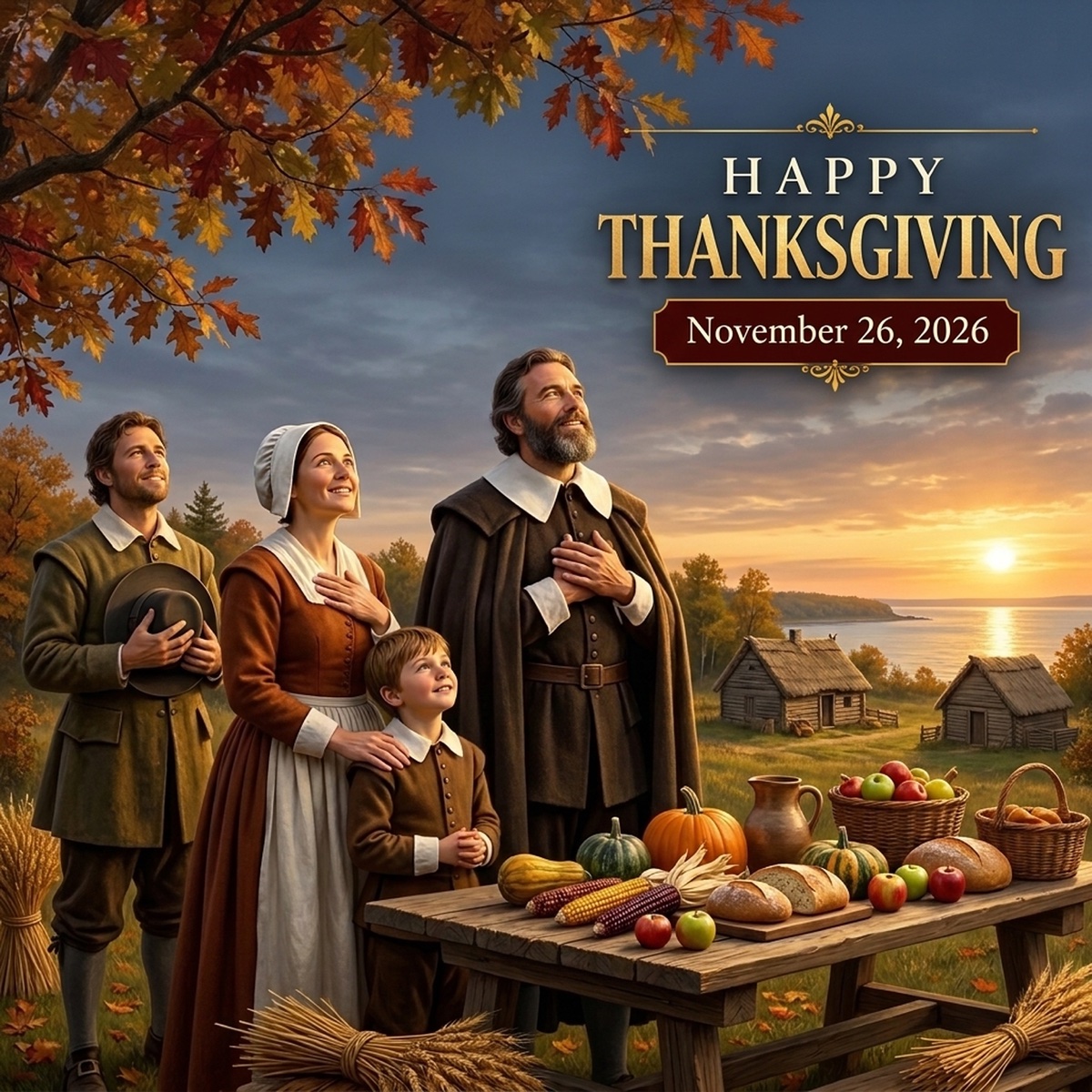
On Thanksgiving Day we count our blessings. One of the greatest is easy to forget, because most of us have never lived without it: the freedom to worship God as our own conscience directs. It is the reason the Pilgrims crossed the Atlantic, it cost a great deal to win, and its history is worth knowing well, because it will be tested again.
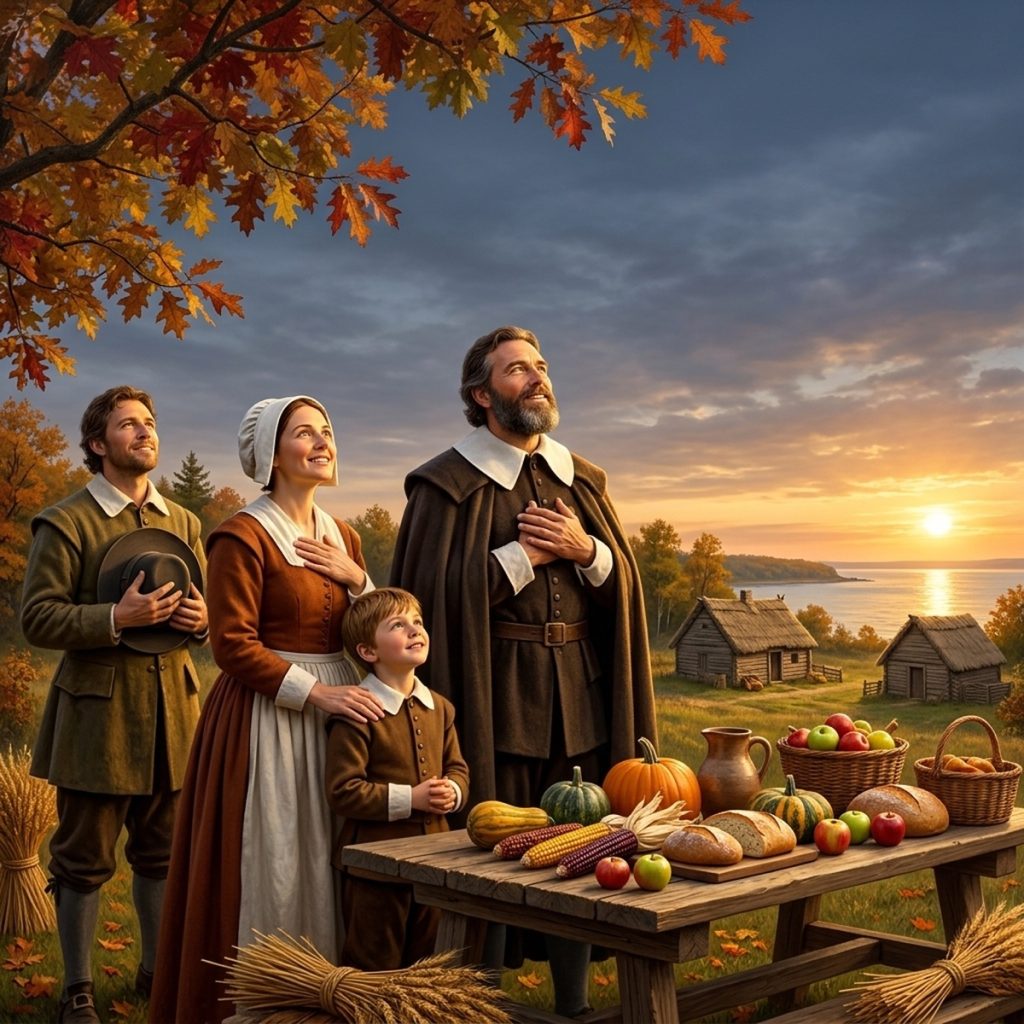
Today, all across the United States, families are sitting down together at a crowded table, and many of them will bow their heads before the meal. Whatever else Thanksgiving has become, at its heart it is a day for remembering that every good thing we have comes from the hand of God, and for saying so out loud. It is also a good day to remember one gift that we seldom count among our blessings, because so many of us have never been without it: the freedom to worship God as our own conscience directs, with no one to punish us for it.
The Pilgrims knew the worth of that freedom far better than most of us do, because they had lived without it. Their story belongs to this day, and it is worth telling again.
Why the Pilgrims Came
The story begins in England, in the years after the Reformation. The Church of England had thrown off the authority and the creed of Rome, but it kept many of Rome’s forms and ceremonies, and there were earnest Christians who could not in conscience take part in them. They believed “that God has in His word established the regulations governing His worship, and that men are not at liberty to add to these or to detract from them.”1 The church, however, had the civil power behind it. “Attendance upon her service was required by law, and unauthorized assemblies for religious worship were prohibited, under penalty of imprisonment, exile, and death.”2
At the opening of the seventeenth century the new king declared that he would make the Puritans “conform, or … harry them out of the land, or else worse.” Hunted and imprisoned, many of them came to feel that for anyone who wished to serve God according to conscience, “England was ceasing forever to be a habitable place.”3 Some of them escaped to Holland. They left behind their houses, their goods and their living, and in a strange country, among people of another language, men who had tilled the soil all their lives had to learn new trades to earn their bread. They accepted it cheerfully and wasted no time in complaining. “Though often pinched with poverty, they thanked God for the blessings which were still granted them and found their joy in unmolested spiritual communion.”4
That is the spirit of this day, long before there was an American shore to keep it on. These exiles had lost nearly everything people usually give thanks for, and they gave thanks anyway, and found their joy in the one thing they had come for: the freedom to worship God in peace.
From Holland they looked across the sea to a land where they might “found for themselves a state, and leave to their children the precious heritage of religious liberty,” and they went forward “without shrinking, in the path of providence.”5 Their pastor, John Robinson, could not sail with them. In his farewell he charged them to follow him no farther than he had followed Christ, and to be ready to receive whatever God might yet show them, “for I am very confident the Lord hath more truth and light yet to break forth out of His holy word.”6 On board the Mayflower, before they ever set foot on these shores, they bound themselves together “in the presence of God and one another” into a civil body to make just laws for the general good of the colony.7
What moved them to face all of this was one desire. “It was the desire for liberty of conscience that inspired the Pilgrims to brave the perils of the long journey across the sea, to endure the hardships and dangers of the wilderness, and with God’s blessing to lay, on the shores of America, the foundation of a mighty nation.”8
What They Had Not Yet Learned
The story would be easier to tell if it ended there, but it does not, and the part that follows may be the part we need most. “Yet honest and God-fearing as they were, the Pilgrims did not yet comprehend the great principle of religious liberty. The freedom which they sacrificed so much to secure for themselves, they were not equally ready to grant to others.” The colonists adopted a rule that only church members should have a voice in the civil government; all the people were made to support the clergy, and the magistrates were given power to suppress heresy. “Thus the secular power was in the hands of the church. It was not long before these measures led to the inevitable result—persecution.”9
The man who saw further was Roger Williams, who came to the New World eleven years after the first colony was planted. He also came for religious freedom, but he saw “what so few in his time had yet seen—that this freedom was the inalienable right of all, whatever might be their creed.”10 The magistrate, he held, is there to restrain crime and never to control the conscience, and he said so plainly: “No one should be bound to worship, or,” he added, “to maintain a worship, against his own consent.”11 For this he was sentenced to banishment, and to avoid arrest he fled in the dead of winter into the forest. “For fourteen weeks,” he wrote, “I was sorely tossed in a bitter season, not knowing what bread or bed did mean.”12 He found refuge with an Indian tribe whose trust he had won, and at last, on the shores of Narragansett Bay, he founded a colony on the principle “that every man should have liberty to worship God according to the light of his own conscience.” His little state of Rhode Island became a refuge for the oppressed, and it grew and prospered until its foundation principles, civil and religious liberty, “became the cornerstones of the American Republic.”13
The Gift Written into a Nation
From there those principles passed into the founding documents of the United States. The Declaration of Independence holds “that all men are created equal; that they are endowed by their Creator with certain unalienable rights,” and the Constitution provides that “Congress shall make no law respecting an establishment of religion, or prohibiting the free exercise thereof.”14 Its framers “recognized the eternal principle that man’s relation with his God is above human legislation, and his rights of conscience inalienable.”15 The people were given the right to govern themselves through representatives of their own choosing, freedom of religious faith was granted to all, and “Republicanism and Protestantism became the fundamental principles of the nation. These principles are the secret of its power and prosperity.”16
No nation had done this before. The American Revolution set up “the first national government upon the earth that accords with the principles announced by Jesus Christ for mankind and for civil government.”17 Christ Himself had drawn the line when He said, “Render to Caesar the things which are Caesar’s, and to God the things that are God’s.” Government is owed what belongs to government, but “as religion pertains to man’s relations to God, it is to be rendered to God alone. It does not pertain to government; it never can be rendered to government.”18
God keeps that line Himself. “God never forces the will or the conscience,” and it is Satan who reaches for compulsion when he cannot win a soul any other way. “Through fear or force he endeavors to rule the conscience and to secure homage to himself,” and to do it he moves religious and secular authorities alike “to the enforcement of human laws in defiance of the law of God.”19 So the liberty we give thanks for today is not a favor that some government handed down and may take back when it likes. It comes from the Creator, and the best any government can do is to protect it and keep its own hands off it.
What the History Teaches
The mistake of the early colonists was not theirs alone. In the long years from Martin Luther to Roger Williams, wherever professed Protestants could seize the civil power, they followed the example of the papacy and used it “to restrict and repress the freedom of the mind, and to persecute those who chose to think differently from the religious majority.”20 In New England, the rule that only church members could vote or hold office was meant to keep the state pure, but “it resulted in the corruption of the church,” because many joined the church for the sake of worldly advantage without any change of heart. The same thing has happened again and again since the days of Constantine. “The union of the church with the state, be the degree never so slight, while it may appear to bring the world nearer to the church, does in reality but bring the church nearer to the world.”21
The lesson of all those centuries is that “religious and civil rights are both secure, and religion and liberty go forward together only when religion and the State are separate.”22 It carries a duty for each of us as well. Every person who claims the right to life, liberty and the pursuit of happiness is pledged by that very claim “so to act as not to interfere with any other person in the free and perfect exercise of his inalienable right to life, liberty, and the pursuit of happiness.”23 The Pilgrims wanted freedom for themselves and were slow to grant it to others. We honor them best by taking to heart what Roger Williams saw and so few of his time had yet seen, and by defending the conscience of the neighbor who does not believe as we do just as firmly as we would defend our own.
What Lies Ahead
This history is not finished, and the Bible says how it will continue. In the thirteenth chapter of Revelation the prophet saw a beast “coming up out of the earth,” with two horns like a lamb. “The lamblike horns indicate youth, innocence, and gentleness, fitly representing the character of the United States when presented to the prophet as ‘coming up’ in 1798.”24 But the same beast “spake as a dragon,” and the meaning is plain, for the speaking of a nation is what its lawmakers and courts do: “The lamblike horns and dragon voice of the symbol point to a striking contradiction between the professions and the practice of the nation thus represented.”25
The safeguards the founders wrote are strong, and that is exactly why the change foretold is so serious. “Only in flagrant violation of these safeguards to the nation’s liberty, can any religious observance be enforced by civil authority.”26 It will not come all at once. As early as 1891 it was already possible to see “a steady encroachment, little by little, of religion upon the State,” each step becoming the precedent for the next.27 The prophecy shows where that road ends: “even in free America, rulers and legislators, in order to secure public favor, will yield to the popular demand for a law enforcing Sunday observance. Liberty of conscience, which has cost so great a sacrifice, will no longer be respected.”28
None of this is a reason to look with suspicion on the Christian next door, for “there are now true Christians in every church, not excepting the Roman Catholic communion, who honestly believe that Sunday is the Sabbath of divine appointment. God accepts their sincerity of purpose and their integrity before Him.” The test comes only “when Sunday observance shall be enforced by law, and the world shall be enlightened concerning the obligation of the true Sabbath,” and men are brought to choose “between the commandments of God and the commandments of men.”29 The warning is about principles, and about what happens when the power of the state is used to settle what a man owes to God. Anyone who loves the religion of Jesus Christ, or the principles on which this nation was founded, or the rights of mankind, has every reason to give “the most active and earnest diligence in defense of the divine heritage bestowed upon the world by Jesus Christ and bequeathed to us by our Revolutionary fathers.”30
The preparation we need is the one the Pilgrims made before they ever sailed. When they first separated from the Church of England, they joined themselves together by a solemn covenant, as the Lord’s free people, “to walk together in all His ways made known or to be made known to them.”31 People who live that way, reading God’s word for themselves, weighing what they hear against it, and ready to follow wherever it leads, will know what they believe and why. And the end of the story is not defeat. Church and state will unite their power to compel all to receive the mark the prophecy speaks of, “yet the people of God will not receive it.”32
Giving Thanks, and Keeping the Gift
So when we give thanks today, it is right to remember that the freedom we enjoy was paid for. Those who came first “patiently endured the privations of the wilderness, watering the tree of liberty with their tears, and with the sweat of their brow, till it took deep root in the land.”33 We sit in its shade without having planted it.
Let us thank God for it, then, the way those exiles in Holland thanked Him for the blessings still left to them. Let us guard it for others as carefully as for ourselves, learn from the history so that we do not repeat it, and keep close to the word of God, so that when liberty of conscience is tested in our own time, we will be found faithful. Happy Thanksgiving.
Notes
-
Ellen G. White, The Great Controversy Between Christ and Satan (1911 ed.), ch. 16, “The Pilgrim Fathers,” p. 289.↩︎
-
Ellen G. White, The Great Controversy (1911 ed.), p. 290.↩︎
-
Ellen G. White, The Great Controversy (1911 ed.), p. 290, quoting George Bancroft, History of the United States of America, pt. 1, ch. 12, and J. G. Palfrey, History of New England, ch. 3.↩︎
-
Ellen G. White, The Great Controversy (1911 ed.), p. 290.↩︎
-
Ellen G. White, The Great Controversy (1911 ed.), p. 291.↩︎
-
Ellen G. White, The Great Controversy (1911 ed.), p. 291, quoting Robinson’s farewell address as given in W. Carlos Martyn, The Pilgrim Fathers of New England, vol. 5, p. 70.↩︎
-
Alonzo T. Jones, The National Sunday Law (1889), p. 13, quoting the Mayflower Compact.↩︎
-
Ellen G. White, The Great Controversy (1911 ed.), p. 292.↩︎
-
Ellen G. White, The Great Controversy (1911 ed.), p. 292.↩︎
-
Ellen G. White, The Great Controversy (1911 ed.), p. 293.↩︎
-
Ellen G. White, The Great Controversy (1911 ed.), p. 294, quoting George Bancroft, History of the United States of America, pt. 1, ch. 15.↩︎
-
Ellen G. White, The Great Controversy (1911 ed.), p. 294, quoting Roger Williams as given by Martyn, vol. 5, pp. 349, 350.↩︎
-
Ellen G. White, The Great Controversy (1911 ed.), p. 295; the words of the colony’s principle are quoted from Martyn, vol. 5, p. 354.↩︎
-
Ellen G. White, The Great Controversy (1911 ed.), p. 295, quoting the Declaration of Independence and the First Amendment to the Constitution.↩︎
-
Ellen G. White, The Great Controversy (1911 ed.), p. 295, quoting a report printed in the Congressional documents of the United States (serial no. 200, document no. 271).↩︎
-
Ellen G. White, The Great Controversy (1911 ed.), ch. 25, “God’s Law Immutable,” p. 441.↩︎
-
Alonzo T. Jones, The Two Republics, or Rome and the United States of America (1891), ch. 24, “The New Republic,” p. 663.↩︎
-
Alonzo T. Jones, The Two Republics (1891), p. 677. The words of Christ are from Matthew 22:21.↩︎
-
Ellen G. White, The Great Controversy (1911 ed.), ch. 36, “The Impending Conflict,” p. 591.↩︎
-
Alonzo T. Jones, The Two Republics (1891), ch. 28, “Conclusion,” p. 861.↩︎
-
Ellen G. White, The Great Controversy (1911 ed.), p. 297.↩︎
-
Alonzo T. Jones, The Two Republics (1891), p. 861.↩︎
-
Alonzo T. Jones, The Two Republics (1891), p. 665.↩︎
-
Ellen G. White, The Great Controversy (1911 ed.), ch. 25, “God’s Law Immutable,” pp. 440, 441. The prophecy is Revelation 13:11.↩︎
-
Ellen G. White, The Great Controversy (1911 ed.), pp. 441, 442, quoting Revelation 13:11.↩︎
-
Ellen G. White, The Great Controversy (1911 ed.), p. 442.↩︎
-
Alonzo T. Jones, The Two Republics (1891), p. 862.↩︎
-
Ellen G. White, The Great Controversy (1911 ed.), p. 592.↩︎
-
Ellen G. White, The Great Controversy (1911 ed.), p. 449.↩︎
-
Alonzo T. Jones, The Two Republics (1891), p. 863.↩︎
-
Ellen G. White, The Great Controversy (1911 ed.), pp. 291, 292, quoting J. Brown, The Pilgrim Fathers, p. 74, and Robinson’s farewell as given by Martyn, vol. 5, pp. 70, 71.↩︎
-
Ellen G. White, The Great Controversy (1911 ed.), p. 450.↩︎
-
Ellen G. White, The Great Controversy (1911 ed.), p. 296, where the passage is printed as a quotation.↩︎