1834–1916
Summary
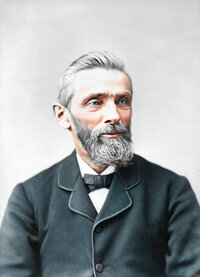
Augustin Cornelius “A. C.” Bourdeau was the pioneer Seventh-day Adventist evangelist to the French-speaking populations of Vermont, Quebec, and the Waldensian valleys of the Italian Alps. With his brother Daniel T. Bourdeau (1835–1905) he labored for over half a century in both English and French-speaking communities; together the brothers established the foundational Adventist work in southern Quebec and pioneered the French-language Adventist publishing effort. Born November 15, 1834, in St. Regis, Lower Canada (now Akwesasne, Quebec/New York border), of a Canadian-French father and France-French mother, brought up Baptist, baptized into the Sabbatarian Adventist faith in 1856 through the witness of William L. Saxby (his future brother-in-law), he served as president of the Vermont Conference (1865–1870), president of the Quebec Conference (1880–1884), and from 1884 to 1888 labored among the French Waldenses of the Alps. He died at North Hatley, Quebec, on April 26, 1916.
From St. Regis to the Sabbatarian Faith (1834–1856)
Per the Ellen G. White Estate’s biographical sketch in Letters and Manuscripts, vol. 1: “A bilingual French Canadian evangelist, Augustin Bourdeau, with his brother, Daniel Bourdeau, is best known for pioneering the Seventh-day Adventist message among both English and French communities in Vermont and Quebec” (The Ellen G. White Letters and Manuscripts: Volume 1, p. 794, par. 2; refcode 1EGWLM 794.2).
The same biographical sketch records his upbringing and entry into the Sabbatarian Adventist faith: “A. C. Bourdeau was brought up a Baptist in northern Vermont and at a young age preached in the local French immigrant communities. In the early 1850s Augustin married Charlotte Saxby. In 1855 Charlotte’s brother, William L. Saxby, introduced the Sabbatarian Adventist message to Augustin. By the next summer Augustin began to preach his new faith. For the next quarter century, with few interruptions, he preached and established new churches on both sides of the Canadian border, but in particular in the eastern townships of southern Quebec” (The Ellen G. White Letters and Manuscripts: Volume 1, p. 794, par. 3; refcode 1EGWLM 794.3).
Uriah Smith’s In Memoriam: Mrs. Bourdeau Genin (1869) records the Bourdeau family ancestry: “At the age of twenty, she, who now sweetly sleeps before us, was married to Augustin Bourdeau, a native of St. Regis, Lower Canada, whose father was Canadian French, and mother France French” (In Memoriam, p. 3, par. 2; refcode IMBG 3.2). The same memoir records the family’s conversion to Protestantism: “Soon after the settlement of Mr. and Mrs. Augustin Bourdeau at this point, they were converted, and fully espoused the cause of Protestantism, with the determination that, by grace divine, nothing would keep them from advancing in the light of the Bible” (In Memoriam, p. 3, par. 3; refcode IMBG 3.3).
The Vermont and Quebec Years (1856–1884)
The same biographical sketch records the long arc of his evangelistic and administrative service: “During this period Bourdeau also served as president of the Vermont Conference (1865-1870) and president of the Quebec Conference (1880-1884)” (The Ellen G. White Letters and Manuscripts: Volume 1, p. 794, par. 3; refcode 1EGWLM 794.3).
Ellen White’s diary of 1859 — recorded in Testimonies for the Church, vol. 1 — preserves an early traveling experience with him: “At St. Albans we found Brethren Gould and A.C. Bourdeau. Brother B. had a convenient covered carriage and two horses, but he drove very slowly, and we did not reach Enosburgh until past one in the morning. We were weary and chilled. We lay down to rest a little after two o’clock and slept until after seven” (Testimonies for the Church, vol. 1, p. 662, par. 1; refcode 1T 662.1).
Mission to the Waldenses of the Alps (1884–1888)
Loughborough’s Great Second Advent Movement records the General Conference vote that sent him to the European field: “At the General Conference held in October, 1883, it was recommended to begin, as soon as possible, the publication of a paper in England. As the result of another vote passed at this conference, Elders Geo. I. Butler, M. C. Wilcox, and A. C. Bourdeau went over to assist in the work in Europe and England” (The Great Second Advent Movement, p. 405, par. 4; refcode GSAM 405.4).
The same paragraph records the field he was assigned to in particular: “A. C. Bourdeau labored among the French people in the valleys of the Alps, among the Waldenses; while M. C. Wilcox connected with the printing and editorial work in England, remaining until the close of 1886” (The Great Second Advent Movement, p. 405, par. 4; refcode GSAM 405.4).
The Ellen G. White Estate’s biographical sketch records the summary of his post-European service: “From 1884 to 1888 he engaged in evangelism in central Europe. On returning from Europe, he spent his later years of ministry in a number of places in Canada and the United States” (The Ellen G. White Letters and Manuscripts: Volume 1, p. 794, par. 3; refcode 1EGWLM 794.3).
Ellen White’s Counsel — and Her Care for the Family
The biographical sketch records both Ellen White’s high regard for the Bourdeau brothers and her unflinching honesty with them. After noting that as early as 1861 Ellen White had expressed her respect for the brothers’ judgment and experience, the sketch continues: “However, the bulk of her correspondence with A. C. Bourdeau dates from 1886, while he was working in Europe, during a low period in his spiritual experience and effectiveness as a preacher” (The Ellen G. White Letters and Manuscripts: Volume 1, p. 794, par. 4; refcode 1EGWLM 794.4).
Ellen White’s letter of 1883 records her invitation by Augustin Bourdeau and her care for his dying wife: “Augustin Bourdeau came on the ground Sabbath and urged me to go where he lived to see the little company there, of about forty. They have built a new meeting house and want it dedicated” (Letters and Manuscripts, vol. 4, Letter 26, 1883, par. 9; refcode 4LtMs, Lt 26, 1883, par. 9). The same letter, in the same paragraph, records Charlotte Bourdeau’s last days: “Sister Augustin Bourdeau is lying at the point of death. She is cheerful, calm, [and] trusting in Jesus, knowing her work on earth is done” (Letters and Manuscripts, vol. 4, Letter 26, 1883, par. 9; refcode 4LtMs, Lt 26, 1883, par. 9).
The Bourdeau Brothers Together — Daniel T. Bourdeau
The Ellen G. White Estate’s parallel sketch on Daniel T. Bourdeau, the younger brother and frequent companion in the work, records their joint pioneering ministry: “A pioneer bilingual evangelist, Daniel Bourdeau was brought up in a French-speaking Baptist community in northern Vermont and converted to Sabbatarian Adventism in 1856 through the agency of his brother, Augustin C. Bourdeau, who had converted shortly before. For almost five decades Daniel Bourdeau preached from Massachusetts to California in the United States, and also in Canada and Europe. Of particular note were his pioneering work in Quebec (together with his brother), groundbreaking work in California with John N. Loughborough (1868–1870), and two missionary journeys to Europe (1876–1878 and 1883–1887)” (The Ellen G. White Letters and Manuscripts: Volume 1, p. 795, par. 1; refcode 1EGWLM 795.1).
Death (1916) and Legacy
Per ESDA, A. C. Bourdeau served on after his return from Europe in a series of pastoral and evangelistic appointments in Canada and the United States, and lived out his last years at North Hatley, Quebec, in the same eastern-townships territory where he had pioneered the Adventist work fifty years before. He died at North Hatley on April 26, 1916. His brother Daniel had died eleven years earlier in 1905. Together the Bourdeau brothers planted the Adventist faith among Quebec’s French-speaking communities, established the foundation of Adventist work in the Canton of Vaud and the Italian Alps, and translated the first French-language Adventist tracts.