1814–1892
Summary
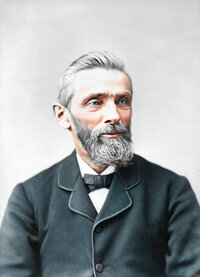
Roswell Fenner Cottrell was a Seventh Day Baptist–turned–Sabbatarian Adventist minister and one of the most prolific writers of the early Adventist movement. After accepting the third angel’s message in 1851 he wrote, by one estimate, more than sixteen hundred articles and poems for the Review and Herald, served as a corresponding editor for six years, prepared the foundational Sabbath-school lessons of the Youth’s Instructor, and contributed the introductory article to volume 1 of Ellen White’s Spiritual Gifts. He is perhaps best remembered for his outspoken opposition to denominational organization in 1860 — opposition that was rebuked by Ellen White in Testimony for the Church No. 6 and which Cottrell later publicly acknowledged. He served one year as president of the New York Conference (1868–1869) and remained in active ministry until his death in 1892.
Heritage and Early Life (1814–1850)
Steinweg, in Lest We Forget, traces the Cottrell line from medieval France through colonial Rhode Island: “In 1638 Nicholas Cottrell, one of John’s descendants, settled in Rhode Island just two years after it was founded. He was a Seventh Day Baptist who sought freedom to worship according to his conscience” (Lest We Forget, ch. 90, p. 168, ¶ 4).
Steinweg records Roswell’s birth and family: “Six generations later, on January 17, 1814, Roswell Fenner Cottrell was born in Brookfield, New York. When he was 19 years old, his family moved to Mill Grove, New York. There he met, courted, and married Cathrane Harvey, and taught public school for ten years” (Lest We Forget, ch. 90, p. 168, ¶ 5).
The Ellen G. White Estate’s biographical sketch in Letters and Manuscripts corroborates the same span: “A writer, poet, and minister, Roswell Cottrell was born into a Seventh Day Baptist home, his father being a Seventh Day Baptist preacher. At age 19 Roswell moved with his family to western New York, where he remained most of his life. About 1835 he married Catherine M. Harvey at Mill Grove, New York, and for 10 years taught in public schools in the area” (The Ellen G. White Letters and Manuscripts: Volume 1, p. 814, par. 1; refcode 1EGWLM 814.1).
The same biographical sketch records Cottrell’s reservations about Millerism and his eventual decision: “Cottrell was rather ambivalent to the Second Advent preaching of the Millerites. Although personally sympathetic to much of their teaching, he could not join a movement that showed very little interest in even investigating the claims of Sabbatarians. Cottrell’s dilemma was resolved when he subsequently came into contact with the Sabbatarian Adventist movement” (The Ellen G. White Letters and Manuscripts: Volume 1, p. 814, par. 1; refcode 1EGWLM 814.1).
Froom adds the central details of his Adventist conversion and his characteristic gift: “He was, in fact, brought up a Seventh Day Baptist, keeping the Sabbath all of his life. He was converted to the advent faith by Bates and Rhodes in 1851, at Washington, New Hampshire. He was a poet, especially noted as a hymn writer” (The Prophetic Faith of Our Fathers, vol. 4, p. 1090, par. 1; refcode PFF4 1090.1).
Acceptance of the Third Angel’s Message (1851)
Arthur White locates the Cottrell family on the geographic path of the early Sabbatarian Adventist preachers: “Mill Grove was en route, and there the Roswell Cottrell family, Seventh Day Baptists, were taking their stand for the full third angel’s message” (Ellen G. White: The Early Years 1827-1862, vol. 1, p. 273, par. 7; refcode 1BIO 273.7).
Steinweg records the substance of the family’s nine-month investigation and Roswell’s settled conclusion. According to her, Roswell, his father John, and his brother John heard Elder Rhodes and Joseph Bates preach the framework of the advent faith and the heavenly sanctuary, and after a nine-month examination “wholeheartedly accepted the message” (Lest We Forget, ch. 90, p. 168, ¶ 8). The November 25, 1851 Review and Herald preserves Cottrell’s own published reasoning, summarized by the Encyclopedia of Seventh-day Adventists as the conviction that the Second Advent message of the 1840s had been “from Heaven” after all and was preparatory to the message of the third angel.
Writer for the Review and the Youth’s Instructor (1854–1855)
Cottrell was ordained in 1854. The Ellen G. White Estate biographical sketch summarizes his early ministry and what came to be his characteristic contribution: “Roswell Cottrell was ordained as a minister in 1854, preaching in western New York and in Pennsylvania, and pioneering in Canada West. He also served briefly as president of the New York Conference (1868-1869). But it was as a writer of articles and tracts that he made his mark” (The Ellen G. White Letters and Manuscripts: Volume 1, p. 814, par. 2; refcode 1EGWLM 814.2).
Froom records his foundational role in the Youth’s Instructor: “Following a year’s gap without lessons, Roswell F. Cottrell contributed a series (August, 1854-July, 1855) on the commandments of God and the faith of Jesus, ending with signs of the second advent, the 2300 years, and the three angels’ messages” (The Prophetic Faith of Our Fathers, vol. 4, p. 1068, par. 3; refcode PFF4 1068.3).
Loughborough places Cottrell at the moving of the Review office to Battle Creek: “The first number of the Review published in Battle Creek in an office owned by Seventh-day Adventists was dated Dec. 4, 1855” (The Great Second Advent Movement, p. 288, par. 2; refcode GSAM 288.2). From that moment, Loughborough adds in the same paragraph, “Elders Waggoner and Cottrell were almost constant contributors to the columns of the Advent Review” (The Great Second Advent Movement, p. 288, par. 2; refcode GSAM 288.2).
Arthur White records his appointment as a corresponding editor: “the appointment of Uriah Smith as the resident (or managing) editor, and five corresponding editors. These were J. N. Andrews, of Iowa; James White and J. H. Waggoner, of Michigan; R. F. Cottrell, of New York; and Stephen Pierce, of Vermont” (Ellen G. White: The Early Years 1827-1862, vol. 1, p. 321, par. 1; refcode 1BIO 321.1).
Affirming Ellen White’s Visions and the Spiritual Gifts Preface (1855–1858)
In December 1855 Cottrell drafted a letter on behalf of thirteen Mill Grove believers refusing the request of J. M. Stephenson, a leader of the anti-vision Messenger Party, to address their congregation. The Ellen G. White Estate biographical sketch records the central declaration of the letter: “if the visions are not of God, they will surely come to nought.” (The Ellen G. White Letters and Manuscripts: Volume 1, p. 814, par. 3; refcode 1EGWLM 814.3).
Ellen White’s response to that letter survives in her January 1, 1856 letter to Elsie Philomela Below in Mill Grove: “Do write to us. You are very near our hearts. What a nice piece Brother Roswell [Cottrell] wrote! It hit the nail on the head; it will do much good” (Manuscript Releases, Letter 9, 1856, par. 12; refcode 1LtMs, Lt 9, 1856, par. 12).
In 1858 Cottrell was invited to write the introductory article to volume 1 of Ellen White’s Spiritual Gifts. The Ellen G. White Estate biographical sketch records the article’s enduring significance: “In 1858 Roswell Cottrell wrote an introduction to volume 1 of Ellen White’s Spiritual Gifts, which has remained a classic Seventh-day Adventist statement on the biblical bases for testing prophetic claims and on the continuation of the gift of prophecy beyond New Testament times” (The Ellen G. White Letters and Manuscripts: Volume 1, p. 814, par. 3; refcode 1EGWLM 814.3).
Arthur White preserves the original notice of the volume’s publication, with Cottrell named as author of the introduction: “This is a work of 224 pages written by Mrs. White, with an introductory article on the perpetuity of spiritual gifts by Brother R. F. Cottrell. Price 50 cents” (Ellen G. White: The Early Years 1827-1862, vol. 1, p. 374, par. 4; refcode 1BIO 374.4).
The Organization Controversy (“Making Us a Name,” 1860–1861)
When James White in February 1860 invited the brethren to comment on his proposal to incorporate the publishing work, Cottrell was the first minister in the field to reply, and his reply was negative. Arthur White records: “The first minister laboring out in the field to respond was R. F. Cottrell, a stalwart corresponding editor of the Review. His immediate reaction was decidedly negative” (Ellen G. White: The Early Years 1827-1862, vol. 1, p. 420, par. 4; refcode 1BIO 420.4).
Cottrell’s reply was published in the Review of March 22, 1860 under the title “Making Us a Name.” Arthur White preserves Cottrell’s opening words: “Brother White has asked the brethren to speak in relation to his proposition to secure the property of the church. I do not know precisely what measure he intends in this suggestion, but understand it is to get incorporated as a religious body according to law.” (Ellen G. White: The Early Years 1827-1862, vol. 1, p. 421, par. 1; refcode 1BIO 421.1). Cottrell’s settled conclusion in the same paragraph was that the proposal would be “wrong”: “since that lies at the foundation of Babylon. I do not think God would approve of it” (Ellen G. White: The Early Years 1827-1862, vol. 1, p. 421, par. 1; refcode 1BIO 421.1).
Arthur White summarizes the reaction his article produced: “Cottrell was experienced and influential, his message, published in James White’s absence, set the pace for a long drawn-out battle” (Ellen G. White: The Early Years 1827-1862, vol. 1, p. 421, par. 2; refcode 1BIO 421.2).
Testimony No. 6 and Cottrell’s Public Acknowledgment (1861)
Ellen White was shown Cottrell’s “wrong stand” and addressed him directly in Testimony for the Church No. 6 (later republished as part of Testimonies for the Church, vol. 1): “I was shown the wrong stand taken by R. F. C. in the Review in regard to organization, and the distracting influence he exerted. He did not sufficiently weigh the matter. His articles were perfectly calculated to have a scattering influence, and to lead minds to come to wrong conclusions, and encourage the slack ideas many have of managing matters relating to the cause of God” (Testimony for the Church, No. 6, p. 4, par. 2; refcode T06 4.2).
Ellen White’s testimony also reproved a more general indolence: “I saw that in temporal matters R. F. C. was too easy and negligent. He has lacked energy, and has considered it a virtue to leave things to the Lord which the Lord has left to him. It is only in cases of great emergency that the Lord interposes for us. We have a work to do, burdens and responsibilities to bear, and in thus doing we obtain an experience” (Testimony for the Church, No. 6, p. 5, par. 1; refcode T06 5.1).
In a manuscript of the same period Ellen White expanded on the same point: “Brother Roswell Cottrell’s experience and influence in this work—his easy way of leaving everything with the Lord—has hurt the church at Mill Grove. His views were erroneous upon this point. It is not pleasing to God to have men leave with Him that which He has left with them” (Manuscript Releases, Manuscript 3, 1861, par. 4; refcode 1LtMs, Ms 3, 1861, par. 4).
She also affirmed his particular gift: “Brother Cottrell could do a great amount of good with his pen. His mental powers have not been troubled and overtaxed and worn as have those of some of the preachers. His bodily strength and nervous system have not been shattered, his thoughts can be clear upon important points of truth. He should use his pen” (Manuscript Releases, Manuscript 3, 1861, par. 8; refcode 1LtMs, Ms 3, 1861, par. 8).
Arthur White records that Cottrell received the rebuke and was the first minister to publish a confession: “Feelings of suspicion, whispered by one to another, contributed largely to the discouragement of James and Ellen White. Testimony No. 6 shook the church into an awakening. As ministers and laymen examined their own hearts, an outpouring of confessions were sent for publication in the Review, appearing over a period of many months.” (Ellen G. White: The Early Years 1827-1862, vol. 1, p. 442, par. 4; refcode 1BIO 442.4). Arthur White continues: “It was he that had set the negative tone in the discussion over organization that swept through the church. It was he that Ellen White first personally addressed in Testimony No. 6” (Ellen G. White: The Early Years 1827-1862, vol. 1, p. 442, par. 4; refcode 1BIO 442.4).
Steinweg records Cottrell’s own words in the wake of the rebuke: “I hope that no one will join my party, for when they have severed themselves from the body and look about for me, they will not find me there, for by the grace of God, I shall be found with the body. I do not believe in popery; neither do I believe in anarchy; but in Bible order, discipline, and government in the church of God” (Lest We Forget, ch. 90, p. 169, ¶ 14).
Later Service in the New York Conference (1862–1892)
After the church organized in October 1860 and the General Conference was constituted in 1863, Cottrell became one of the first credentialed ministers in the New York Conference and continued to write prolifically. The Ellen G. White Estate biographical sketch summarizes the breadth of his contribution: “According to one estimate, Cottrell contributed 1,692 items to the Review, ranging from theological analysis to exhortation to poetry.” (The Ellen G. White Letters and Manuscripts: Volume 1, p. 814, par. 2; refcode 1EGWLM 814.2). The same paragraph records the New York Conference’s recognition of his writing as a form of pastoral labor and the lasting influence of his hymns: “Some of his poetry was set to music and has appeared in a range of Adventist hymnals up to the present” (The Ellen G. White Letters and Manuscripts: Volume 1, p. 814, par. 2; refcode 1EGWLM 814.2).
Death (1892)
Roswell F. Cottrell died at his home in Mill Grove, New York, on March 23, 1892, at the age of 78. Steinweg’s Lest We Forget article records the steady tenor of his lifelong service: “During the forty years he lived after accepting the three angels’ messages, he worked in evangelism; he defended the Seventh-day Sabbath and conditional immortality by the written and spoken word; accepted the health message; and he held offices of Secretary and President of the New York Conference. As an elder pastor, he was Chaplain at the Battle Creek Sanitarium” (Lest We Forget, ch. 90, p. 170, ¶ 16).